AI filmmaking is the production of films, ads, and VFX using generative AI models directed by human filmmakers. It is a pipeline discipline, not a prompt box. The global AI video market is projected to grow from $847 million in 2026 to $3.35 billion by 2034 (Fortune Business Insights, 2025), and at Adwhyta, our AI film studio, it's how we make award-winning cinema.
I'm going to say something early that most guides on this keyword won't: which AI tool you use is the least important decision you'll make. I've directed AI films that won seven international awards in 2026, and not one of those wins came down to a model choice. They came down to direction. This guide is the version of that argument I give brands and production houses before they commission anything. The whole script-to-screen picture: a complete guide to AI filmmaking as it's actually practiced in serious production in 2026, not as it's demoed.
Key Takeaways
- AI filmmaking is a service discipline, not a software category. The difference between AI slop and cinema is direction, pipeline, and post-production, not the video generation model.
- Cost is the least interesting advantage, but it is real. On our own productions, AI cuts cost and time by 60-90% against a comparable traditional shoot, and a studio-grade AI ad film delivers in weeks rather than months. Nobody in this market publishes a fixed rate card, so treat any number you see quoted as a starting point for a scoped quote.
- The 2026 bottleneck is character consistency and continuity. It's the #1 thing to interrogate any studio about before you brief.
- Consumers don't reject AI ads. They reject undirected ones. Comfort with brands using AI fell from 57% to 46% (2023 to 2024, MarketingCharts) even as 87% of marketers adopted generative AI (Salesforce, 2026). Craft is the whole game.
- Read time: ~20 minutes.
What Is AI Film Production? (A Studio Definition, Not a Tool Definition)
AI film production is the professional discipline of making films (ads, shorts, VFX sequences, animation) using generative AI models under human creative direction: scripted, storyboarded, art-directed, generated across a multi-model pipeline, then finished with VFX-grade post-production. A tool generates clips. A studio delivers cinema.
That distinction sounds like marketing until you've sat with both outputs side by side. Here's the practical version:
- A tool gives you 5-10 second clips from a text-to-video prompt. Impressive, and disconnected.
- A pipeline gives you a sequence: consistent characters, coherent lighting, camera grammar that cuts together, sound that was designed rather than defaulted.
- A studio gives you accountability. Someone whose name is on the film when it fails, and who has shipped enough to know where it fails.
Generative AI in filmmaking isn't one technology, either. It's a family: AI image generation for style frames, AI video generation models for motion, AI voice for dubbing, AI music for score. When we built Adwhyta's production workflows, we didn't pick one generator. We run a custom multi-model stack: ComfyUI, Flux, Kling, Veo, Hailuo, and Runway for image and video generation and motion, ElevenLabs plus a multi-tool lipsync chain for voice, Suno plus original composition for score. Not a single prompt box. Because different AI models are best at different jobs: no single video model leads on faces, physics, motion, and lighting at the same time. In 2026, none is even close.
AI-native vs hybrid vs AI-assisted pipelines
The industry has quietly settled into three modes of working, and knowing which one your project needs will save you weeks of misaligned briefs:
| Pipeline type | What it means | Best for | Human role |
|---|---|---|---|
| AI-native | Every frame generated; no camera ever rolls | Brand films, impossible worlds, animation, mythological/fantasy content | Director, writer, art director, editor, sound. Everything except the camera crew |
| Hybrid | Live-action plates + AI environments, doubles, extensions | Ads with real product handling, films needing hero performances | Full traditional crew for plates + AI unit for the rest |
| AI-assisted | Traditional production; AI used in previz, cleanup, VFX | Production houses cutting VFX cost/time | Traditional pipeline with an AI visualization team attached |
Our short film Unmasked was AI-native. Our VFX work for production houses (digital doubles, background replacements, environment extensions) is AI-assisted. Most brand work in 2026 lands in hybrid. If a vendor can't tell you which mode your brief needs, that's your first red flag.
Who this guide is for
Two readers, honestly. Brand and marketing heads deciding whether an AI film can carry a campaign without embarrassing the brand. And filmmakers, production houses, and OTT teams deciding whether AI VFX can stretch a budget without looking stretched. If you're a hobbyist hunting free AI filmmaking tools, this genuinely isn't that article, and you'll be happier elsewhere.
How Does a Professional AI Filmmaking Workflow Work? The 7-Stage Script-to-Screen Pipeline
A professional AI film moves through seven stages from script to screen: development and scripting, storyboards and previz, asset and character build, video generation, VFX and hybrid integration, sound and music, and grade-and-polish delivery. Each stage of production has human sign-off in a complete AI filmmaking pipeline. The generation step people fixate on is one stage out of seven.
How to Make an AI Film (Step-by-Step)
- Write the script and lock the story before any generation.
- Storyboard and previz the sequence. Build style frames.
- Build characters and assets as locked, reusable references.
- Generate shots across a multi-model stack, take by take.
- Composite and integrate with VFX-grade post-production.
- Design sound, music, and dubbing.
- Grade, polish, and deliver masters and cutdowns.
That's the skeleton. Here's the same AI filmmaking workflow with the muscle attached, the way we run it at Adwhyta:
- Development & AI-assisted scripting. The script comes first, same as it has for a century. AI helps us iterate beat sheets and alt lines fast, but "Technology is a servant of narrative structure" is not a slogan here. It's the org chart.
- Storyboards, previz, style frames & virtual location scouting. Before generating a single shot, we lock the look: storyboard the sequence, build style frames and color scripts that double as production stills for the pitch deck, run virtual scouts of environments that don't exist. This pre-production stage is where AI is quietly at its most valuable. A director can see forty versions of a world before committing to one. Cheap iteration here prevents expensive confusion later.
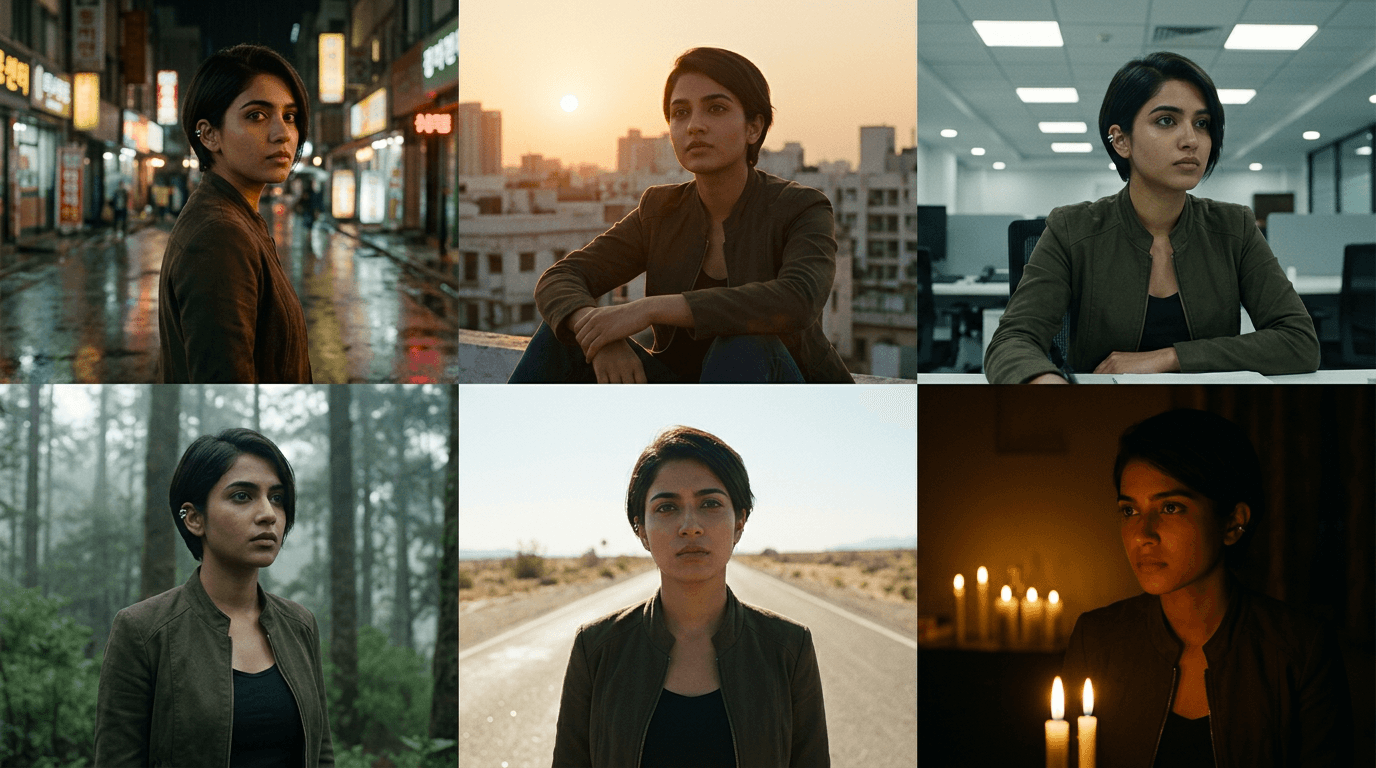
- Asset & character build. Faces, wardrobes, and sets are locked as reusable references. Our proprietary face, style, and lighting models exist so a character in shot 42 is the same human as in shot 3. This stage barely existed in 2024 tutorials. It is now most of the work.
- Generation. The multi-model stack earns its keep: we use AI to generate dozens of takes per shot across different video generation models by shot type, with selects made the way an editor picks takes on a real set. That's real production discipline, not roulette.
- VFX & hybrid live-action integration. Compositing AI elements into plates (or plates into AI worlds), cleanup, custom 4K upscaling. Our rule here is absolute: no raw AI artifact goes unpolished.
- Sound, music & dubbing. Score via Suno plus original composition; AI voice via ElevenLabs. Lipsync with temporal tracking so multilingual variants hold facial consistency. AI audio and sound design are half of why AI films feel "real", and the half everyone skips.
- Grade, polish & delivery. Final grade, celluloid-simulation passes (noise, micro-movement, environmental interaction), masters and cutdowns.

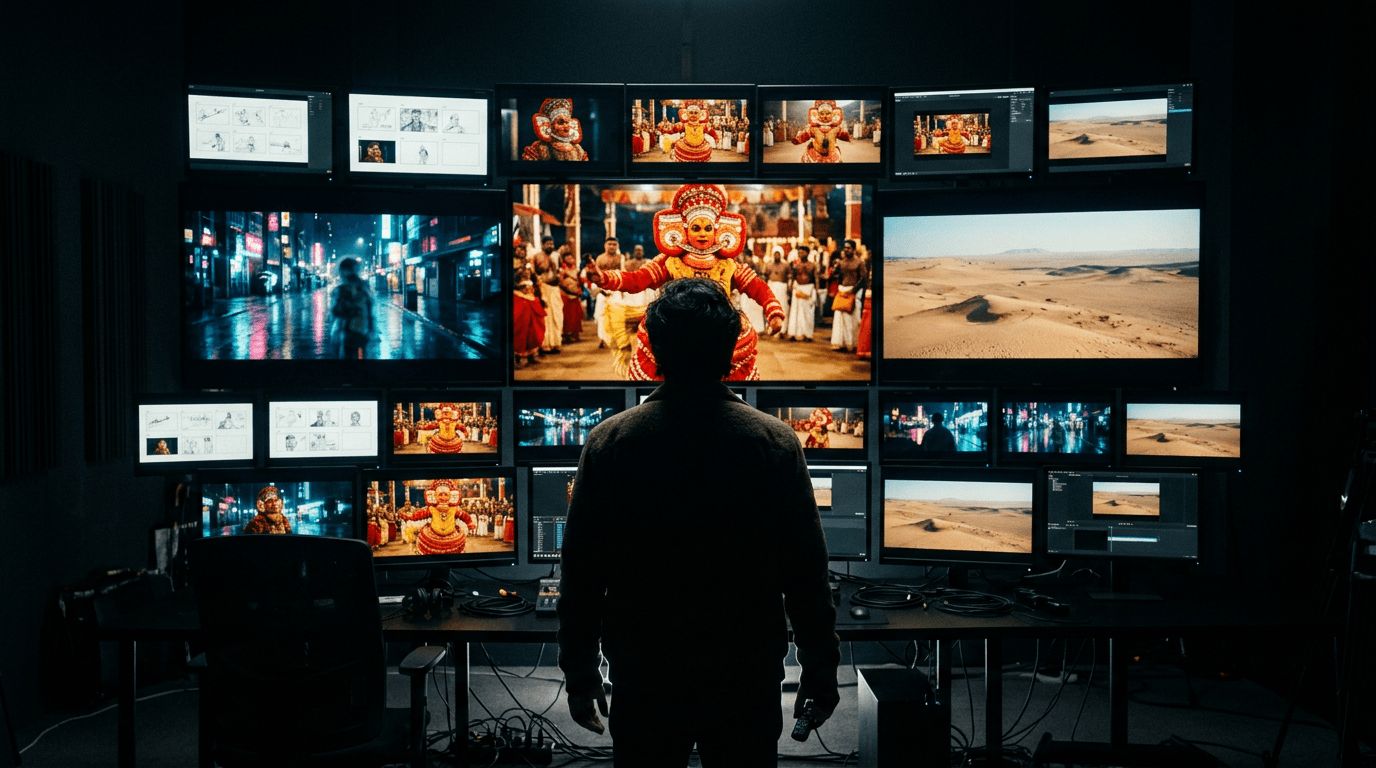
When we made Unmasked, a seven-minute full AI short film about a Theyyam dancer and a Gen-Z vlogger, the hardest stage wasn't generation. It was stage 3. Theyyam costume and makeup are sacred, precise, and unforgiving of AI's tendency to improvise ornament. Getting that fidelity locked before generation is the kind of unglamorous work that later read as "cinematography" to festival juries. The film went on to win Best AI Short (Gold) at the Bali International AI Film Festival, Best Film at AI Film Awards India, Best Cinematography at Indywood AI Cinefest, and Best Editing at the India AI Film Festival, with an Official Selection at Cannes World AI Film and a nomination at Seoul International AI Film.
Can AI make a movie on its own?
No. AI can generate shots. It cannot make a film. Every watchable AI film in 2026 has a human who wrote the story, directed the look, chose the takes, cut the edit, and designed the sound. Let the AI decide everything and a full AI pipeline still produces footage, not cinema. The honest formulation: AI removed the camera, not the filmmaker.
AI Film vs Traditional Film Production: Cost Breakdown, Speed & Creative Trade-offs
AI film production cuts cost and time by 60-90% against a traditional shoot in our own work, and removes location, crew, and scheduling constraints outright. Traditional shoots still win on live human performance, precise product handling, and the trust that comes from photographed reality. Most smart 2026 briefs are hybrids.
Full disclosure: we're an AI studio, so we're biased. But here's an honest cost breakdown, including the column vendors don't show you:
| Factor | Traditional production | AI production (studio-grade) |
|---|---|---|
| 30-sec commercial cost | Crew, kit, location, and talent set the floor. National TV creative runs into six and seven figures | A fraction of the traditional equivalent, quoted against a brief rather than a rate card |
| Timeline | Weeks to months (pre-pro, shoot, post) | Weeks rather than months for an ad film, once the script and references are locked |
| Locations | Permits, travel, weather | Unlimited. Any era, any world, "shot entirely on imagination" |
| Revisions | Reshoots = new budget | Iteration is nearly free; regenerate, don't reshoot |
| Language variants | Re-record, re-edit, sometimes re-shoot | AI dubbing + lipsync with facial consistency |
| Hero performance | The gold standard: real actors, real micro-expression | Improving fast; still the weakest link for long emotional takes |
| Product accuracy | Perfect, you photographed the product | Needs hybrid plates or heavy supervision for exact labels, textures, pours |
| Audience trust | Photography carries implicit credibility | Earned only through craft; sloppy AI actively damages brands |
The case that made every marketer look up: during the 2025 NBA Finals, prediction-market brand Kalshi aired an AI ad made by a single AI filmmaker in two days for about $2,000, roughly 300-400 generated clips cut down to 15 finals, against a slot where traditional creative quotes run to seven figures. That's about a 95% reduction in production cost (NPR, 2025). But notice what actually made it work: it was directed to be absurd on purpose. The aesthetic was a choice, not an accident. That's the difference between a stunt that lands and slop that airs.
And here's my contrarian position, stated plainly: "cheaper" is the least interesting thing about AI filmmaking. Everyone prices the savings. Almost nobody prices what near-free iteration does to direction itself. On a traditional film set, you get the coverage you could afford. The edit is archaeology on a fixed shoot. In an AI production pipeline, if the cut isn't working, you re-block the scene, change the lens, move the sun. The film stays soft, revisable, until it's right. That's a different way of directing, not a discounted version of the old one. Brands that only ask "how much cheaper?" are optimizing the boring variable.
What Can AI Films Do (and Still Not Do) in 2026?
In 2026, AI filmmaking excels at stylized and impossible worlds, previsualization, animation, brand films, and high-volume regional variants. It still struggles with sustained live-action hero performances, precise physical product interaction, and long-take emotional continuity, which is why serious studios run hybrid pipelines for those.
"Is AI filmmaking worth it?" is the wrong question for the state of AI in 2026. The right one is "for which shots?" After two years of shipping this work, here's my honest map.
Where AI is already the better choice:
- Previsualization and concept decks. A production house can see its VFX-heavy sequence, fully rendered, graded, and scored, before committing crores to it. This alone is quietly transforming how Indian films get greenlit.
- Worlds you can't shoot. Mythology, sci-fi, period recreation, abstract brand worlds. Our set piece The Ring exists because generative world-building removed the question "can we afford this world?" entirely.
- Stylized animation. Consistent character universes at a fraction of 3D animation budgets.
- Volume and variants. Twelve regional versions of one campaign, dubbed and lipsynced, without twelve shoots. AI avatars carry presenter-led formats the same way.
- VFX augmentation. Digital doubles, environment extensions, background replacement, AI aging. All as an extension of a traditional production house pipeline.
Where it still loses, honestly:
- The long emotional close-up. A three-second smile, AI can do. Ninety seconds of a mother's face deciding whether to forgive: that's still an actor's job. Micro-expression drift over long takes remains the tell.
- Exact product physics. The beer pour, the fabric drape of your actual SKU, legible label typography under motion. Hybrid plates solve this. Pure video generation still gambles with it.
- Unbroken spatial continuity. Complex multi-character blocking across many cuts requires the consistency systems below. And even then, it's supervised craft, not a button.
Will AI replace Hollywood directors and writers?
No, and the framing hides what's actually happening. AI replaces line items, not authorship: location costs, VFX render farms, some crew functions on AI-native work. Direction, writing, taste, and editorial judgment have become more valuable, not less, because generation is cheap and selection is not. The filmmakers most threatened by AI are the ones whose only skill was operating expensive equipment. The ones who thrive treat AI systems as the newest department on the lot.
Misconceptions about AI filmmaking that cost brands money
- "The model makes the film." Modern AI makes clips. The filmmaking process (script, direction, edit, sound) makes the film. Even the most advanced AI can't be briefed to have taste, and expecting AI to handle direction is how slop gets made.
- "It's instant." Studio-grade work runs days to weeks. What's instant is iteration, not delivery.
- "It's free." The floor price is near zero. The finished-film price is direction, consistency systems, and post-production. That gap is the entire market.
- "Audiences can't tell." They can, and the data below says they penalize brands for it when the craft is missing.
- "One tool will win." The stack changes quarterly. Production workflows and taste compound. Bet on the discipline, not the dedicated AI tool of the month.
I wanted to understand why AI faces feel dead. That question basically founded our realism pipeline. The answer, mostly: real faces never stop moving, and real footage is never noise-free. So we add imperfection back on purpose (custom noise shaders, micro-movement parameters, physical environmental interaction) to simulate celluloid reality. It works. Which is either encouraging or unsettling, depending on your mood.
AI Filmmaking Tools in 2026: How the Best AI Tools for Filmmakers Fit the Pipeline
The best AI tools for filmmakers in 2026 are pipeline components, not complete solutions: image models for style frames, video generation models for motion, voice and music models for audio, and upscalers for finishing. Serious AI video production runs several of them per film. Choose by shot type, not by brand loyalty.
The SERP for this keyword is wall-to-wall tool rankings, so let me do something more useful than another top-10: map AI video production tools to the production stage where they actually earn money. The market splits into production platforms that bundle the whole pipeline (LTX Studio, Melies) and point tools that do one job extremely well. Tools change quarterly. This map doesn't.
| Pipeline stage | Tool category | Representative names (2026) | What to evaluate |
|---|---|---|---|
| Scripting & previz | LLMs, storyboard generators | Claude, ChatGPT; image models for boards | Iteration speed, not prose quality. Humans write the final draft |
| Style frames & characters | AI image generation | Midjourney, Flux, Nano Banana Pro | Character reference control, style consistency across frames |
| Video generation | Text/image-to-video models | Veo 3.1, Kling 2.6, Runway Gen-3, Hailuo, Luma (Sora 2 is being retired, see the FAQ) | Identity hold across shots, physics, camera control, native audio |
| Orchestration | Node-based pipelines | ComfyUI | Repeatability. This is where a stack becomes a pipeline |
| Voice & dubbing | AI voice + lipsync chains | ElevenLabs + temporal lipsync tools | Facial consistency across languages, emotional range |
| Music & audio | AI music generation | Suno, plus original composition | Rights clarity, stem access for the mix |
| Finishing | Upscalers, AI video editing aids | Topaz Video AI; NLE-integrated AI tools | Artifact removal at 4K, grain and grade survival |
Three buying rules from the studio side. First, the best AI video generator for cinematic films changes by shot type: one AI video model leads on physics, another on faces, another on camera moves, which is exactly why we run AI tools like Veo, Kling, and Runway side by side. Knowing how to use AI tools matters less than knowing when. How you use the AI on a given shot is the actual skill. Second, never evaluate a tool for film work on its showreel. Evaluate every tool for AI video on your hardest shot (a hand pouring liquid, a face at 90mm holding an emotion). Third, if you're a brand, you shouldn't be comparing AI video tools at all. You should be choosing the AI video production services partner whose pipeline already made these bets, tested them, and survived them. For teams who want to learn AI filmmaking hands-on, start your AI filmmaking journey with one image model, one video model, and an NLE you already know. Add tools only when a real shot demands them.
Quality Control: Character Consistency, Continuity & Brand Safety
Character consistency (keeping a face, wardrobe, and world identical across every shot) is AI filmmaking's defining quality problem in 2026. Studios solve it with locked reference models, shot-to-shot continuity supervision, and VFX-grade post. Tools alone don't. It should be the first thing you interrogate before hiring anyone.
If you remember one section of this guide, make it this one. Serious AI filmmaking is a consistency discipline: studio-grade production requires reference systems, supervision, and post. Every 2026 conversation about AI film limitations converges on the same two words: consistency and continuity. It's what separates a reel of pretty clips from a film.
How do you keep character consistency in AI filmmaking?
The professional method, condensed: build a character reference sheet (front, side, profile, wardrobe) in an image model, lock it as the canonical identity, then anchor every video generation to that reference through the model's identity features and seed control. Then verify shot-to-shot in post. Reference sheets solve most of it. Supervision catches the rest.
What a real quality-control system looks like:
- Locked character references. Proprietary face, style, and lighting models so your protagonist (or brand mascot) is the same being in every frame, across an entire campaign rather than a single scene.
- Continuity supervision. Someone whose actual job is catching the jacket that changed buttons between cuts. On a traditional set this role is a century old. AI filmmaking pipelines need it more, not less.
- Temporal-tracked lipsync. Dialogue and dubbing that holds facial identity across languages. Our multilingual ad variants depend on this.
- A no-raw-output rule. Ours is blunt: we don't ship raw generations. Every frame passes through compositing, cleanup, and grade. Slop is what raw output looks like at scale.
Then there's brand safety, which is bigger than aesthetics:
- Likeness and voice rights. Synthetic humans must be genuinely synthetic or properly licensed. No accidental celebrity faces, no cloned voices without releases.
- Ownership of outputs. Commercial use rights for AI-generated content vary by tool and plan. A studio should hand you clean chain-of-title in writing, covering what the models permit and what the law can actually protect (see the copyright FAQ below).
- Disclosure. Platforms and several jurisdictions increasingly expect AI-content labeling, and as of August 2026 those requirements are still moving. Treat disclosure as a creative constraint from day one, not a legal patch at delivery, and check the current policy of every platform you're delivering to before you lock the edit.
- Provenance and archive. Which models, which prompts, which training-safe assets. Documented, so the brand can answer questions later.
- Taste. The consumer data below says trust in AI ads is fragile. A visibly broken frame doesn't just look bad. It reads as the brand not caring.
That last point has numbers. Consumer comfort with brands using AI fell from 57% in Q3 2023 to 46% in Q3 2024 (MarketingCharts, 2024), and worry about fake or misleading AI advertising has been a running theme in consumer surveys since. Meanwhile 87% of marketers now use generative AI in at least one recurring workflow, up from 51% in early 2024 (Salesforce State of Marketing 2026). Read those together and the conclusion writes itself: the market isn't rejecting AI content. It's rejecting slop. Adoption up, trust down. The entire gap is craft.
After the Generation: Editing, Distribution & the AI Film Festival Circuit
AI footage still has to become a film the old way: selects, an edit with rhythm, sound design, and a grade, done in a standard NLE workflow. Distribution has changed faster: a real AI film festival circuit now exists (Bali, Seoul, Cannes World AI Film, India's festivals), and it's become the medium's main external quality check.
This section exists because almost every guide to AI video production stops at "generate the shot." That's like a cooking guide that ends when the groceries arrive.
Editing. AI-generated shots drop into a completely conventional edit: Premiere, Resolve, the same video editor workflow post-production teams have used for years, with an AI video editor assist inside the NLE for cleanup at most. If anything, AI video editing matters more here, for a reason that surprised me: you have too many takes. A traditional shoot gives you the coverage you could afford. A generation pipeline gives you forty versions of every shot. The editor's taste becomes the bottleneck, and the edit rhythm (when to cut, when to hold) is one of the strongest human fingerprints left on the finished film. Unmasked won Best Editing at the India AI Film Festival, and I'd argue that award had less to do with AI than any of the others.
Distribution and festivals. Here's something that didn't exist three years ago: a functioning AI film festival circuit. Bali International AI Film Festival, Seoul International AI Film, Cannes World AI Film (to be precise: an AI festival, not the Festival de Cannes), AI Film Awards India, Indywood AI Cinefest, plus AI categories creeping into mainstream fests. For brands, this circuit is quietly useful. A festival laurel on your brand film is earned media and a third-party quality signal in a category drowning in self-praise. For studios, it's the only external scoreboard we have. When you're evaluating an AI film production company, festival results are one of the few claims you can independently check.
One practical note on deliverables. Ask for masters and cutdowns in the same delivery. The marginal cost of a 6-sec, 15-sec, and vertical edit from an AI pipeline is small, and it's where most of the media value hides.
How Much Does AI Filmmaking Cost? (Budget Bands by Format)
AI filmmaking costs a fraction of a comparable traditional production and delivers in weeks rather than months. There is no rate card: no serious studio in this market publishes one, because format, length, and above all realism drive the number far more than duration does. A scoped brief gets a scoped quote.
Nothing below is a quote, and none of it is a price list. Real briefs price on ambition, and premium studios (ours included) price on craft, not on being the cheapest option.
| Format | Traditional benchmark | AI production, in practice | Typical timeline |
|---|---|---|---|
| Short film (3-10 min) | Indie budgets swing wildly with crew, cast, and locations | Direct production cost collapses. Our own The Countdown was made for under $75, pre-AI, which taught us budget was never the point | Days to weeks |
| 30-sec brand ad (India) | Premium TVCs run into lakhs and crores before airtime | A fraction of that, scoped against the brief rather than the runtime | Weeks, not months |
| 30-sec commercial (global) | Six to seven figures for national TV creative | Kalshi's NBA Finals ad was made by a single AI filmmaker for about $2,000 (NPR, 2025) | Days to a fortnight |
| VFX sequence (per project) | Crores for fantasy/mythology sequences | Galleri5's AI studio head reports AI cutting mythology/fantasy production costs to one-fifth and timelines to a quarter (RTÉ/Reuters, 2026) | Project-dependent |
| Regional/language variants | Near-linear cost per version | Marginal cost per version via AI dub + lipsync | Days per batch |
Three things a table like this can't say about your budget:
First: the floor is not the market. Yes, AI can create a video for almost nothing. The entire budget question for brands is the distance between "generated" and "finished": direction, consistency systems, sound, grade. That distance is what you're paying a film studio for.
Second: cost scales with realism, not length. A 60-second stylized animation can cost less than a 15-second photoreal hybrid with product handling. Brief accordingly.
Third: the cheapest brief is a precise one. Locked script, locked storyboard references, clear brand guardrails. Vague briefs burn iterations, and while iterations are cheap, direction time isn't.
Choosing an AI Film Production Company: 12 Questions to Ask Before You Brief
There's no honest answer to "which company is best for AI filmmaking", but there's a reliable way to find out who's best for your brief: interrogate pipeline depth, consistency systems, post standards, rights hygiene, and shipped work. A studio that survives these twelve questions can be trusted with your brand.
This checklist is our editorial framework, built from sitting on the studio side of these calls, not scraped from anyone's SERP. Steal it freely, including when you evaluate us.
- Show me three finished films, not a showreel. Reels hide continuity failures between the best five seconds of everything. Full pieces can't.
- Which pipeline mode fits my brief (AI-native, hybrid, or AI-assisted) and why? Wrong-mode projects fail politely and expensively.
- What's your character-consistency system? If the answer is a tool name rather than a process, keep looking.
- Who directs? A named filmmaker with a body of work, or a prompt operator? Ask to speak to the director, not the account manager.
- What does your post pipeline look like after video generation? The word you want to hear is "compositing." The phrase you don't: "we deliver the generations."
- How do you handle likeness, voice, and music rights? Synthetic-human provenance, voice licensing, score ownership. In writing.
- What won't you fake? A studio with taste has refusals: real product claims, undisclosed synthetic endorsements, competitor lookalikes.
- How many iterations are included, and what does a revision actually cost? "Unlimited" is a sales answer. A real number is a pipeline answer.
- Can you show consistency across a campaign, not just a film? Same character, same world, six deliverables, three languages.
- What's your multilingual/dubbing pipeline? Lipsync with facial consistency is a technical capability, not an edit-room afterthought.
- What happens when a shot won't converge? Every honest AI studio has war stories of shots that took absurd numbers of attempts. The ones who claim otherwise haven't shipped enough.
- What have you won, and against whom? Awards aren't everything. But in a field this new, festival juries are one of the few external quality checks that exist. We'd cite our seven international awards in 2026 here. Ask any studio for their equivalent.
If you only have time for three: ask 1, 3, and 5. Portfolio, consistency, post. Everything else is downstream.
The Future of AI Filmmaking in India
India is structurally positioned to lead AI filmmaking: a ₹5,400 crore VFX industry (2023) with 4,000+ studios already 30-50% cheaper than the US and Europe (FICCI-EY via IBEF), a government AVGC-XR push targeting ~5% of the global market, and the world's highest-volume film culture. AI multiplies an advantage India already had.
The honest backdrop first: India's animation, VFX and post segment contracted 9% to ₹103 billion in 2024, with VFX itself down 14% as global production volumes fell (FICCI-EY, 2025). That sounds like a bear case. I read it as the opposite. It's precisely why Indian studios are adopting AI faster than their Western counterparts. AI is transforming the world's most prolific film industry from the cost side first. When your business model is cost-advantaged execution, a technology that cuts mythology and fantasy production costs to one-fifth and production timelines to a quarter (per Galleri5's AI studio head, RTÉ/Reuters, 2026) isn't a threat. It's the moat, refilled. EY's own read of the segment is that AI lifts media and entertainment revenues while pulling costs down over the medium term.
The capital is already moving. Abundantia Entertainment (with InVideo, under the aiON banner) has announced an $11 million AI studio investment, roughly ₹100 crore, and expects AI-generated or AI-assisted content to reach a third of its revenue within three years (Gulf Business, 2026). Galleri5 built an AI Mahabharat for JioStar that has logged 26.5 million+ views since its October release, alongside brutal reviews of its lip-sync and styling, which rather proves this guide's thesis about craft. Xanadu in Mumbai is developing its own platform-led pipeline. These are serious plays and genuinely good for the ecosystem. Big-capital bets legitimize the applications of AI across the entire film value chain for every brand watching. Where a boutique like ours differs is the theory of quality: they're scaling volume. We're scaling production while maintaining a single director's taste. Founder-led, filmmaker-directed, every project through the same hands. India will need both. Volume proves the market. Craft keeps it trusted, and the trust numbers above say trust is the scarce resource.
There's also a cultural argument I'll happily overstate: AI filmmaking removes the budget ceiling from imagination, and no film culture has more un-filmed imagination per rupee than India. Mythology, regional epics, hundred-language storytelling. The stories were never missing. The crores were. That's the "why" behind my own arc: I made a festival-screened sci-fi short film, The Countdown, for under $75 in 2018, gave a TEDx talk about DIY filmmaking, and founded Adwhyta to redefine VFX workflows with AI, so filmmakers can create grand cinematic visions without prohibitive budgets. The $75 film now has an AI-powered feature trailer. Budget was never the point. Vision was. VISION Reborn, as we put it.
Key Takeaways & How to Start Your First AI Film Production Project
Let's compress 4,700 words into the parts you'll repeat in your next meeting:
- AI filmmaking is a directed, script-to-screen pipeline discipline. Script → storyboard/previz → characters → generation → VFX → sound → grade. Not a text box with a render button.
- Pick the mode before the vendor: AI-native, hybrid, or AI-assisted. Most 2026 brand work is hybrid.
- Interrogate consistency and post-production. Character consistency and continuity are the 2026 quality frontier; "we don't ship raw generations" is the standard to demand.
- Budget: a studio-grade AI ad film costs a fraction of the traditional equivalent and lands in weeks, not months. But brief for craft, not floor price. Adoption is up, trust is down, and the gap is exactly the money you're tempted to save.
- The tools debate is a decoy. Video generation models converge. Direction doesn't. Hire taste.
Get a pilot scene produced in 2 weeks
The lowest-risk way to evaluate AI filmmaking isn't a workshop or a webinar. It's one scene. Bring us a script page, a product, or a world you've never been able to afford, and we'll direct, generate, and finish a pilot scene through the full Adwhyta pipeline, typically within two weeks. You'll discover how AI handles your brand or film before committing to full production on a campaign or a feature. Commission a film or book the studio (it starts with a 30-minute call), or browse the Velocity Archive, our 14-work public portfolio, first. For brands ready to go deeper, our AI film production services page breaks down engagement models.