Key Takeaways
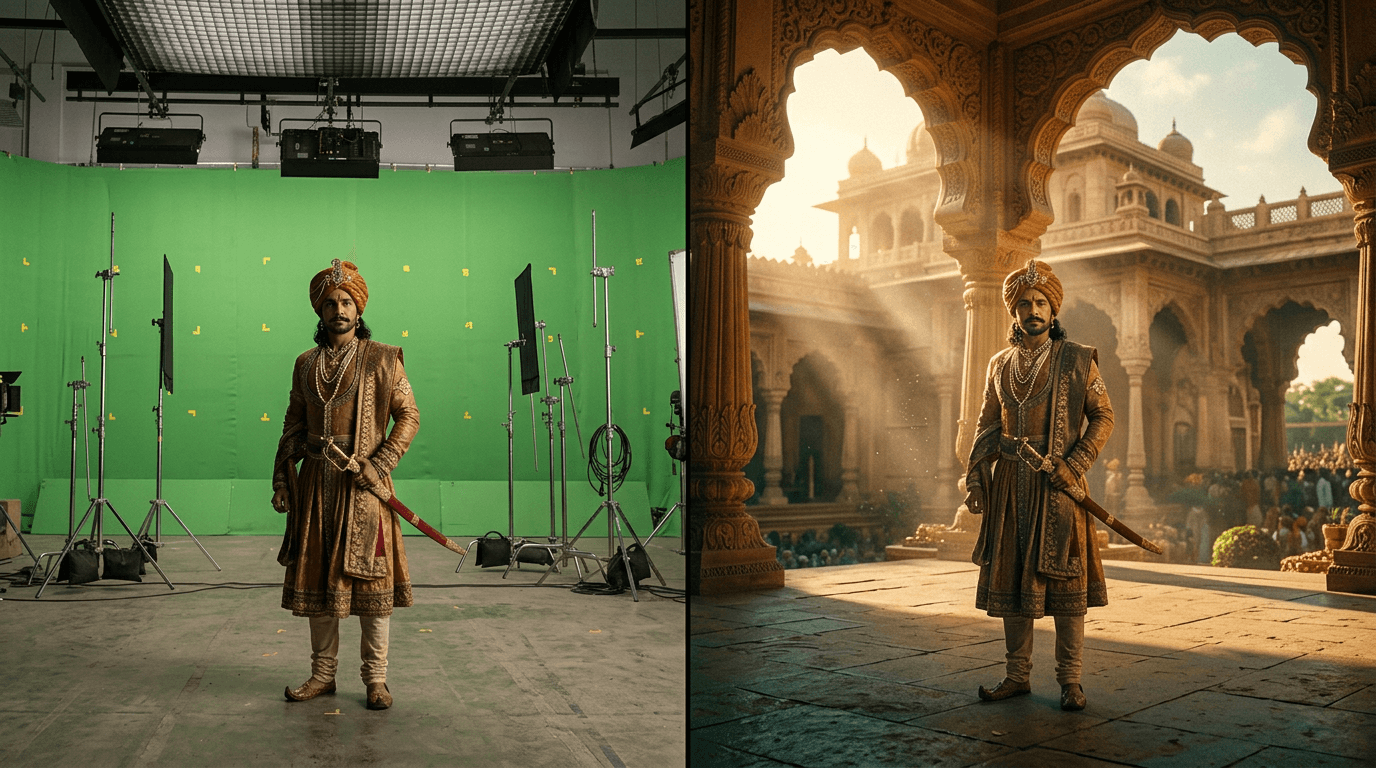
- VFX (visual effects) is imagery created or manipulated outside of live-action photography. It combines real footage with computer-generated imagery and other digital elements to show things too dangerous, expensive, or impossible to film.
- The 9 core types of visual effects: CGI, compositing, rotoscoping, matte painting, motion capture, green screen/chroma key, particle effects, de-aging and digital doubles, and set extension.
- Artificial intelligence compressed the VFX pipeline. AI rotoscoping alone saves 20–65% of task time depending on the shot (Roland Berger), and up to 90% on rote masking work.
- Our verdict as a working AI VFX studio: the future of VFX isn't cheaper labor. It's direction. Machines now do the tracing; taste is the part that doesn't automate.
Reading time: about 17 minutes. Written by a director who ships VFX work, not a content agency.
I've spent nearly a decade making films, and I still watch people's faces do a specific thing when a VFX quote lands. First disbelief. Then some quick math. Then the quiet question: "Wait, what exactly am I paying for?"
So let's answer the real question underneath it. Visual effects (VFX) is the craft of creating or manipulating imagery outside of live-action photography. It's how a bare parking lot becomes a battlefield, how an actor ages forty years between cuts, and how a mythological kingdom gets built by artists who never poured a single foundation.
I run Adwhyta, a quality-driven AI film studio whose work runs from narrative films and ad films to highly stylised animation and microdramas for international clients. We do VFX the new way, with a custom multi-model AI stack finished by human compositors. Full disclosure: that makes me biased about where this industry is heading. But it also means everything in this guide comes from shipping actual shots, including an AI short that won seven international awards, and not from summarizing other people's blog posts.
Here's everything worth knowing about VFX in 2026: what visual effects actually are, the nine core types, how the post-production workflow runs, what VFX costs in India, and why AI in VFX is both a smaller and a much bigger disruption to filmmaking than you've heard.
What Is VFX (Visual Effects)? The 30-Second Answer
VFX (visual effects) is imagery created, altered, or enhanced outside of live-action filming. It integrates real footage with computer-generated elements to produce shots that would be dangerous, prohibitively expensive, or physically impossible to capture on camera. Nearly every film, series, and premium ad made today uses VFX somewhere.
That's the featured-snippet version. The honest version is shorter: VFX is professional lying. Your eye believes a thing happened in front of a camera. It didn't. The craft is in how completely you believe it.
VFX Full Form, VFX Meaning & Quick Definition
- VFX full form: Visual Effects. (Not "video effects," a surprisingly common guess.)
- VFX meaning in one line: any imagery made or changed digitally rather than photographed directly.
- Category: post-production, mostly. The work happens after (and increasingly before and during) the shoot.
- Goal: invisible integration. The best VFX shot is the one nobody claps for because nobody noticed it.
- Not the same as: SFX (practical special effects done live on set) or CGI (one ingredient inside VFX). More on that mess next.
A stat that sets the stage: India's VFX and post-production sector generated roughly ₹5,400 crore (about $647M) in 2023, spread across 4,000+ studios, with around 70% of revenue coming from international outsourcing work (FICCI-EY). The visual effects industry is not a niche craft. It's an industrial layer under almost everything you watch.
VFX vs SFX vs CGI: Clearing Up the Special Effects Confusion
VFX is digital work done to footage, mostly in post-production. SFX (special effects) are practical, physical effects performed live on set: rain rigs, explosions, prosthetics. CGI (computer-generated imagery) is one tool within VFX: fully computer-built characters, objects, or environments. All CGI in films is VFX; not all VFX is CGI.
The three get swapped around constantly, even by people in the film industry. A quick table:
| VFX | SFX | CGI | |
|---|---|---|---|
| Where it happens | In post (on computers) | Live on set | On computers |
| What it is | Any digital image creation/manipulation | Practical effects: fire, rain, squibs, prosthetics | 3D computer-generated imagery |
| Example | Compositing an actor into a digital palace | An actual car flipped with a cannon rig | A fully digital dragon |
| Relationship | The umbrella | A sibling discipline | A subset of VFX |
The one that trips everyone: rotoscoping and wire removal are visual effects but involve zero CGI. Nothing was generated. Live-action footage was surgically altered.
I'd argue this taxonomy is starting to crack, by the way. When a shot is generated by an AI model from a director's reference frames, is it photography? Post? Neither, honestly. It's a third thing the textbooks haven't named yet. We wrote a full comparison with famous movie scenes in VFX vs CGI vs SFX explained if you want the deep version.
The 9 Core Types of Visual Effects (With Film Examples)
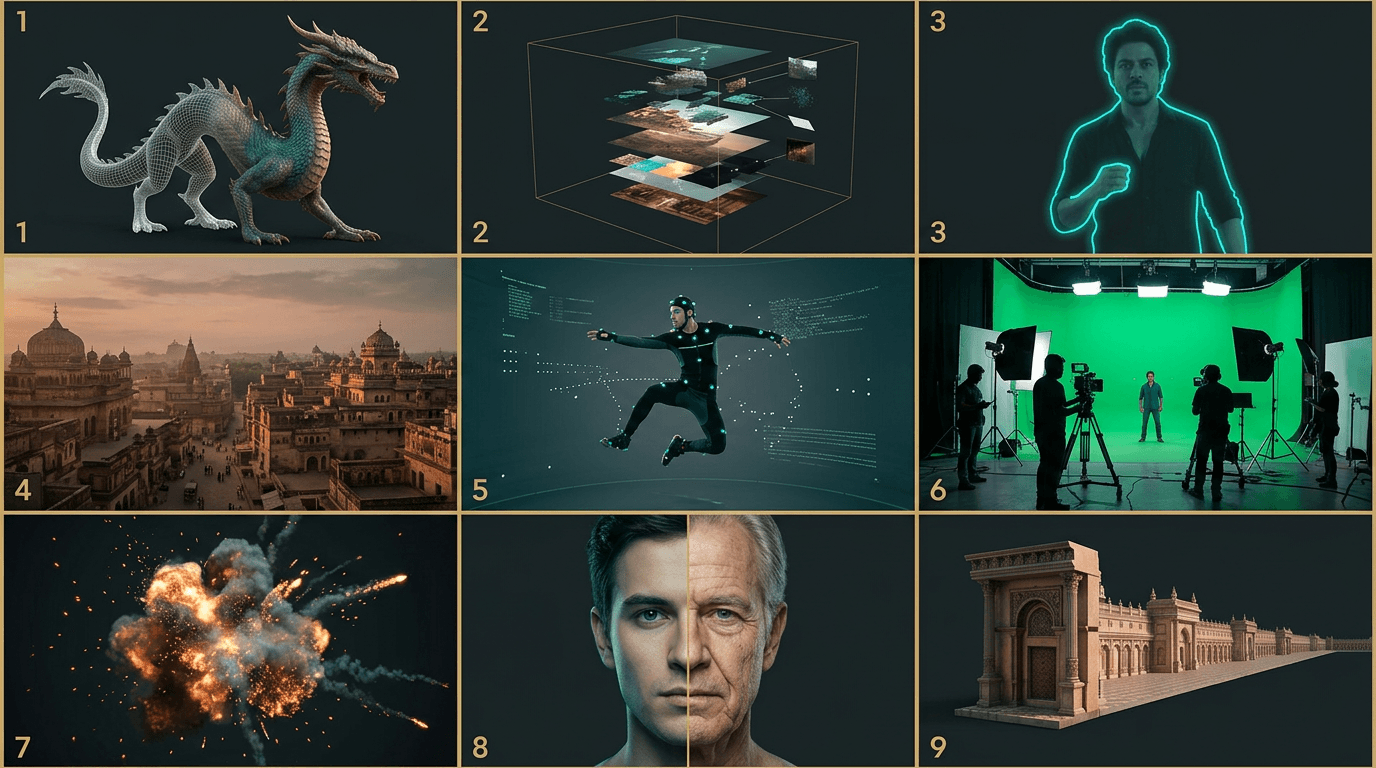
The nine core types of visual effects are: CGI, compositing, rotoscoping, matte painting, motion capture, green screen (chroma key), particle effects, de-aging with digital doubles, and environment/set extension. Almost every VFX shot ever made is some combination of these nine techniques.
1. CGI (Computer-Generated Imagery)
Fully digital assets: creatures, vehicles, props, whole worlds, built through 3D modeling, texturing, and rendering. When people say "the VFX were amazing," they usually mean the CGI was. Modern computer-generated imagery is why a film can cast a dragon and light it like it's really there.
2. Compositing
The invisible king of VFX. Compositing layers multiple visual elements (live plates, CG renders, matte paintings, smoke elements) into one composite shot that reads as a single photograph. Weak compositing is why cheap VFX "floats." At our studio, compositing is where every AI-generated element earns its place in a frame or gets rejected. We don't ship raw generations.
3. Rotoscoping
Frame-by-frame tracing to cut a subject out of its background. For decades rotoscoping was the industry's grunt work, thousands of artist-hours of tracing hair and fingers. Remember this one. It's the technique AI hit first and hardest.
4. Matte Painting
Painted or digitally illustrated backgrounds that extend a world: the city outside the window, the mountain range behind the fort. Matte painting was once literal paint on glass, then high-resolution digital environments, and now, increasingly, AI-generated base plates refined by artists.
5. Motion Capture
Recording a real performer's movement and mapping it onto a digital character. Motion capture is what separates character animation that carries human weight and hesitation from expensive puppetry. Our pipeline uses AI motion transfer for the same reason traditional studios use mocap suits: performance is the thing audiences actually feel.
6. Green Screen / Chroma Key
Shoot against a uniform color, key it out, put anything behind the actor. Green screen and chroma key work remain the workhorse of budget-conscious film production, though AI-driven matting is quietly making the physical green screen optional in more cases. We covered whether you still need one in green screen in the AI era.
7. Particle Effects
Fire, smoke, rain, dust, magic, destruction: thousands of tiny elements governed by physics rules. Particle work is the most computationally hungry corner of VFX; render farms exist largely to simulate it. Full physics simulation remains one of the few tasks generative models still can't fake convincingly.
8. De-Aging & Digital Doubles
Making an actor younger, older, or duplicating them entirely as a digital human, with facial animation that stays consistent frame to frame. De-aging was once reserved for nine-figure budgets; it's now a standard service line. Digital doubles, character replacement, and AI aging are part of our regular VFX work for production houses.
9. Environment / Set Extension
Build 10% of the set physically, extend the other 90% digitally. Set extension is the single most cost-effective trick in the book and the reason period dramas are affordable at all.
(Games use several of these in real-time, which is a different discipline with different constraints. That's covered in how VFX works in games vs films.)
How VFX Is Made: The Traditional VFX Pipeline
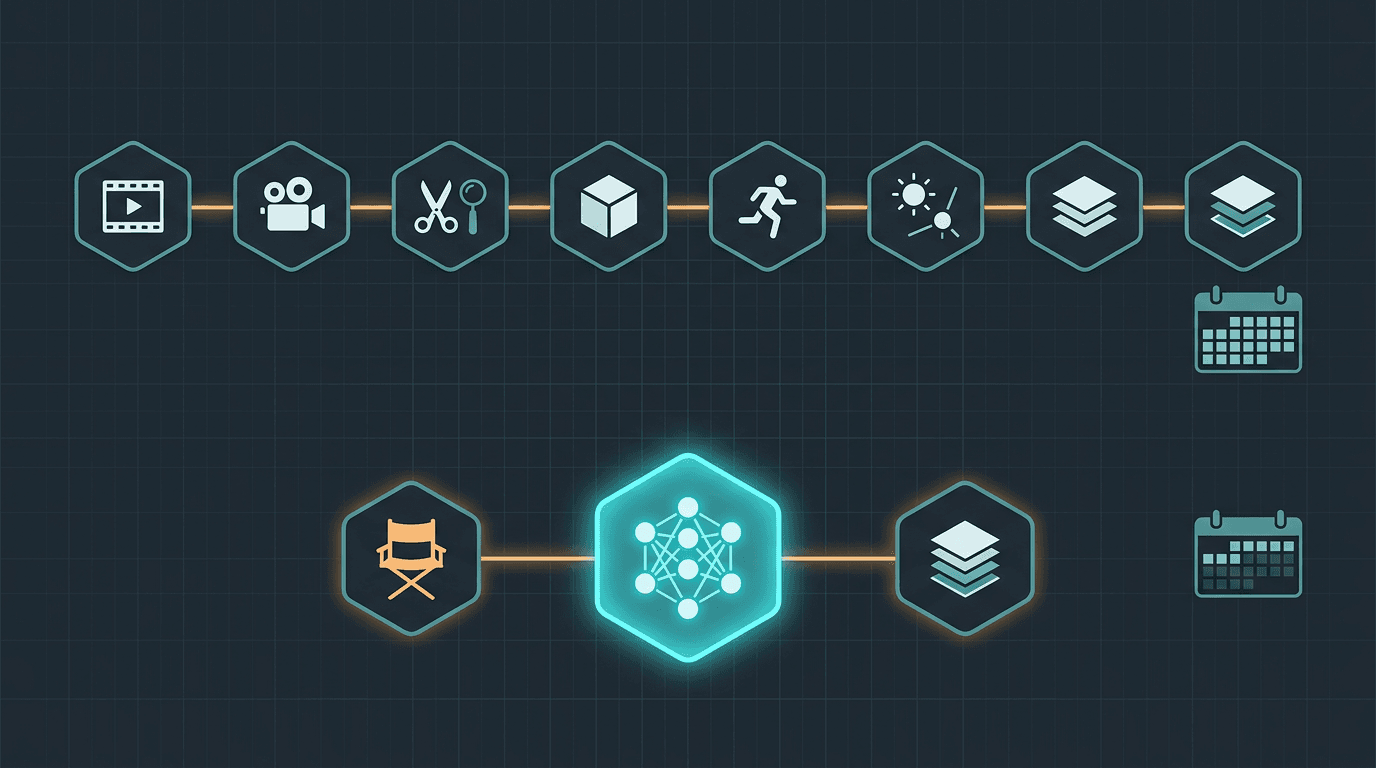
The traditional VFX pipeline runs: previsualization → on-set supervision → plate preparation (roto, cleanup, tracking) → asset creation (modeling, texturing, rigging) → animation and simulation → lighting and rendering → compositing → grading and delivery. A single complex shot can pass through dozens of specialist artists over weeks or months.
The part outsiders never guess: most of those hours aren't creative. They're preparation. Before an animator or compositor does anything artistic to a shot, someone has to rotoscope the actors, track the camera, clean the plate, and remove the rig, all under a VFX supervisor keeping continuity honest. On a big film, that prep layer of the post-production workflow is thousands of hours of repetitive tasks.
Scale check: Baahubali 2, India's landmark VFX production, contained roughly 2,500 VFX shots handled by about 35 studios worldwide, with Hyderabad's Makuta VFX as principal studio. One film. Thirty-five companies. That's what traditional VFX looks like at full stretch.
It works. It's also slow, expensive, and brutally labor-intensive, which matters enormously for what happened next.
How AI Rewired the VFX Workflow in 3 Years
Between 2023 and 2026, artificial intelligence absorbed the VFX pipeline's most labor-intensive layers. AI rotoscoping and matting save 20–65% of task time depending on shot complexity (Roland Berger), with vendors claiming up to 90% on rote masking. Generative models now produce base environments, extensions, and even full shots that artists refine instead of build.
I want to be precise here, because AI visual effects drown in hype from one side and denial from the other.
AI Rotoscoping, Cleanup & Plate Work
- Rotoscoping and matting. The industry's least-loved job is now largely machine-assisted, using deep learning matting models. Savings run 20–65% per task depending on motion blur and complexity (Roland Berger), and vendor tools claim up to 90% on straightforward masking. Take the vendor numbers with salt; the direction is not in dispute.
- Cleanup and plate restoration. Wire removal, marker removal, dead-pixel fixes, even full AI video restoration and 4K remasters of archival footage. Rote, rules-based, perfect for machines. Custom 4K upscaling is part of our own post stack for exactly this reason.
- Tracking and matchmove. AI motion tracking locks a camera solve in minutes; machine learning handles what junior artists once ground through frame by frame.
AI Set Extension, Environments & De-Aging
- Set extension and environments. Generative AI models produce base environments in hours that took matte painters weeks. Artists art-direct and repair rather than paint from zero.
- De-aging and digital humans. What cost a nine-figure film a dedicated research team now runs on accessible AI models with temporal tracking and facial consistency. A digital double that once needed months of specialist work is now a routine deliverable in an AI-powered VFX pipeline.
- Previsualization. Full sequences can be visualized before a rupee is spent on production. We deliver previs and visual concept decks as a standalone service because previsualization changes how producers greenlight complex VFX sequences.
What Artificial Intelligence Didn't Change
The shot still has to be directed. A model doesn't know that the cut needs a low angle here because the character just lost power in the scene. It doesn't keep a character's face consistent across 40 shots, hold lighting continuity through a sequence, or notice that the composite reads fake because the shadow falls a half-degree wrong. That judgment layer is exactly where AI output goes to die without experienced eyes.
This is why I founded Adwhyta: to redefine VFX workflows and pipelines using AI so filmmakers can create grand cinematic visions without prohibitive budgets. We run a custom multi-model stack, and I'll date it deliberately, because pipelines here get rebuilt yearly. As of mid-2026 that means Seedance with omni reference (our workhorse for the past six months for character- and style-consistent generation), Kling 3, Veo, Nano Banana for character consistency, Seaweed 2, Hailuo, and Runway, plus proprietary face, style, and lighting models, all finished with VFX-grade compositing, custom noise shaders, and micro-movement parameters so the output holds up on a cinema screen. The workflows we built in the 2024 ComfyUI/Flux era are already obsolete; even our 2025 pipelines have been rebuilt. A custom multi-model stack. Not a single prompt box. The full breakdown of how modern VFX teams use AI in practice lives in our AI VFX guide.
When we made Unmasked, our short about a Theyyam dancer and a Gen-Z vlogger, the AI generated frames fast, but almost nothing survived. We generated between one and one-and-a-half hours of footage for an eight-minute film; only 5–10% of AI generations were usable. The climax VFX effect, roughly 15–20 seconds on screen, took 150–200 generated clips and iteration after iteration to get the Theyyam costume's fire glow behaving consistently, shot after shot, so the film felt photographed rather than assembled. The film went on to win seven international awards, including Best AI Short (Gold) at the Bali International AI Film Festival and an Official Selection at Cannes World AI Film. Audiences and juries don't reward generation. They reward craft.
VFX in Indian Cinema: From Baahubali to the AI Era
India is one of the world's largest VFX hubs: roughly ₹5,400 crore in 2023 revenue, 4,000+ VFX studios, and about 70% of income from international outsourcing (FICCI-EY). Baahubali proved Indian studios could carry epic-scale visual effects; the AI era is now testing whether India's cost-advantage model can survive automation.
The Indian VFX story has two acts.
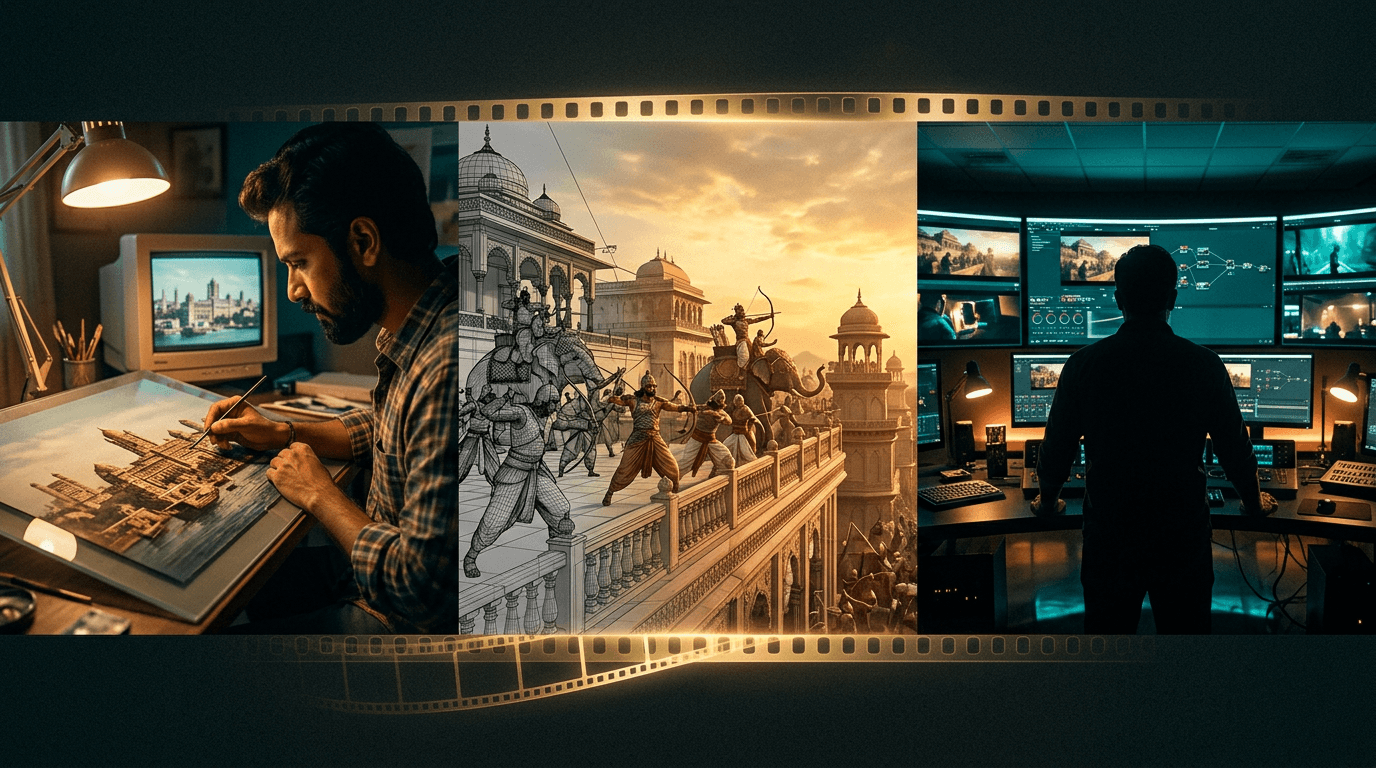
Act one: the arbitrage era. For two decades, India's pitch to Hollywood and the global film industry was straightforward: equally skilled VFX artists at 30–50% lower cost. It worked spectacularly. Mumbai, Hyderabad, and Chennai became post-production engines for the planet (we've mapped the scenes in Mumbai, Hyderabad, and Chennai separately). Baahubali showed the ceiling was higher than anyone thought: a homegrown epic with ~2,500 VFX shots, world-class, mostly made in India.
Act two: the reckoning. In 2024, India's animation, VFX, and post segment contracted 9%, with VFX itself declining 14% as global production volumes fell (FICCI-EY). And here's my uncomfortable take, the one that gets me arguments at industry meetups: the cost advantage that built the Indian VFX industry is dying, and pretending otherwise is the real threat.
Think about what the arbitrage was actually selling: labor-intensive tasks like roto, cleanup, and matchmove done by cheaper artists. Those are precisely the tasks AI and machine learning are automating everywhere on Earth, at the same speed, for everyone. When a machine does the tracing 20–65% faster in Los Angeles AND in Hyderabad, "our artists cost less" stops being a moat. Indian studio heads are already reporting AI cutting mythology and fantasy production costs to one-fifth and timelines to a quarter. That efficiency is wonderful for filmmakers and lethal for any VFX company whose only pitch was seat count.
What survives? Craft, direction, and speed of adoption. EY projects AI could lift Indian M&E revenues ~10% while cutting costs ~15% in the medium term, and India's AVGC-XR ambition ($40B, 5% of the global market) explicitly bets on AI-forward capability rather than headcount across VFX and animation. The Indian VFX studios that thrive next decade will be the ones selling judgment, not hours. That's the entire thesis our studio is built on, and it's why we operate as an extended AI visualization team for production houses instead of a shot factory. (Where India's players stack up globally: best VFX companies in the world.)
What VFX Costs (Traditional vs AI-Accelerated Pricing)
Traditional VFX is priced per shot, by complexity: simple cleanup costs far less than creature work or full CG environments, and hero sequences on major films run into crores. AI-accelerated pipelines compress the labor hours behind each shot, with Indian studio heads reporting cost reductions up to one-fifth of traditional budgets on heavy fantasy work.
Honest caveat up front: nobody can give you a universal VFX price list, and anyone who does is guessing. VFX cost depends on shot count, complexity, resolution, iterations, and how clean your plates are. What I can give you is the structure:
| Cost driver | Traditional pipeline | AI-accelerated pipeline |
|---|---|---|
| Roto/cleanup/prep | Large artist-hour block, billed per shot | Largely automated; humans QC |
| Environments & extensions | Matte painters + CG teams, weeks | Generated base + artist refinement, days |
| Digital doubles / de-aging | Specialist teams, top-tier budgets only | Accessible model stacks + compositing polish |
| Iterations | Expensive; each revision re-renders | Cheap at draft stage; polish still costs |
| Where money concentrates | Labor hours across every stage | Direction, art direction, final compositing |
Reference points from the wider market: AI production methods are cutting ad film cost and time by 60–90% versus traditional shoots, and the much-discussed Kalshi NBA Finals spot (2025) was made by one person in 2–3 days for under $2,000 against seven-figure traditional quotes. VFX-heavy narrative work doesn't compress that hard (polish is stubborn), but the direction of travel is identical. Indian context: traditional premium TVCs run ₹20 lakh–₹2 crore+, while AI ad films enter around ₹2–5 lakh.
One thing I tell every producer who calls us: cheap without craft is how you get AI slop, and audiences smell it. Consumer comfort with brands that use AI in ads actually fell from 57% to 46% between 2023 and 2024, and 57% worry about fake AI ads. The market isn't rejecting AI. It's rejecting slop. Budget for polish or don't bother.
For actual per-shot and per-minute VFX pricing in India, we've published a dedicated page: VFX cost in India. For a scoped quote on your project, that's what our VFX services page is for.

VFX Tools & Software in 2026: Traditional Suites vs AI Model Stacks
Traditional VFX software splits by specialty: compositing software like Nuke and Adobe After Effects, 3D packages, and simulation tools, each demanding years to master. AI-era VFX stacks are different: multiple generative models chained into custom workflows, with traditional compositing still doing the final finishing. The software matters less than who's directing it.
A common beginner mistake is asking "which VFX software should I learn?" as if there's one answer. There isn't, and there never was. Traditional studios run different specialist VFX tools for compositing (Nuke at the high end, Adobe After Effects in motion-graphics-heavy work), 3D asset creation, and physics simulation, and a single shot might touch five of them. (We keep this section deliberately survey-level; tool-by-tool tutorials aren't what a definitional guide is for.)
There's also a third track worth knowing about: real-time rendering. Game engines, Unreal Engine most visibly, now drive virtual production stages where the background renders live behind the actors instead of being composited months later. Real-time rendering inverts the old bargain of visual effects production: you trade some final-frame fidelity for the ability to see the shot while you're standing on set. (The game-side craft is its own world; see VFX in games vs films.)
What's genuinely new in 2026 is the shape of the AI stack. An AI-powered VFX pipeline isn't one program. Ours chains the generation models listed earlier, Seedance with omni reference doing the consistency heavy-lifting as of mid-2026, into conventional VFX-grade compositing at the end. The generative layer changes monthly. The finishing layer, and the taste applied there, barely changes at all.
Which is the quiet lesson about VFX tools generally: software has never made anyone a filmmaker. AI tools are the newest proof. A tool is not a film. Direction is.
VFX Careers: Courses, VFX Artist Jobs & the Changing Market
VFX careers in 2026 split into two tracks: traditional specialist roles (compositor, FX TD, lighting artist) that AI is thinning at the junior level, and hybrid AI-era roles (AI pipeline artist, generative art director) that barely existed in 2023. Entry-level rote work is disappearing; judgment-heavy roles are gaining value.
I get asked about VFX careers by students constantly, and I won't sugarcoat it. The classic entry path for a VFX artist was rote work: junior roto artist, cleanup artist, matchmove. You earned your eye by doing the boring stuff for two years. That rung of the ladder is dissolving, because repetitive tasks are what AI does best. India's 2024 VFX contraction hit exactly those seats hardest.
But the demand for what visual effects produce is growing, and India's AVGC-XR plan projects 160,000 new jobs a year across animation, VFX, gaming, and adjacent content creation. The VFX jobs are just different:
- Compositing remains the safest craft. Someone has to make every element, AI-generated or not, sit truthfully in a frame. Our compositors are the last gate before anything ships.
- AI pipeline artists who can wire AI models together, manage character consistency, and art-direct generations are scarce and getting paid for it.
- Generalists with taste beat specialists without it. A junior animator who understands camera grammar, light, and edit rhythm can direct AI-powered tools. A junior who only knows one software's rote workflow is competing with the software.
My honest advice to anyone entering now: learn cinema first, tools second. Study why a shot works. The founders of the next great VFX studios will be the people who can direct machines, and direction can't be prompted.
Hiring a VFX Studio in 2026: What to Look For
When hiring a VFX studio in 2026, evaluate four things: proof of finished craft (not showreels of isolated shots), pipeline transparency (traditional, AI, or hybrid and why), director-level involvement in your project, and how they handle revisions and consistency. Price alone is a trap; cheap raw AI output costs more to fix than to redo.
Whether you're a production house with a VFX-heavy sequence or a brand weighing an effects-driven ad, the evaluation logic for choosing a VFX company is the same:
- Look for finished, awarded, public work. Isolated wow-shots are easy to cherry-pick. Complete pieces that held an audience (festival selections, awards, shipped campaigns) are hard to fake. This applies to us too: judge our Velocity Archive portfolio before you believe a word of this article.
- Ask what their pipeline actually is. "We use AI" tells you nothing. Which models? What's the human layer? Who does final compositing? A serious studio can walk you through where machine output ends and craft begins. If the answer sounds like a single prompt box, the output will look like one.
- Ask who directs. The single biggest quality variable in AI-era VFX is whether a filmmaker is making shot-level decisions or whether generations are being batch-approved. At Adwhyta the founder directs every project; that's a boutique constraint we chose deliberately.
- Test revisions and consistency. Ask how they'd keep your lead actor's digital double consistent across 30 shots, or how many iterations a hero shot gets. Vague answers here predict pain later.
India's landscape now spans traditional giants (Red Chillies VFX, DNEG's India operations, Makuta), big-capital AI ventures like aiON (₹100 crore committed) and Galleri5's IP plays, and boutique AI-native studios like Xanadu and us. Each model has real strengths. Capital buys volume; boutiques sell direction. Match the VFX studio to whether your project needs a thousand shots or a hundred perfect ones. Our pitch, for the record, lives at AI-accelerated VFX services in India.
The Future of VFX: Integrating AI Without Losing the Craft
The future of VFX is a merger, not a replacement: generative AI absorbs volume work while a new role — the AI artist and creative supervisor — directs it. The integration of artificial intelligence collapses cost floors (a ₹500-crore-scale spectacle becomes feasible at roughly ₹5–10 crore), but screenwriting, direction, edit, and sound remain stubbornly human.
Here's the framing I keep coming back to when people ask where AI in visual effects goes next. AI filmmaking is not just prompt engineering; it's much closer to an animation film process, and it's tedious. Roughly 80% of the work is still done at the scripting table. What changes is the economics underneath: production cost is what collapses, not the intellectual labor. A film that needed a ₹500-crore budget for its spectacle becomes feasible at ₹5–10 crore. Not ₹5 lakh, because writing, music, edit, sound, and visual storytelling remain human work, and that's precisely where the value concentrates.
The role that's emerging in the world of visual effects looks like Pixar's director-as-lead-animator model: an AI artist cum creative supervisor who writes, directs, and supervises generation in one seat, replacing the old silos between writing, direction, and VFX. Off-the-shelf AI solutions will keep commoditizing the bottom of the market. The top of the market, complex VFX with narrative stakes, gets more director-driven, not less.
So when someone tells you AI will either destroy the VFX industry or magically democratize it, both are half-true and both miss the point. The teams integrating AI deepest right now are the ones most obsessed with the oldest things in cinema: story, performance, and the frame.