AI video production in 2026 costs anywhere from $30 per month for a tool subscription to ₹2-5 lakh for a studio-produced ad film in India, with US agencies starting around $5,000 for a 30-second spot. The honest answer sits inside that spread, and this pricing guide maps every layer of it — tools, hidden costs, studio quotes, and the budget worksheet to plan your own.
Key Takeaways
- Direct answer: AI video generation runs $20-$220 per finished minute at the tool layer (LTX, 2026); professional AI ad films in India start around ₹2-5 lakh, delivered in 7-15 working days.
- The real cost driver: iteration rate, not per-second price. A "cheap" model that needs 40 takes costs more than a pricier one that nails the shot in 8.
- The hidden cost stack: revisions, commercial rights, upscaling, music licensing, and sound design routinely double a naive tool-only budget.
- AI vs traditional video production: 60-90% cheaper for comparable quality, and days instead of months.
AI video production cost is the total price of producing a finished video using generative AI, covering three layers: tool or API fees, human craft (direction, video editing, sound), and rights. It's typically 60-90% cheaper than traditional production, but the layers behave very differently, which is why quoted AI video costs vary 100x.
I run an AI film studio, so I look at these numbers from the director's chair, not a pricing page. Full disclosure: we're an AI studio, so we're biased. But I'll also tell you exactly where a ₹30,000 budget beats a ₹3 lakh one, because pretending otherwise is how this industry gets its reputation for slop.
One more thing before the tables. In 2018 I made a sci-fi short, The Countdown, for under $75. It screened at Comic Con Hyderabad and made the finals at Duemila30 in Milan. So when I say budget was never the point, that's not a slogan. Craft decides what a rupee buys. The numbers below tell you how many rupees you need.

AI Video Production Cost in 2026: The Short Answer
AI video production costs $20-$220 per finished minute at the generation layer (LTX, 2026). Add human craft and rights, and realistic budgets run: DIY ai video tools $30-$100 per month, freelancers from ~$100 per minute for professional video work, AI studios from ~$5,000 per 30-second film in the US or ₹2-5 lakh in India.
Here's the master pricing table. Every number after this section unpacks one of these rows.
| Approach | Typical cost in 2026 | Production time | Best for |
|---|---|---|---|
| DIY tool subscription | $10-$200 per month | Hours-days | Video clips, tests, social filler |
| API / per-second generation | ~$0.07-$0.40 per second | Minutes per clip | Developers, volume workflows |
| Freelancer | $100+ per finished minute | Days | Simple edits, explainers |
| AI studio (India) | ₹2-5 lakh entry per ad film | 7-15 working days | Brand films, ad campaigns |
| AI agency (US) | From ~$5,000 per 30-sec spot | 1-3 weeks | Polished brand work |
| Traditional production | $15,000-$50,000+ per 30-sec; premium Indian TVCs ₹20 lakh-₹2 Cr+ | 6-12 weeks | Celebrity spots, tactile realism |
That last row is the traditional production headline. Agency production runs $1,000-$5,000 per finished minute for freelance crews and $15,000-$50,000+ through a full-service production team (Lemonlight, 2026). AI compresses that budget by 60-90% — a cost reduction the industry has never seen at this speed. The Kalshi NBA Finals ad in 2025 made the point loudly: one creator, 2-3 days, under $2,000, airing where seven-figure spots normally live.
So why doesn't everyone just pay $30 per month? Because of the next three sections.
How Much Does AI Video Cost Per Minute? Per-Minute Pricing Benchmarks
Per-minute AI video generation costs $0.50-$30 in raw credits, but $20-$220 per finished minute once you count discarded takes (LTX, 2026). Freelancers charge from ~$100 per minute; studios quote per project cost, with Indian AI ad films starting around ₹2-5 lakh for a 30-60 second film.
Here's the contrarian bit, and I'll defend it with arithmetic: per-minute pricing is the wrong metric. Iteration rate is the real cost.
The gap between $0.50 and $220 for the "same" minute isn't a typo. It's the difference between the minute you generated and the minute you kept. LTX's 2026 cost analysis says it plainly: the dominant cost driver is iteration rate, not per-second price. A video generator with tighter prompt adherence and better control is often cheaper per finished shot than a bargain model that sprays variations.
Do the math on a single hero shot. Say your tool charges $0.10 per second of generated video and you need a 6-second shot. One take: 60 cents. Lovely. But nobody ships take one. If character consistency drifts, hands melt, or the physics wobble, you're regenerating. At 40 takes — a completely ordinary number for a shot that has to carry emotion — that 60-cent shot's effective cost is $24, plus the hours you spent judging takes. Multiply across a 30-shot film and "cheap" quietly became the expensive option.
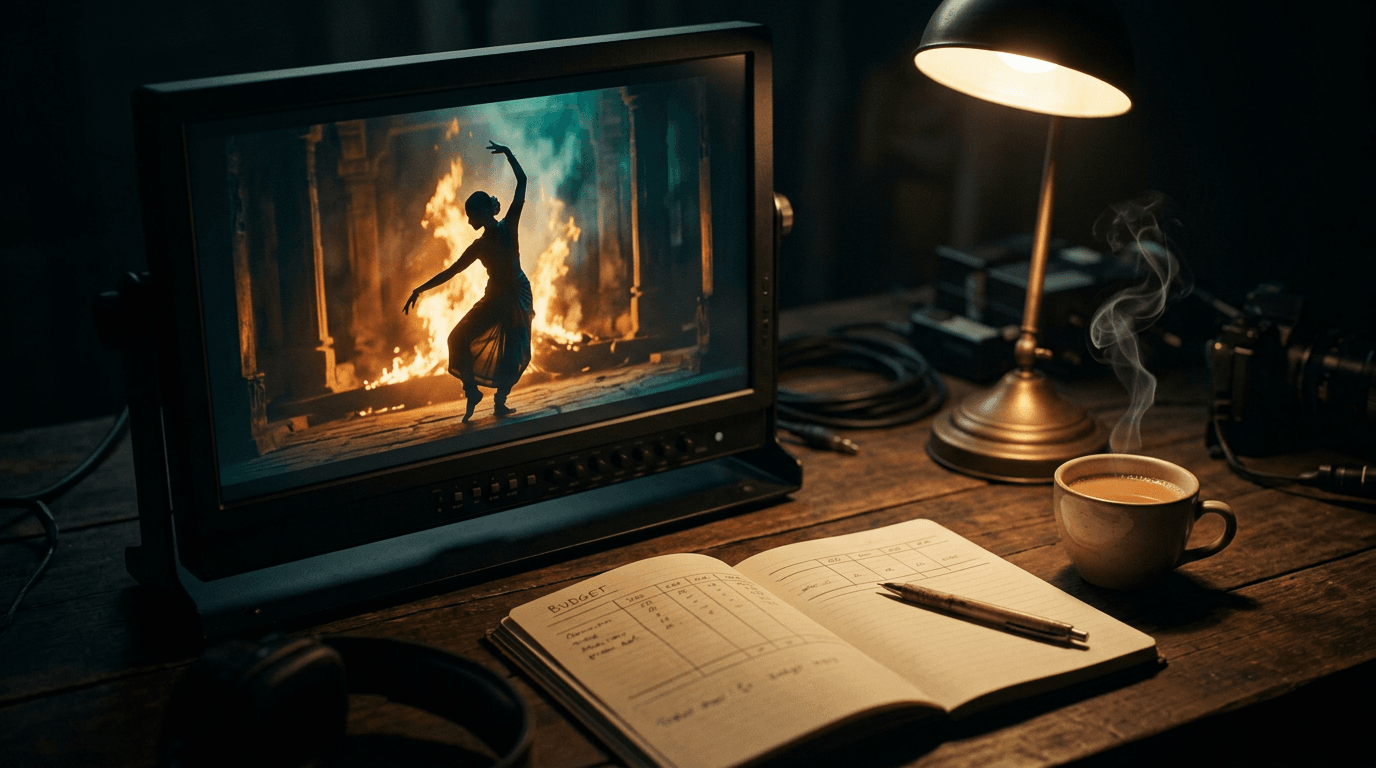
I can put real numbers on that waste rate, because I lived it. When we made Unmasked, our short about a Theyyam dancer and a Gen-Z vlogger, we generated between one and one-and-a-half HOURS of footage for an eight-minute film — only 5-10% of AI generations were usable. The climax VFX effect, roughly 15-20 seconds on screen, took 150-200 generated clips. The expensive part was never the generation fees. It was holding one face, one costume, one fire-lit mood across every frame — the consistency work that decides whether a film feels like cinema or like clips. That film went on to win Gold at the Bali International AI Film Festival and six other international honors, and I promise you no award has ever been given for lowest credit spend.
API rates, for the pipeline-minded, as of mid-2026: Kling 3.0 Standard around $0.07 per second, Seedance 2.0 Fast near $0.09 per second, and Google's Veo from $0.05 per second (Veo 3.1 Lite) up to $0.40 per second for the standard tier via the Gemini API. Useful for volume automation and per-video cost modeling. Irrelevant if what you need is one video that makes people feel something.
Hidden Costs in AI Video Production: The Full Cost Breakdown
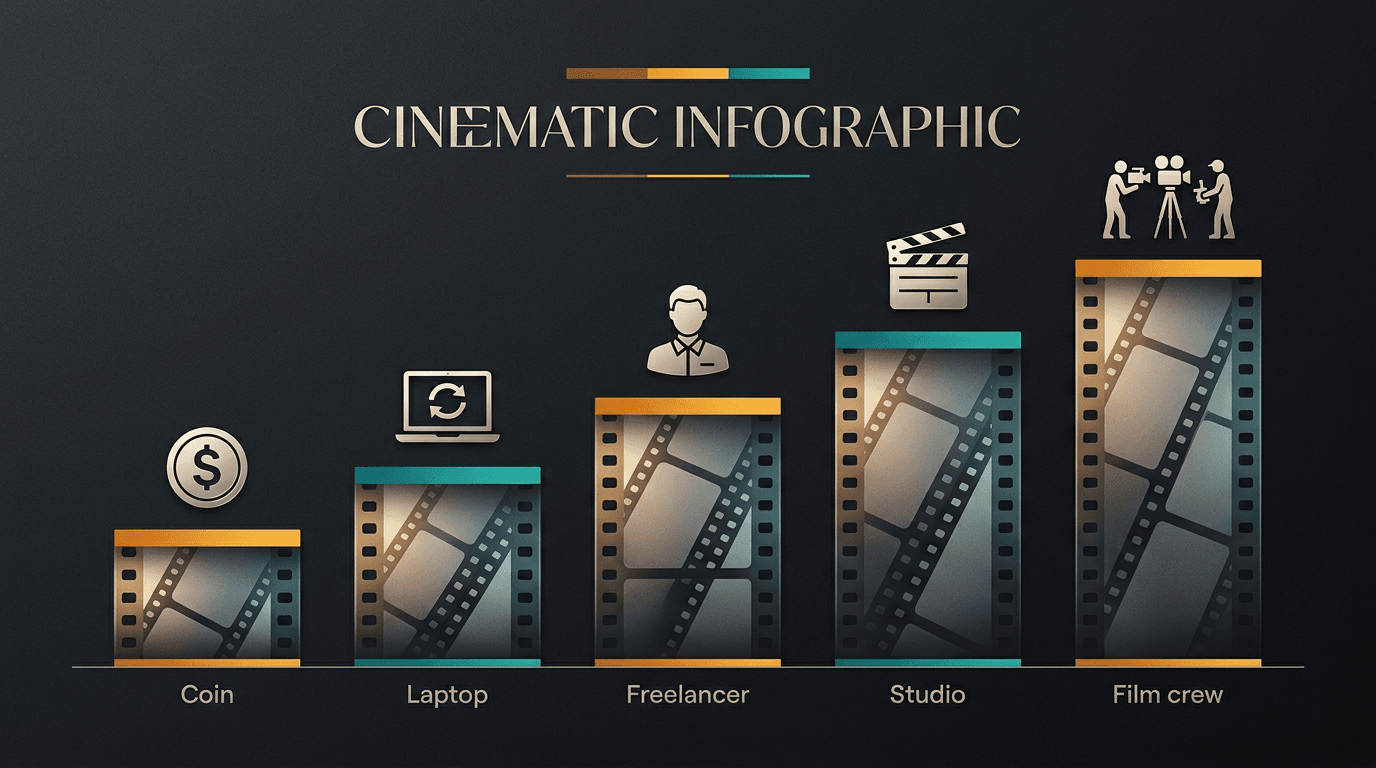
The hidden costs — revision rounds, commercial usage rights, upscaling, music licensing, and sound design — typically add 50-100% to a naive AI video budget. Standard packages include 2-3 revision rounds with extra rounds billable, and music licensing alone runs $50-$1,000+ per track for commercial use.
Nobody's pricing page mentions these. Every real invoice includes them. Here's the cost breakdown:
| Hidden cost | Typical range (2026) | Why it hits |
|---|---|---|
| Revision rounds | 2-3 rounds standard; extra rounds billable (industry guide) | Each round burns credits and days |
| Commercial usage rights | Gated to paid tiers on most ai tools | Free-tier output often can't legally run as an ad |
| Upscaling & cleanup | e.g. Topaz Video AI: $199 one-time or $50/month | Raw 720p generations aren't broadcast-ready |
| Music licensing | $50-$1,000+ per track | Unlicensed tracks risk claims and takedowns |
| Voiceover, dubbing, lipsync | Varies; premium voice cloning costs extra | Realism is the expensive part |
| Credit-burn mechanics | Some platforms charge credits for previews, exports, upscales | Video editing itself consumes budget |
Two of these bite hardest.
First, rights. If you generate a brand video on a free or personal tier, many platforms don't grant commercial usage. Your "free" ad is a legal liability wearing a trench coat. Always check the license line before the video quality line.
Second, sound. AI video pricing conversations are weirdly silent about audio, which is funny, because audiences forgive a soft frame long before they forgive dead sound. Voice, dubbing, lipsync accuracy, score, mix — on our productions the audio chain (we run ElevenLabs plus a multi-tool lipsync pipeline, with Suno and original composition for score) gets the same obsession in post-production as the picture. Budget for it, or your final video will look expensive and feel cheap.
AI Video Generator Pricing Per Month: The Subscription Math
Entry AI video generator subscriptions look cheap — Kling from $10 per month, Runway from $12 per month, Veo via Google AI Pro at $19.99 per month — but caps, credit mechanics, and human hours mean a single polished 60-second video routinely consumes a full month's allowance plus 20-40 hours of skilled labor.
The 2026 subscription board, roughly: Kling Standard at $10 per month (about $6.60 effective on annual billing). Runway Standard at $12 per month with 625 credits — around 62 ten-second generations — and $76 per month for Pro. Veo access through Google AI Pro at $19.99 per month. And the lineup churns fast — brutally so. OpenAI shut down the Sora consumer app on April 26, 2026, with the API scheduled to follow in September. If your production process was built on a single tool, it just retired under you. (This is one reason we run a multi-model stack: ai video tools are replaceable, films aren't.)
Honest transparency: if what you need is video clips — product demo spins, social filler, quick concept tests — these tools are genuinely, wonderfully cheap for that kind of video creation. Use them. You don't need a studio to test a hook.
Now the volume math for an actual film. A 60-second brand film is maybe 10-15 shots. At even 10 takes per shot (kind, for anything with faces), that's 100-150 generations before edit. On a 625-credit plan you're buying top-ups by day three. Cap-based tools pinch harder — Synthesia's $29 per month tier caps output at 10 minutes a month, so every tweak to a finished video eats the ration. Watch video length too: most generators price and cap by the second, so a 90-second cut costs half again more than a 60-second one before you've touched quality.
Then add the invisible line item: the time cost of a human who can write, direct, judge takes, edit, and mix. Call it 20-40 hours for one polished minute. The subscription was never the full cost. It was the ante.

DIY AI Video vs Traditional Video Production: The Real Cost Gap
DIY ai video runs $30-$200 per month in tools plus your hours; traditional video production runs $15,000-$50,000+ per 30-second spot; studio-grade ai production sits between at ₹2-5 lakh. The cost gap is real, but each of the three production methods buys a different level of control, production quality, and risk.
Most cost comparisons frame this as production vs production — AI on one side, cameras on the other. In practice there are three lanes, and the smart brands pick per project:
- DIY ai-generated video. Cheapest cost structure by far. Perfect for testing hooks, social video content, and internal training video needs where polish matters less than speed. The catch: your team's hours are the real spend, and quality ceilings show up fast when a human face has to emote.
- Full production, traditional. A production team, locations, kit, celebrity schedules. Still unbeatable for tactile product realism and campaigns built on a star's presence. You pay for certainty — in money and in production time.
- Studio-grade AI (the middle lane). Cinematic output at a fraction of the cost of a shoot, with direction and post-production baked in. This is where most brand films now land, and where the per-project total cost stays predictable.
For video marketing teams, the honest play is integrating ai video where iteration wins (performance variants, regional versions, concept tests) and reserving traditional shoots for the one standard video a year that genuinely needs a physical set. The full head-to-head — same brief, both pipelines, line-item costs — lives in our AI vs traditional video production comparison.
AI Video Pricing at a Studio: What You're Actually Paying For
A studio quote — ₹2-5 lakh entry in India, $5,000+ in the US — buys direction, screenwriting, a controlled multi-model workflow, character and scene consistency, VFX-grade post, sound design, and cleared rights. You're not paying for generation; you're paying for the judgment that makes generations into a film.
Production companies structure quotes nothing like a subscription. Deconstruct ours and the pricing structures look like this:
- Script and direction. Narrative structure, camera grammar, edit rhythm. Technology is a servant of narrative structure — a tool is not a film.
- A custom multi-model stack, not a single prompt box. As of mid-2026 we route shots across Seedance with omni reference (our workhorse for character- and style-consistent generation), Kling 3, Veo, Nano Banana for character consistency, Seaweed 2, Hailuo, and Runway — depending on what each shot needs: motion, faces, environments. The stack itself is rebuilt yearly; our 2024-era ComfyUI and Flux workflows are already obsolete.
- Consistency systems. Face, style, and lighting pipelines so your protagonist in shot 27 is the person from shot 2.
- VFX-grade post. Cleanup, compositing, custom 4K upscaling. We don't ship raw generations.
- Sound. Voice, dubbing with temporal-tracked lipsync, original score.
- Rights. Commercially cleared output. Boring. Essential.
Why does the premium tier exist at all, when ai tools are this good? Because audiences got sharp. Consumer comfort with AI in ads fell from 57% to 46%, and 57% of consumers now worry about fake AI ads. Read that carefully: the market isn't rejecting AI. It's rejecting slop. Craft and authenticity are the differentiators, and they're precisely the line items a subscription can't sell you.
That's the honest pitch for a production company like ours — premium ai production at AI economics, not the cheapest render in the room. Our proof lives in laurels, not adjectives: seven international AI film awards in 2026, from Bali Gold to a Cannes World AI Film official selection. See the work on our Velocity Archive or the AI ad films service page.
Video Production Costs by Video Type: Ad Film, Explainer, Training Video, Series
Production costs range by video type in India, 2026: talking-head avatar explainers ₹300-₹900 per finished minute; AI brand ad films ₹2-5 lakh entry; premium cinematic AI films around ₹2 lakh+ per minute; multi-language campaign packages ₹2-6 lakh. Traditional premium TVCs still run ₹20 lakh-₹2 Cr+.
| Video type | Market range (India, 2026) | Notes |
|---|---|---|
| Avatar/talking-head explainer or training video | ₹300-₹900 per finished minute | Tool-driven, script is the craft |
| Social/performance marketing video variants | Low per-variant cost after the first film | AI's superpower: versioning one video into many |
| Brand ad film (30-60s) | ₹2-5 lakh entry | Studio-grade, 7-15 working days |
| Premium cinematic brand film | ₹2 lakh+ per minute | Consistency, emotion, polish |
| Multi-language campaign (10+ variants) | ₹2-6 lakh package | Dubbing + lipsync at near-zero marginal cost |
| Short film / series episode | Wildly variable | Iteration count rules everything |
Each video type deserves its own full economics breakdown; this pillar keeps the ranges. For scheduling realities, our AI video production timeline guide covers why "7-15 working days" is honest and "24 hours" usually isn't.
How Much Does Video Production Cost in India vs Globally?
Indian AI video production costs 40-70% less than equivalent Western output — ₹2-5 lakh versus $5,000+ starting points — on top of India's long-standing VFX and post-production cost advantage over US and European studios. Delivery runs 7-15 working days, with multilingual variants at near-zero marginal cost.
India was already the world's post-production back office: a roughly ₹5,400 crore VFX industry with 4,000+ studios, priced well below US and European rates (FICCI-EY, 2025). Current Indian real pricing — the ₹2-5 lakh entry band and 7-15 working day delivery — is corroborated by independent India market breakdowns. AI stacks a second discount on top of the first. A global brand commissioning from India isn't buying "cheaper" — it's buying the same generative video models, directed by filmmakers who grew up on the world's most story-hungry cinema market, at rates the local economy makes possible.
The part nobody talks about: languages. India forced its filmmakers to think multilingual from birth. AI dubbing with accurate lipsync turns one master film into ten language variants for a fraction of the cost of a reshoot. For a festive campaign across Hindi, Tamil, Telugu, and Bengali markets, that single capability often pays for the entire production budget.
The catch, and I'll say it plainly: rate arbitrage attracts volume shops, and volume shops make slop. If a quote seems impossibly low, ask to see finished films, not showreels of other people's models. The cost savings are real. So is the quality spread. Our AI video statistics roundup has the market numbers if you want ammunition for a budget meeting, and our AI video ROI guide does the payback math on the other side of the ledger.
How to Reduce Video Production Costs: Budget Worksheet
Budget an AI video in five steps: pick format, set finished length, choose a quality tier (tool / freelancer / studio), count language or platform variants, then add the hidden stack — rights, music, sound, upscaling, and at least two revision rounds. Sum the layers before you approach anyone for a quote.
Walk the worksheet:
- Format. Ad film? Explainer? Series pilot? (Sets the base row from the table above.)
- Finished length. Budget per finished minute, not per generated minute — even for a single video. Assume a 10-20x generation-to-keep ratio for anything cinematic.
- Quality tier. Will viewers meet a face? Faces need consistency systems. Consistency needs a studio or serious skill hours.
- Variants. Languages × aspect ratios × cutdowns. This is where you use ai video to quietly save the most.
- The hidden stack. Rights, music, sound design, upscale, revisions. If your tool-layer estimate is X, sane total video budgets land at 1.5X-2X.
| Line item | Your estimate |
|---|---|
| Base production (format × length × tier) | ₹ ______ |
| Variants (languages, ratios) | ₹ ______ |
| Music + rights | ₹ ______ |
| Sound design + VO/dubbing | ₹ ______ |
| Revisions buffer (2 rounds min) | ₹ ______ |
| Final cost (total) | ₹ ______ |
One more budgeting tip from the trenches: the way to reduce video production costs isn't squeezing the day rate, it's deciding early which shots deserve iteration. We triage every board into "must be perfect" (faces, product, emotional beats) and "good in two takes" (establishers, cutaways). That single habit routinely saves 30-40% of generation spend, and it's why AI production is structurally cheaper, not just discounted. And if your real question is whether to build this capability in-house instead of buying it, that's a different cost sheet entirely.
The Future of Video Production Pricing
Expect generation-layer cost drops to continue through 2026-2027 while craft costs hold steady. The gap between raw ai video generation and finished cinema will keep widening — which means budgets shift from shooting to judgment: direction, consistency, and sound.
Every pricing table in this guide has a short shelf life at the tool layer — per-second rates have fallen repeatedly, and they'll fall again. What doesn't drop is the human layer: screenwriting, direction, taste. Our own experience of video production in 2026 says the workflow you build this year will be rebuilt next year, so the future of video budgeting is less about locking a rate card and more about partnering with people who re-learn the stack faster than it churns. Video cost in 2026 is a moving target at the tool layer and remarkably stable at the craft layer. Plan budgets around finished outcomes, not per-second prices, and the churn works for you instead of against you.
Get an Exact Quote
Ranges are for articles. Films get numbers.
If you're budgeting a brand film, an ad campaign, a narrative film, an animation or microdrama series, or VFX-heavy sequences, book a 30-minute call and we'll scope it against your brief — format, length, languages, timeline, and the honest tier you actually need (sometimes that's not us, and we'll say so). Browse our video production packages for transparent starting points, or start with the work itself.