An AI storyboard generator turns a script into sequential storyboard frames using generative image models, so a director can see a scene before anyone books a location. Previsualization goes one step further and puts those frames in motion, with timing, camera movement, and sound. At Adwhyta, that motion version is what we hand producers to raise money.
I have sat in enough pitch meetings to know how they fail. Not because the idea was bad. Because the room could not see it. You describe a Theyyam dancer stepping through firelight and the financier is politely nodding while picturing something forty percent less interesting than what is in your head. Then somebody asks what the budget is, and now they are pricing a thing they never actually saw.
This is a guide to fixing that, written from inside a working AI filmmaking pipeline rather than from a software product page. What previs actually is, how filmmakers get the AI version of it built, where it beats hand-drawn storyboards and where it very much does not, and what to do with the assets afterwards.
Key Takeaways
- An AI storyboard generator produces frames. A pitch film produces belief. Those are different deliverables and only one of them gets a project financed.
- Previs used to cost weeks and real money. A directed AI previs sequence can now be built in days, which changes when in a project's life it becomes worth doing.
- The frames are the easy part. Holding one visual language across a whole sequence is the hard part, and it is where most AI pre-production output falls apart.
- 3D previs is still the industry standard for VFX-heavy action. AI previs wins on final-look fidelity. Serious projects use both.
- Previs assets are not disposable. Character sheets, style frames, and lighting references built for the pitch carry straight into production.
- Read time: about 14 minutes.
What Is an AI Storyboard Generator?
An AI storyboard generator is an AI-powered tool that reads a script or a scene description and generates sequential visual frames for it using generative image models. Good ones let you set shot size, camera angle, and style, and keep characters recognisable from panel to panel. They replace the drawing, not the directing.
That last sentence is the one people skip. A generator gives you AI-generated images fast. Whether those images cut together into something a producer can follow is a separate question, and it is a directing question.
The category has grown quickly because the underlying problem in filmmaking is old and universal. Every filmmaker, from a studio director to an indie filmmaker with a laptop, has to make other people see the film before it exists. AI tools made the first pass of that nearly free. What they did not do is make the second pass, the one where you decide which version is the film, any easier.
Storyboard, Animatic, Ripomatic, Previs
These four words get used interchangeably in pitch emails and they should not be. Each one proves a different thing to the person holding the money.
| Deliverable | What it is | What it proves in a pitch |
|---|---|---|
| Storyboard | Still storyboard frames, one per shot, in order | You have thought the scene through shot by shot |
| Animatic | Boards on a timeline with timing, voice, and temp music | You know how long the scene plays and where it breathes |
| Ripomatic | Existing footage cut together as a tone reference | You can point at a feeling that already exists somewhere |
| 3D previs | Rough 3D blocking in Maya or Unreal Engine with a virtual camera | Your camera moves and your stunts are physically possible |
| AI previs | Generated frames and AI video shots with a locked look, cut to sound | The finished thing will look like this |
Most projects need two of these, not five. A dialogue-driven drama pitch probably wants an animatic. A VFX-heavy action sequence still wants rough 3D previs, because you need real spatial truth for camera control and blocking. A brand film pitch almost always wants the AI version, because the client is buying the look.
Where Previsualization Fits in the Pre-Production Workflow
Previsualization sits after the script is locked enough to break down, and before anything expensive is committed. In a traditional pre-production workflow the storyboard artist, the production designer, the cinematographer, and the first AD all read the same boards, and each takes something different from them. The DP is reading for lighting setups. The production designer is reading for sets and props. The first AD is reading for how many setups that scene will cost in shooting hours.
The boards are a shared visual language. That function does not disappear when the frames come out of a model instead of a pencil. If anything it gets more important, because you can now iterate through forty versions of a look in an afternoon and someone has to decide which one the film is.
At Adwhyta this is the stage where we build style frames and virtual location scouts before any shot generation starts, the same way we describe it in our AI video workflow breakdown. Cheap iteration early prevents expensive confusion later. That is the whole argument for previs, and it predates AI by about fifty years.
Previsualization in Film Before AI Arrived
Worth a short detour, because the AI conversation makes more sense against it.
Previsualization in film started as hand-drawn storyboards and matured into full 3D. By the 2000s, any VFX-heavy blockbuster ran a dedicated previs department: artists building low-polygon 3D assets in 3D software like Maya, later Unreal Engine, blocking characters and a virtual 3D camera through a rough 3D version of the scene. Directors could swap lenses, test blocking, and time a sequence before a single set got built. That practice became the industry standard for action and effects work, and it fed directly into modern virtual production stages where the previs is quite literally what the LED wall plays back.
The cost of that fidelity was always time and specialist labour. Full 3D previs is a production in miniature. It is why the technique stayed concentrated at the top of the budget range and why most films, most ads, and almost every pitch never had access to it.
AI generation collapsed that access problem for one specific job: showing what something will look like. It did not collapse it for the other job, showing where things physically are in space. Keeping those two straight is most of what separates useful AI previs from expensive-looking noise.
Why Pitches Live or Die on Visualization
Here is the thing nobody says out loud: previs is a financing instrument. It is not an art deliverable. Its job is to move a decision from "sounds interesting" to "how much".
The Countdown is the example I know best, because I made it. A live-action sci-fi thriller shot for under $75, which screened at Comic Con Hyderabad and finished as a finalist at the Duemila30 Film Fest in Milan. It became the subject of my TEDx talk in 2019. The feature version of that story is the thing I have wanted to make for years, and the way we are selling it now is an AI-produced feature trailer. Not a document. A trailer. You watch it and you know what the film is.
That shift matters more in India than almost anywhere. Indian VFX revenue was roughly ₹5,400 crore in 2023 across 4,000-plus studios. Then the animation, VFX and post-production segment contracted 9% to ₹103 billion in 2024, with visual effects alone declining 14% as global production volumes fell (FICCI-EY, March 2025). Budgets got careful. Careful money wants to see the thing before it funds the thing. Meanwhile studio heads working in mythology and fantasy report large reductions in both production cost and schedule when AI carries the visual load, which means the ambitious pitch is no longer automatically the unfundable pitch.
One honest correction while we are here, because I have watched producers get this wrong in both directions. AI compresses production cost, not every cost. A Rs 500 crore scale film becomes feasible at Rs 5 to 10 crore. It does not become feasible at Rs 5 lakh. Writing, music, edit, sound, and intellectual labour do not compress, and a pitch film that pretends otherwise sets up a fight later.
How to Turn Your Script Into an AI Pitch Film
Five steps: break the script into shots, choose one visual style and lock it, direct the framing and camera for each shot, generate the frames or clips, then cut them to music and voice as an animatic. The generation step is the fastest of the five. The style lock is the one that decides whether it works.
That is the snippet version. Here is how the script to storyboard stage actually runs in our studio.
- Script breakdown. Read the scene for beats, not for shots. Then assign shot sizes to the beats. A wide shot to establish, an over-the-shoulder to hold tension, an insert on the prop that matters. If your visual storyboard has eleven wides in a row, the problem is not the tool.
- Style selection and character build. Pick the look once. Photorealistic, painterly, graphic-novel ink, concept-art render. Then build the characters as reusable references before generating any shot. Nano Banana was the inflection point for us here, because it replaced a lot of tedious fine-tuning work for character consistency.
- Framing and camera direction. This is where a prompt stops being a description and becomes a shot: lens length, camera height, depth of field, camera movement, motivated light source. "A woman in a temple" is a wish. "50mm, chest height, shallow focus, single warm source from frame left, slow push in" is a shot. We go deeper on that structure in our prompt structure guide, and on the grammar itself under AI cinematography.
- Generation. Generate takes, plural, and select like an editor. As of mid-2026 our workhorse for AI generation is Seedance with omni reference for character-consistent output, alongside Kling 3, Veo, Hailuo and Runway depending on the job. A custom multi-model stack. Not a single prompt box.
- Animatic edit. Cut the storyboard frames to a timeline with temp score, voice, and sound design. Sound is half of why a pitch film lands and it is the half everyone skips.
How do you create an AI storyboard from a script?
Paste the scene into a script-to-storyboard tool and it will give you frames in minutes. That gets you a first pass to react to, which is genuinely useful. To get boards a producer can act on, you then need to fix shot composition, lock the character look, and re-generate the frames that lie about the geography of the space. The tool does the drawing. You still do the coverage. If you want the craft layer underneath this, our AI storyboarding craft piece goes shot by shot.
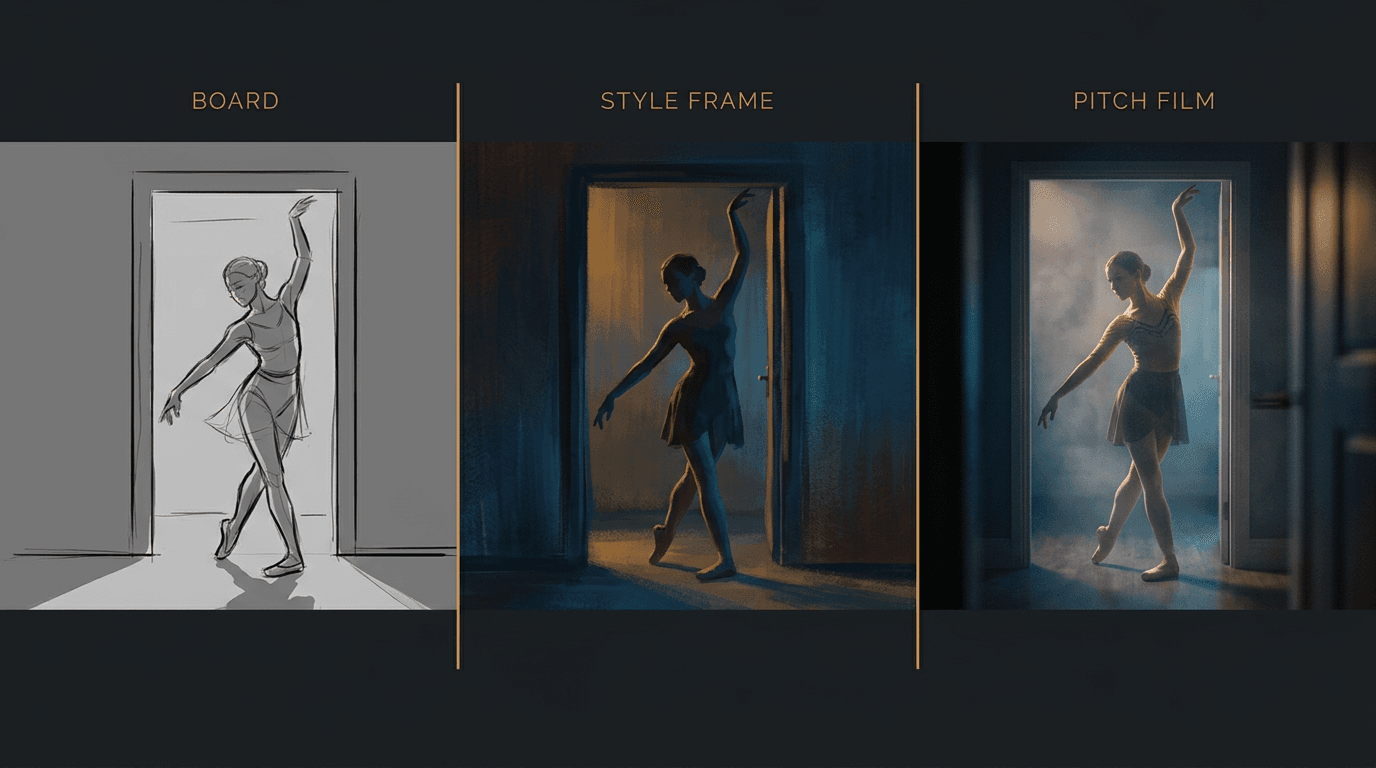
AI Previs vs 3D Previs and the Storyboard Artist
| Storyboard artist | 3D previs | AI previs | |
|---|---|---|---|
| Speed | Days per sequence | Weeks | Hours to days |
| Camera truth | Interpretive | Exact, real 3D camera | Approximate, improving |
| Final-look fidelity | Low by design | Low, rough 3D | High, close to finished frames |
| Cost profile | Day rate per artist | Specialist 3D modeling team | Subscription plus direction time |
| Best for | Comedy, dialogue, fast iteration on ideas | VFX-heavy action, stunts, virtual production | Pitches, brand films, tone and look decisions |
| Where it still wins | A great artist reads subtext | Physical accuracy for the first AD and stunt team | Nothing else shows the finished look this early |
3D previs remains the industry standard on VFX-heavy films for a reason. When you need to know whether the crane move clears the set piece, low-poly 3D assets in Unreal Engine will tell you the truth and a generated frame will confidently lie. Use both. They answer different questions, and the production decisions that hang off each one are different too.
The storyboard artist question deserves a straight answer as well, since it is the anxious subtext of every filmmaking thread about this. A generator does the volume work an artist drawing storyboards used to do under deadline. It does not do the thinking an artist does when they read a scene and find the one image that carries the subtext. The artists I know who are busiest right now are the ones directing the generation rather than competing with it.
What is the best AI tool for pre-visualization in film?
There is no single best one, and any list that claims otherwise is ranking affiliate links. Pick by the job: script breakdown tools for coverage, board-and-approval tools for team review, script-to-video platforms for animatics, and a multi-model generation stack when the pitch has to look like the finished film.
For the record, the AI tools that come up most in 2026 pre-production conversations are LTX Studio and Katalist for script-to-storyboard-to-animatic, Boords for collaborative boards and approvals, Filmustage for script breakdown, and Adobe Firefly Boards. They are good at what they do. Where they stop is direction, and that is not a criticism of them, it is a description of the category. A tool ships you frames. It does not sit in the room and defend a look.
What Makes a Pitch Film Win the Room
Consistency. Almost nothing else.
A pitch film loses when the face changes between shots, when the light comes from nowhere, when the grade drifts, when shot four is 35mm and shot five is a fisheye for no reason. Financiers may not have the vocabulary for it, but they feel the incoherence instantly, and what they conclude is that you have not thought it through. Visual storytelling is a promise that the person who made this can hold an idea steady for ninety minutes.
Some numbers from our own work, because I would rather give you the unglamorous truth than a workflow diagram. For Unmasked, our seven-minute short film about a Theyyam dancer and a Gen-Z vlogger, we generated between one and one and a half hours of footage. Only 5 to 10% of AI generations were usable. The climax visual effects beat, 15 to 20 seconds on screen, took 150 to 200 generated clips. The whole film ran about three months end to end and the first 20 to 25 days of that were spent purely writing the screenplay. It won Best AI Short (Gold) at the Bali International AI Film Festival, Best Film at AI Film Awards India, Best Cinematography at Indywood AI Cinefest, and Best Editing at the India AI Film Festival, with an Official Selection at Cannes World AI Film.
None of that is a story about prompting. As I have said before: AI filmmaking is not just prompt engineering, it is very much like an animation film process, and it is very tedious. 80% of the work is done at the scripting table.
The practical takeaway for a pitch is that the ratio holds at smaller scale. If you want two polished minutes, plan to make and throw away a great deal more than two minutes. Budget the selection time, not only the generation time.
Can AI make a realistic animated pitch film?
Yes, for most pitch purposes. A 60 to 120 second AI pitch film can carry photorealistic environments, consistent characters, real camera grammar, score and dubbed voice. Sustained emotional close-ups and exact product handling are still the weak spots, so smart pitch films cut around them rather than pretending.
Cutting around a weakness is a craft decision, and it is what a director does on a live set too. If the long emotional hold is the one thing the film is about, that is a signal to go hybrid production and shoot a plate for that beat rather than forcing the generation.
How to Use Previs Frames in a Pitch Deck
A pitch deck and a pitch film do different work, and I keep seeing people collapse them into one messy PDF.
The film is the argument. Two minutes, sound on, no talking over it. The deck is the follow-up, the thing that gets forwarded to someone who was not in the room. What belongs in the deck is a small set of frames chosen as visual reference, not a contact sheet of everything you generated. One frame that establishes the world. One that establishes the protagonist. One that shows the most expensive thing you are asking them to fund, so nobody is surprised later.
For indie filmmakers especially, this discipline is worth more than another twenty frames. A tight deck backed by a directed animatic reads as a filmmaker with a clear creative vision. Forty inconsistent AI-powered images read as somebody who found a tool. The room can tell the difference in about four seconds.
From Previs to Production, Reusing AI Assets Downstream
This is the part producers underestimate. In a traditional pipeline, boards get thrown away after the shoot. In an AI pipeline they do not, because the assets you built to visualize the film are the same assets you generate the film with.
Our production order on Unmasked was character sheets first, then environments and scenes, then character placement per camera angle, then prompted performance and movement, then a lip-sync pass, then upscaling. Everything in the first two stages is previs work. If you built the character sheet properly for the pitch, you do not rebuild it for production. The style frames become lighting references. The location concepts become environment plates. The animatic becomes the edit's spine, so the cut is already timed before a single final shot is generated.
The same assets keep paying out sideways as well. Locked character references make regional language variants straightforward, because the face and the world stay fixed while the performance and lip sync change. For VFX-heavy work, a pre-vis sequence doubles as the brief we hand our own compositors.
That is why I push clients to treat previs as the first stage of production rather than a sales expense. You are not paying twice. You are paying early. It is the same argument that runs through our AI film production guide, and it is the reason our pre-visualization work sits inside the production pipeline at Adwhyta rather than beside it.
Previsualization Best Practices for Filmmakers
Four best practices I would give filmmakers starting their first AI previs sequence this week, whether the project is a commercial, a short film, or a feature.
Lock the look before you generate volume. Every hour spent choosing a style after you have 200 frames is an hour of rework.
Generate wide, select narrow. Expect most of what you make to be unusable, because it will be, and budget the time accordingly instead of being surprised by it.
Cut to sound early. An animatic without audio always feels slower and worse than the film will actually be, and people react to that feeling rather than to your idea.
Do not show raw generations. We do not ship them, and neither should your pitch. One unpolished artifact in a two-minute reel is what the room will remember.
Commission an AI Pitch Film
If you have a script, a deck, or a campaign idea that keeps dying in the room, that is a visualization problem and it is fixable in days rather than months. We build pitch films, previs sequences, style frames, cast comps, and location concepts for directors, production houses, and brands, and the assets carry into production if the project gets made.
Book a 30-minute consult at adwhyta.com/contact, or watch what a locked look actually looks like in the Velocity Archive.
Frequently Asked Questions
What is an AI pitch film? An AI pitch film is a 1 to 2 minute cinematic animatic that visualizes a film, series, or commercial idea before physical production begins. It shows decision makers the exact tone, lighting, and pacing of the proposed concept rather than describing them.
Can AI pre-visualization match specific camera shots and angles? Largely, yes. Shot sizes, focal lengths, camera height, depth of field, and moves like pans and push-ins can all be directed into the generation. Precise physical camera geometry, the kind a stunt team needs, is still better answered by rough 3D previs.
How does AI pre-vis save money in actual production? By moving expensive decisions earlier. Visualizing complex stunts, lighting setups, or VFX-heavy sequences beforehand lets a crew resolve blocking and camera problems on a laptop instead of on a set day, where an hour of confusion costs a lot of money.
How much does an AI storyboard generator or pitch film cost in India? Tools run on monthly subscriptions in the tens of dollars. A directed pitch film is a production, so it is quoted like one, and it lands well below the cost of a traditional shoot for the same material. We do not publish a fixed band for pitch films; send the script and we quote against it.
Is an AI storyboard generator worth it? For fast internal iteration, yes, almost always. For anything a client or financier will see, the generator alone is not enough. What gets funded is a directed sequence with one consistent look, and that needs a filmmaker in the loop.
Written by MSN Karthik, Founder, Writer & Director at Adwhyta AI Studio. IIT Guwahati alumnus, co-founder of Zipy.ai, TEDx speaker, and award-winning AI filmmaker whose short Unmasked won 7 international AI film awards including Gold at the Bali International AI Film Festival. He once made a festival-screened sci-fi short for under $75.