Key Takeaways
- Generative AI in advertising is now table stakes: 87% of marketers use generative AI in recurring workflows (Salesforce State of Marketing 2026).
- McKinsey estimates generative AI could add roughly $463 billion a year in productivity to marketing and sales (McKinsey, The Economic Potential of Generative AI).
- The real use-case menu is 12 items long, and most brands' use of generative AI covers only two of them.
- The catch: consumer comfort with AI in ads fell from 57% to 46%. Craft, not creative volume, is what separates campaigns from slop.
Generative AI in Advertising: Cutting Through the Hype
Generative AI advertising is the use of generative artificial intelligence models that create new content (video, images, voice, ad copy, music) to concept, produce, adapt, and test marketing campaigns. It differs from the older machine learning that decides where ads run. In 2026, the use of AI spans the entire production chain, and brands use it far beyond image generation.
Full disclosure: I run an AI film studio, so I'm biased. But I'm also allergic to hype. Half the "AI is revolutionizing everything, agencies are dead" posts on LinkedIn come from people who've never shipped a real campaign with these generative AI tools. And half the dismissals come from marketers who stopped experimenting in 2024, back when faces still melted mid-frame.
The truth sits in the boring middle. AI is changing how ads actually get made, and brands using generative AI keep finding new corners of the workflow to hand it every quarter. It's also failing at specific things, predictably. The marketing teams that stay ahead are the ones who know which is which.
Here's the full menu.
12 Ways Brands Use Generative AI in Advertising Today
- Concepting and moodboards: AI-generated visual directions in hours instead of weeks
- Previsualization: rendering the film before you commit budget to it
- Style exploration: testing ten visual worlds for one script
- Casting comps: trying character looks before booking talent
- Full AI production: the finished commercial itself, generated end to end
- Versioning: one master film adapted into dozens of formats and variants
- Multilingual localization: dubbing and lip-syncing into new languages at scale
- Personalization and DCO: ad creative assembled per audience in real-time
- UGC-style ads at scale: creator-style content without creator logistics
- Creative testing velocity: twenty hooks tested where you used to afford two
- Revival campaigns: restoring or extending archive footage and past campaigns
- Synthetic audience research: pre-testing concepts on digital twins of consumers
Bookmark that list. Each use case below gets the same treatment: what it is, a real example, and who should care.
Use Cases 1–4: Concepting, Previz, Style Exploration, Casting Comps
These four live upstream of production, which is why finance teams love them. Nothing gets shot yet. Nothing gets wasted.
Concepting and moodboards. A creative team can now walk into a client meeting with thirty frames that look like the actual film, not stock photos with a prayer attached. Among all the AI in marketing examples I've seen land in a boardroom, this is the quietest and the most reliable. When we pitched our short film work, concept frames did the selling before a single shot existed.
Previsualization. This one changed our studio's economics more than any other use case. We render the whole film cheaply first, find the weak scenes, and fix them before real production begins. Our $75 sci-fi short "The Countdown" got to a Comic Con Hyderabad screening precisely because every rupee went into shots we'd already validated in previz.
Style exploration. One script, ten visual worlds, one afternoon. Painterly? Photoreal? Anime? Using natural language prompts you look at every direction before committing, instead of arguing about adjectives in a conference room.
Casting comps. Generating character looks (age, wardrobe, energy) before booking talent. Useful, with a caveat: likeness rights are a legal minefield, so keep comps synthetic and generic.
Use Cases 5–8: Production, Versioning, Localization, Ad Creative Personalization
The middle of the funnel, where the film gets made and multiplied.
Full AI production. The headline act of AI in advertising. Kalshi's NBA Finals ad was made by one person in about two days for under $2,000, against seven-figure traditional quotes (NPR). Our own AI video pipeline runs script to storyboard to generation to VFX-grade polish. As of mid-2026 that means a multi-model stack (Seedance with omni reference as the workhorse, plus Kling 3, Veo, and Nano Banana for character consistency), not a single prompt box. If you want the full process, I broke it down in how to make a commercial with an AI-first pipeline.
Versioning. One master film becomes a 6-second bumper, a 9:16 reel, a festive edit, and a retail-window variant. This used to be weeks of edit-suite time; now it's an automated workflow with a human editor approving output. See one idea, every channel for how we structure it.
Multilingual localization. Voice cloning plus lip-sync means the same actor convincingly speaks Hindi, Tamil, and English. For Indian brands running marketing campaigns across eight language markets, this alone can justify the whole AI budget. The ROI math is almost unfair.
Personalization and DCO. Dynamic creative optimization uses customer data to assemble ad variants per viewer in real-time: different product shots, offers, and voiceovers by segment. Amazon Ads and Adobe have pushed this hardest at enterprise scale, and it's where digital advertising gets genuinely AI-driven rather than AI-decorated.
Use Cases 9–12: UGC Scale, Testing ROI, Revivals, Synthetic Research
The unglamorous quartet. Also where the sharpest ROI usually hides.
UGC-style video ads at scale. Creator-style talking-head and demo content, AI-generated instead of briefed, shipped, and chased. We run this as a dedicated service (AI UGC video) because D2C brands burn more time on creator logistics than on strategy.
Creative testing velocity. My honest take: this is the single best reason for AI adoption, better than cost savings. When an extra variant costs a fraction of the original film instead of another full production budget, you test twenty hooks instead of two. Campaign performance stops being a debate and starts being a dataset, and conversion rates improve because you optimize campaigns on evidence instead of taste.
Revival campaigns. Restoring archive footage, extending old brand films, bringing a 1990s campaign back at modern resolution. Nostalgia is cheap fuel when the restoration isn't.
Synthetic audience research. The frontier use case. Brands pre-test concepts on digital twins (AI panels modeled on vast amounts of real consumer behavior data) before spending media money. Promising, but treat it as a filter, not an oracle: independent validation of how closely synthetic panels track real buying behaviour is still thin.
Beyond the Ad Film: Where Gen AI Fits the Wider Marketing Workflow
Not every win is cinematic. The unsexy AI applications around a campaign often pay for the sexy part, because their automation attacks the repetitive tasks that eat your team's week. AI helps most in the places nobody was ever going to hire a specialist for.
- Ad copy and headline variants drafted by AI, edited by humans, tested by the platform (the fastest advertising copy loop most teams have ever run)
- Product descriptions and product recommendations generated at catalog scale for retail and marketplace listings
- AI chatbots handling post-click questions, so paid traffic doesn't die on an unanswered FAQ
- Briefs, decks, and reports drafted with ChatGPT-class assistants to save time for actual thinking
None of this content generation wins awards. All of it compounds. The brands treating gen AI as a full-stack content creation layer, rather than a video toy, are the ones quietly pulling ahead, and new generative AI capabilities keep folding into these generative AI solutions almost monthly. Agentic AI is the next wave here: systems that don't just generate an asset but run the whole test-learn-iterate loop across channels with human checkpoints.
What's Overhyped: Where Generative AI Still Fails Advertisers
Time for the cold water. Three failure modes show up constantly.
Emotion is still hard. AI models render faces beautifully and feelings badly. Getting a performance that lands meant regenerating some shots of our award-winning short "Unmasked" far more times than any schedule budgets for. Most teams ship iteration three. That's how you get AI-generated content that reads as slop.
Consumers are noticing. Comfort with brands using AI dropped from 57% in Q3 2023 to 46% in Q3 2024 (MarketingCharts), and Kantar's Media Reactions 2025 found more than half of consumers worry generative AI will produce fake or misleading ads. The polarized reception of Coca-Cola's AI holiday campaign showed that "made with AI" is now a brand-safety variable, not a novelty (we broke down the famous cases here). Brand consistency and disclosure now matter as much as render quality.
Prompt boxes don't make films. A tool is not a film. Direction is. The gap between a raw generation and a broadcast-ready commercial is exactly the gap between an AI ad generator and an AI ad studio. Free tools will get you a clip. They will not get you a campaign.
Are there legal or copyright risks with generative AI advertising?
Yes, three big ones: training-data copyright exposure, likeness rights for anything resembling a real person, and disclosure rules (India's ASCI has draft AI-disclosure guidelines). Keep human review on every output, keep talent contracts explicit about AI use, and disclose when synthetic content could mislead.
Where Are Your Marketing Teams on the AI Adoption Curve?
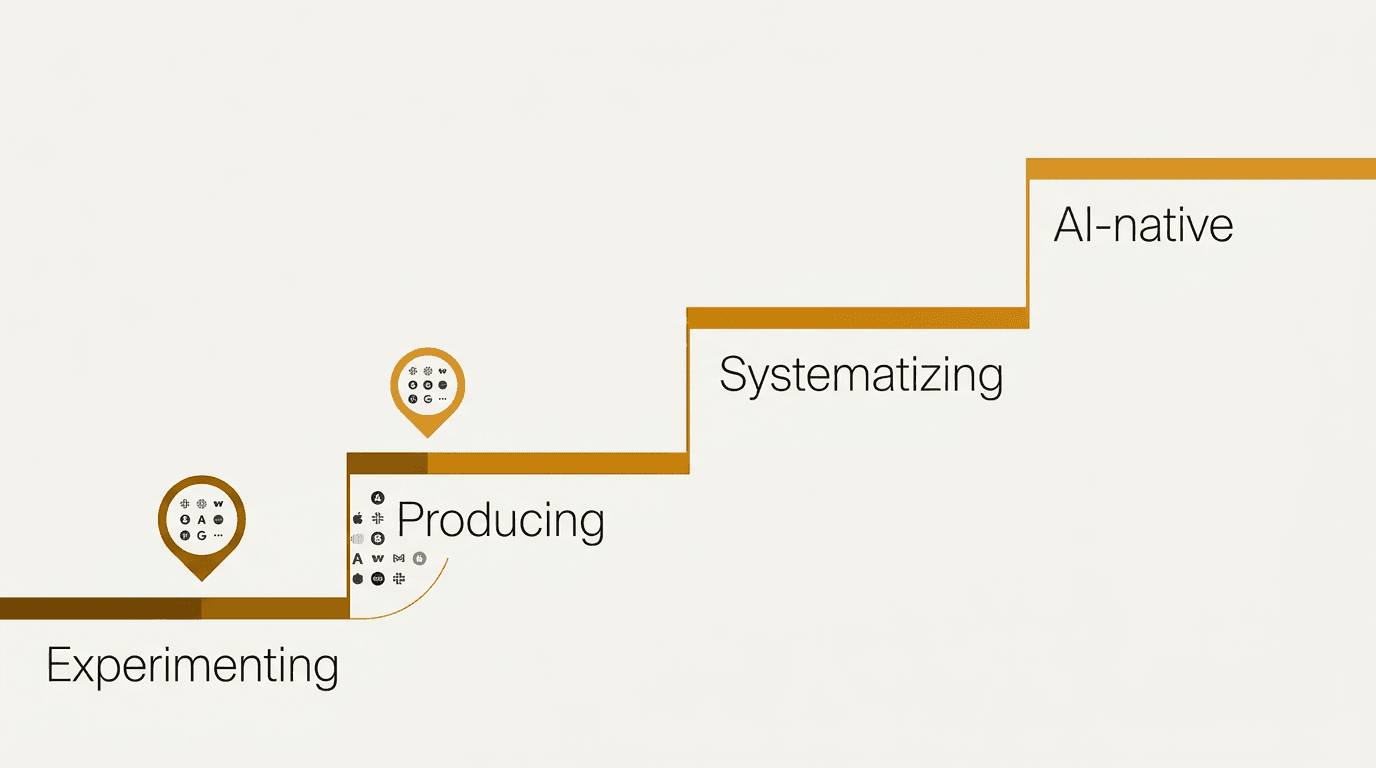
Every advertiser I've talked to this year fits one of four stages.
- Experimenting: someone on the team uses AI to create images for decks. No workflow.
- Producing: first real AI-generated ads shipped, usually versioning or UGC-style.
- Systematizing: AI is in the standing production process with QC gates and testing loops.
- AI-native: creative volume, testing, and localization all assume AI. Rare — a small minority of brands, in my experience across client conversations this year.
Most of the market sits at stage one or two. That's the opportunity: moving one stage ahead of your category is a genuine edge in 2026, and it won't be in two years, because new AI technology adoption curves flatten fast once the laggards panic.
Building Your Generative AI Advertising Roadmap
Skip the enterprise transformation deck. Your marketing strategy needs five moves, in order:
- Pick one use case from the list, not five. Versioning or UGC-style ad creation are the safest first wins.
- Run a paid pilot on one live campaign with a real KPI, not a demo.
- Set a craft bar: a named human approves every AI-powered output. No raw generations ship.
- Add testing velocity once production works. This is where ROI compounds and marketing efforts stop guessing.
- Then go strategic: scale AI across channels with localization, personalization, and synthetic research, in that order.
If you want the full strategic picture first, start with our AI advertising playbook for brands. And if you'd rather commission than build in-house AI capability, that's literally what we do.