Last updated: 2 August 2026
The first question every brand asks us about AI video is some version of the same thing. "If it's AI, does that mean no actors?"
No. Not unless you want it to be.
The version of AI production that most working studios actually deliver in 2026 keeps real people in front of a real camera, and generates everything behind them. That approach has a name now, and it is showing up on Hollywood call sheets.
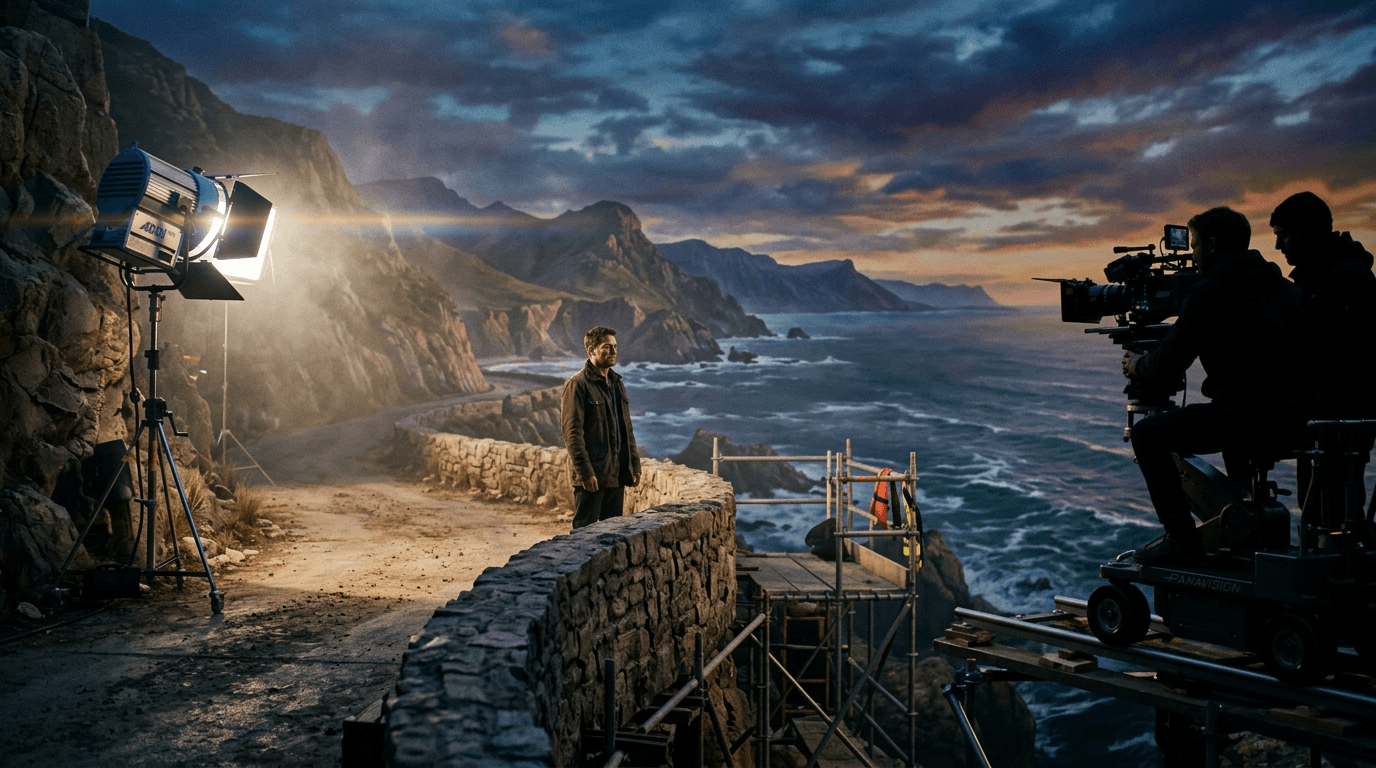
A hybrid AI film is a production that shoots real actors and real cinematography, then uses generative AI to build the environments, visual effects and set extensions around that footage. The human performance is captured. The world it happens in is generated.
Key Takeaways
- Hybrid film production combines live-action footage with AI-generated environments, VFX and set extensions inside one directed pipeline. Nothing about it requires you to give up a real face on camera.
- As of August 2026 the flagship example is Terrarium, a horror feature from producer Steven Schneider with Artlist and Secret Level, running what the partners describe as a DGA and SAG-AFTRA compliant hybrid workflow (Deadline, May 2026).
- The commercial case is simple. You pay for a small practical set and a short shoot day, then generate the world that would have cost you a location, a build, or a VFX bid.
- Hybrid is not a compromise position. It buys back the thing generative video is still worst at, which is one specific human face carrying one specific emotion across a whole scene.
- Full AI still wins on non-human worlds, impossible geography and campaigns with no shoot budget at all. We say where, below.
What Is a Hybrid AI Film?
A hybrid AI film blends real footage with generated imagery. Real actors, real lenses and real light supply the performance. Generative AI supplies environments, crowds, creatures, set extensions and effects that would otherwise need a location, a build or a full VFX bid. One director controls both halves of the film.
The clean way to think about it is to separate two questions that traditional filmmaking always answered together. What gets captured? What gets constructed?
Every film has always done some of both. A matte painting behind an actor in 1935 was a hybrid shot. So was every green-screen composite since, and so is most CGI work in any blockbuster you have watched this decade. What changed is the cost and the speed of the construction half. Building a photoreal alien coastline used to mean a VFX vendor, a bid, and four months. Now it means reference images, a model, a lot of selects and a compositor.
Put plainly: a hybrid film uses AI for the world and a camera for the people. Traditional production does the opposite, building the world physically and photographing all of it.
One quick disambiguation, because it costs people time. In the events and corporate video world, "hybrid production" means an in-person shoot streamed to a remote audience. That is a different thing entirely. Everything on this page is about the AI sense of the term.
Hybrid AI Filmmaking vs a Fully Generative AI Film
A fully generative AI film has no camera in it. Faces, bodies, rooms, weather, all of it comes out of a model, guided by prompts, reference images and a lot of iteration. A hybrid AI film has a shoot day.
The difference matters most in close-up. A generated face can be extraordinary in a single shot and inconsistent across twelve. A captured face is the same face every time, because it belongs to a person who was standing there.
The Hybrid Spectrum, From Full AI to AI-Assisted Live Action
Hybrid is a range, not a setting. Where a project sits on it should be a budget decision and a story decision, in that order.
| Position | What gets captured | What gets generated | Suits |
|---|---|---|---|
| Fully generative AI film | Nothing | Everything | Non-human worlds, mythology, stylised brand films, zero shoot budget |
| Hybrid, generation-led | Faces and hero performance only, often on a clean stage | Environments, crowds, creatures, most effects | Brand films needing one recognisable human and an impossible world |
| Hybrid, capture-led | Full scene on a small practical set or location | Set extensions, sky replacement, background depth, VFX beats | Ads with product handling, testimonials, anything with physical interaction |
| AI-assisted live action | Everything | Nothing new. AI does cleanup, grading, rotoscoping, dubbing | Conventional shoots wanting post-production savings without a visual change |
Most of what gets sold as "an AI ad" in 2026 sits in the middle two rows. That is the useful part of the range, and it is where our work sits too.
How Does Hybrid Film Production Work?
Hybrid film production runs in five stages: write and previsualise the scene, shoot the live-action plates against a clean or minimal set, generate the environments and effects from reference material, composite the two together, then grade and finish so both halves share one look. Direction, not AI generation, is where the time goes.
- Write and previsualise. Storyboard the scene, then build a rough animatic so everyone can see which elements will be captured and which will be generated before a single rupee is spent on set.
- Shoot the plates. Real actors, real lenses, controlled light. The plate is the anchor: the piece of genuine footage everything else has to match.
- Generate the world. Environments, extensions, crowds and effects are generated from reference frames, with the plate's lens, light direction and colour as the brief.
- Composite. Generated material is tracked, matted and layered against the plate. This is ordinary VFX work, and it is where most hybrid shots are won or lost.
- Grade and finish. One grade over both halves, plus sound design, so the seam disappears.
Plates, Performance and Generative Environments
The word "plate" does a lot of work here. A plate is footage shot specifically so that something can be added to it later. On a hybrid shoot the plate is usually an actor on a small practical set, a clean stage, or a partial build that covers only what the camera sees in the foreground.
That partial-build approach is the practical heart of hybrid, and it is more common in 2026 than a full chroma stage. Studios document extending a small studio pool into open ocean and an eight-foot cave wall into a full cave system (Axis AI Studios). The physical set only has to be real where the actor touches it.
Chroma still has a role, especially for full replacements, and we cover when it earns its keep in green screen and compositing in the AI era.
How Live-Action Footage and AI Generation Combine
The combine step is the one people picture least accurately. They imagine a model being handed a video file and returning a finished shot. What actually happens is closer to old-fashioned visual effects with a faster asset factory bolted to the front.
Your live-action footage goes in with its own physics already baked: a lens, a sensor, a grain structure, a specific direction of light, and the tiny handheld drift of a real operator. Anything generated has to inherit all of that or the eye rejects it. So the generated environment is matched for perspective, tracked to the camera move, matted at the edges, colour-matched, then degraded slightly so it sits in the same optical world as the plate.
That last step is counter-intuitive and it is where a lot of AI work fails. Generated imagery often arrives too clean. Real footage has flaws, and the composite only holds when both halves share them.
The Hybrid Workflow, Stage by Stage
The stage order above is the same one we run internally, and it is a subset of the wider AI film pipeline. Two things surprise people the first time.
The shoot is short. When most of the environment is generated, a day of principal photography can cover what a location schedule would have spread over three.
Post-production is long. Not because the tools are slow, but because selection is slow. More on that in a moment, with real numbers.
Hybrid Production vs LED-Volume Virtual Production
Both put a real actor inside a world that does not exist. An LED volume renders that world live on a wall so the camera photographs it in-camera. Hybrid AI production generates it afterwards and composites it in. The volume buys certainty on the day. Hybrid buys iteration after it.
Virtual production earned its reputation for good reason. Shooting against a real-time rendered environment on LED gives actors something to react to, gives your DP interactive light, and gets you a near-final frame in camera. It is also expensive and it front-loads every decision.
| LED-volume virtual production | Hybrid AI production | |
|---|---|---|
| Stage cost | Vendor-published 2026 rate guides put volume day rates roughly between $7,000 and $50,000 depending on wall size and crew (Vitrina) | A modest practical set or clean stage, at conventional studio rates |
| Lead time | Environments must be built and validated before the shoot day | Environments generated after the shoot, in parallel with the edit |
| Changing your mind | Expensive, because the wall content is locked to the schedule | Cheap, because you regenerate the background against the same plate |
| In-camera realism | Interactive light and real reflections | Light must be matched in the grade and the composite |
| Best for | Vehicles, driving, moving light, long dialogue in one world | Environments that need to change, scale, or be invented late |
The market data says both are growing. Virtual production was valued near $3.67 billion in 2026, with LED-volume stages the fastest-expanding segment at over 30% a year (Mordor Intelligence). Hybrid AI production is not replacing volumes. It is giving projects that could never afford a volume day the same creative freedom, later in the process.
When Hybrid Beats a Full AI Film (and When It Doesn't)
Full disclosure: we are an AI studio, so treat what follows accordingly. We still turn down hybrid when the project does not need it.
Go hybrid when: the film depends on one recognisable human face, when a product has to be physically handled on camera, when a brand ambassador is contractually the point, or when your legal team needs a clean chain of consent for every face on screen.
Go full AI when: there are no humans in close-up at all, when the world is the star, when the schedule is measured in days, or when the shoot budget genuinely does not exist. Our own award-winning short film work sits here, and it works.
Stay conventional when: the whole film is two people talking in a room you can already afford. Artificial intelligence adds cost and risk to a scene that a camera solves in an afternoon. Nobody sells you that answer, which is why it is worth writing down.
Anatomy of a Hybrid Scene, Real Footage and CGI Shot by Shot
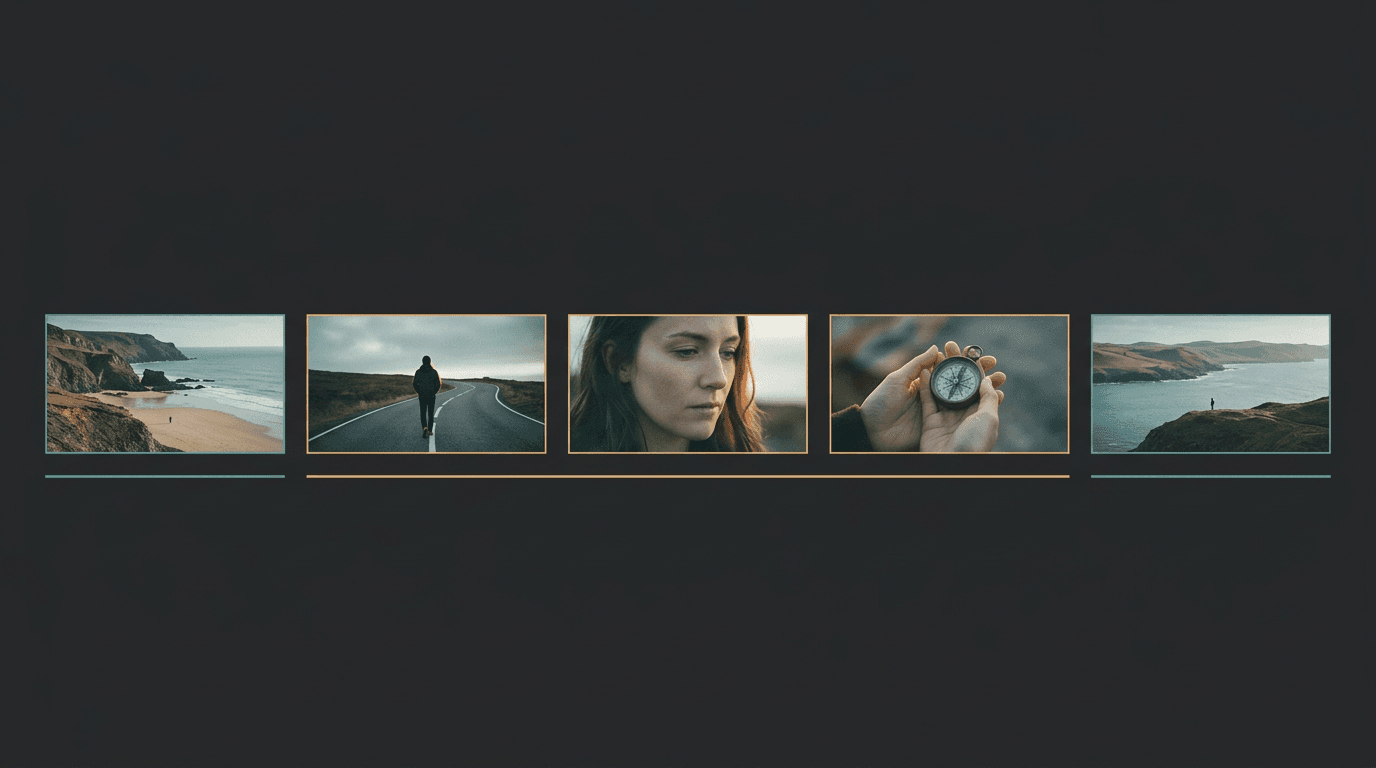
Take a thirty-second brand film. A founder walks out of a workshop onto a cliff road at dusk, holding the product, and says two lines.
- Wide establishing shot. Fully generated. No face is readable at that distance, so nothing needs to be captured. The cliff road never existed.
- Medium shot, founder walking. Plate. Shot on a six-metre practical section of road with real light. Everything past the shoulder of the road is a generated extension.
- Close-up, dialogue. Plate, untouched. This is the shot the entire budget exists to protect.
- Insert, hands on product. Plate. Physical interaction is the single hardest thing for a model to fake convincingly, and clients notice.
- Final drone-style pull-back. Fully generated, with the founder as a small figure. Distance hides the tell.
That gives you a simple decision rule, and it is the one we actually use. If the viewer reads the element as a face, shoot it. If they read it as a body in motion, test both. If they read it as a place, generate it.
Note what this does to a shot list. Two of five shots carry real footage of a person. The other three carry a generated environment. The film still reads as photographed, because the shots that hold a human gaze are the photographed ones.
What Hybrid Filmmaking Changes for Actors, DOPs and Directors
Actors keep their job, and gain a strange new one: performing to something that is not there yet, with more precision than a green screen ever demanded. Terrarium is being run as a DGA and SAG-AFTRA compliant production (PR Newswire, May 2026), which matters more than any model release this year. Hybrid workflows that respect union frameworks are the ones that will scale.
Cinematographers gain the most control. The lens, the light direction and the contrast ratio of the plate become the specification the generated half must match. A DP who lights with intent gives the generation stage a target. A DP who lights flat gives it nothing.
Directors carry the whole burden. You are directing performance and curating a very large pile of generated options, which is a different muscle from any traditional filmmaking job. Creative direction stops being a set of instructions and becomes a filter you apply a thousand times. Here is the number nobody publishes.
On Unmasked, our seven-award short film, we generated between one and one and a half hours of footage for an eight-minute film. Only 5 to 10% of AI generations were usable. A single climax effect running 15 to 20 seconds on screen took 150 to 200 generated clips. The whole film took about three months, and the first 20 to 25 days went entirely to writing the screenplay.
The hybrid parts of that film are the ones people ask about least and learn from most. My wife, a trained classical dancer, performed the dance sequences that drove the AI motion capture. I performed the action sequences myself. Real human movement, captured, then carried into generated characters. That is hybrid at the performance layer rather than the background layer, and it is why the movement reads as human rather than as an approximation of human.
As the founder line goes: AI filmmaking is not just prompt engineering. It is very much like an animation film process, and it is tedious.
Are Hollywood Directors Using Generative AI?
Yes, and increasingly on the record. Netflix used generative AI for final footage in El Eternauta in 2025. Producer Steven Schneider announced the hybrid feature Terrarium with Artlist and Secret Level in May 2026. Natasha Lyonne is directing Uncanny Valley, a hybrid feature that uses a model trained on licensed material.
Netflix is the clearest data point. For El Eternauta, released April 2025, the team generated a building-collapse sequence in Buenos Aires using in-house tools at Eyeline Studios. Co-CEO Ted Sarandos said the shot came together roughly ten times faster than a conventional VFX workflow, and that the cost would not have been feasible on the show's budget otherwise (Interesting Engineering).
Terrarium is the studio-scale version. Written and directed by Jason Zada, produced by Christina Lee Storm for Secret Level, with Artlist financing and executive producing, it runs the Artlist AI platform inside Secret Level's own filmmaking pipeline. The partners call it Hollywood's first AI-hybrid feature. Treat that superlative as their framing rather than settled fact, but the workflow claim is the interesting part.
Uncanny Valley is the ethics-forward version. Natasha Lyonne directs, co-writing with Brit Marling, produced through Asteria and Animal Pictures, using Moonvalley's Marey model, which its makers say was trained only on licensed content (Variety).
Three different studios, three different postures, one shared choice: keep the humans, generate the rest. If you want the running record of who is doing what, we keep a monthly page on the state of AI filmmaking.
What Are the Benefits of Hybrid Filmmaking?
Hybrid production cuts the cost of the world without cutting the cast. Locations become generated, builds shrink to what the camera touches, and reshoots of a background no longer require a crew. Emotional performance stays real, which is what keeps a film from feeling synthetic.
The gain is not only money. It is the ability to change your mind after the shoot. A generated background can be revised in a day, in the edit, with the client watching. Try that with a location.
It also widens what a mid-budget brand can attempt. Hybrid does not transform your budget so much as it transforms what the budget can buy. Periods, weather, scale and geography stop being budget lines. That is genuine creative freedom, and the innovation that matters here is commercial rather than technical: a category of cinematic idea that used to be unaffordable is now quotable. After four years of working with these models I still find that remarkable.
One honest caveat on cost, from our own experience of quoting these projects. AI compresses production cost, not every cost. A film that would have cost Rs 500 crore becomes feasible at roughly Rs 5 to 10 crore, not at Rs 5 lakh. Writing, music, sound, edit and the intellectual labour of direction do not compress at all. Anyone quoting you otherwise is selling you a demo, not a film. There is more on where the savings genuinely land in our AI versus traditional video production comparison.
Why Hybrid Production Protects Emotional Storytelling
This is the part I care about most, so read it as a position rather than a fact.
The reason audiences flinch at bad AI content is almost never resolution. It is that nothing in the frame is having an experience. Faces hold the wrong expression a beat too long, eyes track nothing, and a viewer's threat-detection wiring notices before their taste does. Consumer research has been moving in exactly that direction. Comfort with brands using AI dropped from 57% to 46% between 2023 and 2024, and 57% of consumers say they worry about fake AI ads, according to consumer research reported by MarketingCharts in 2024.
That does not mean audiences reject the technology. It means they reject the absence of a person in it.
A hybrid production puts the person back in the only place a viewer checks: the face during the emotional beat of the scene. Everything else, the sky, the crowd, the burning building, is set dressing that generative AI is genuinely good at now. This is why we argue that craft and creativity, not model choice, decide whether an AI film works, and why we wrote a whole guide to avoiding AI slop.
Storytelling is not a rendering problem. It never was.
Hybrid Short Films, Brand Films and Other Formats That Fit
The hybrid format suits some briefs far better than others. In our own work the pattern is consistent.
Brand films with a founder, an ambassador or a customer on camera are the strongest fit, because the whole point is a specific human. Product video production works well when hands touch the product for real and the environment around it is invented. Short film and narrative work fits when the story needs one impossible place and a handful of real faces. Music videos and mood pieces often do better fully generated, because nobody is checking a face for micro-expression.
Testimonials and interviews mostly should not be hybrid at all. If someone is telling the truth to camera in a real office, shoot the real office.
The other honest limit is duration. Long dialogue scenes in a single generated environment are still hard, which is exactly the case an LED volume was built for.
The AI Tools and Models Behind a Hybrid Studio Pipeline
No single tool does this. A hybrid production pipeline is a stack, and the stack changes.
As of August 2026, the video models doing serious work are Seedance 2.5 from ByteDance, announced in June 2026, Google DeepMind's Veo 3.1, and Kling 3.0 from Kuaishou, released in February 2026 (comparison, July 2026). One correction worth making because half the internet has not caught up: stop planning around Sora. OpenAI closed the Sora app in April 2026 and is deprecating the Sora 2 API in September 2026 (OpenAI deprecations).
Our own stack, for the last six months or so, has leaned on Seedance with omni reference for character and style consistent generation, alongside Kling 3, Veo, Nano Banana, Seaweed 2, Hailuo and Runway. Voice and dubbing run through ElevenLabs plus a multi-tool lipsync pass. Score comes from Suno plus original composition. A custom multi-model stack, not a single prompt box.
The churn is real and it is the actual cost of this work. The workflows we built in 2024 did not work in 2025, and our 2025 workflows do not work today. Any new hybrid studio quoting you a fixed pipeline is quoting you a pipeline that expires. Character consistency, not resolution, is still the binding constraint on the whole filmmaking process, which is why we wrote a separate piece on character consistency in AI video.
If you want the vocabulary behind the compositing half of all this, start with what VFX actually is and the deeper AI VFX guide.

How to Plan Your First Hybrid Video Production
- Decide the face question first. Does this film need one specific human, recognisable across shots? If yes, you are shooting a plate. Everything else follows.
- Previsualise before you book anything. A rough animatic settles the shoot list. See AI previsualisation and pitch films.
- Build only what the camera touches. Six metres of real road, not a real road.
- Light with intent. Give the generation stage a lens, a key direction and a contrast ratio to match.
- Budget the selection time, not the generation time. Assume you will look at far more material than you use.
- Settle rights and consent up front. Every face, voice and likeness needs a paper trail, and the rules on synthetic likeness are tightening. We cover the Indian position in AI filmmaking ethics and copyright, and the wider question of synthetic performers in AI actors and digital humans.