AI animation is generative production, not a filter. At Adwhyta, an AI film studio with 7 international AI film awards in 2026, we use it to make animated films at a fraction of traditional animation budgets. The global AI video market hit roughly $847M in 2026 (Fortune Business Insights). Here's how it actually works.
Key Takeaways
- AI animation uses generative models to produce animated footage from scripts, designs, and reference art, cutting production cost dramatically versus traditional 2D animation and 3D animation pipelines.
- The quality ceiling isn't the model. It's consistency and direction. An AI animation video generator makes gorgeous single shots. Studios make 60 shots that belong to the same film.
- Cost snapshot: AI generation alone runs roughly $20-220 per finished minute. AI-plus-studio hybrid work runs about $100-2,000+, traditional 2D runs ~$1,500-25,000, and traditional 3D can pass $50,000 (industry cost-guide aggregates).
- Our verdict: use a generator for throwaway social clips. Commission an AI animation studio the moment a character has to survive more than a handful of shots with your brand attached.
AI Animation in 2026: State of the Art
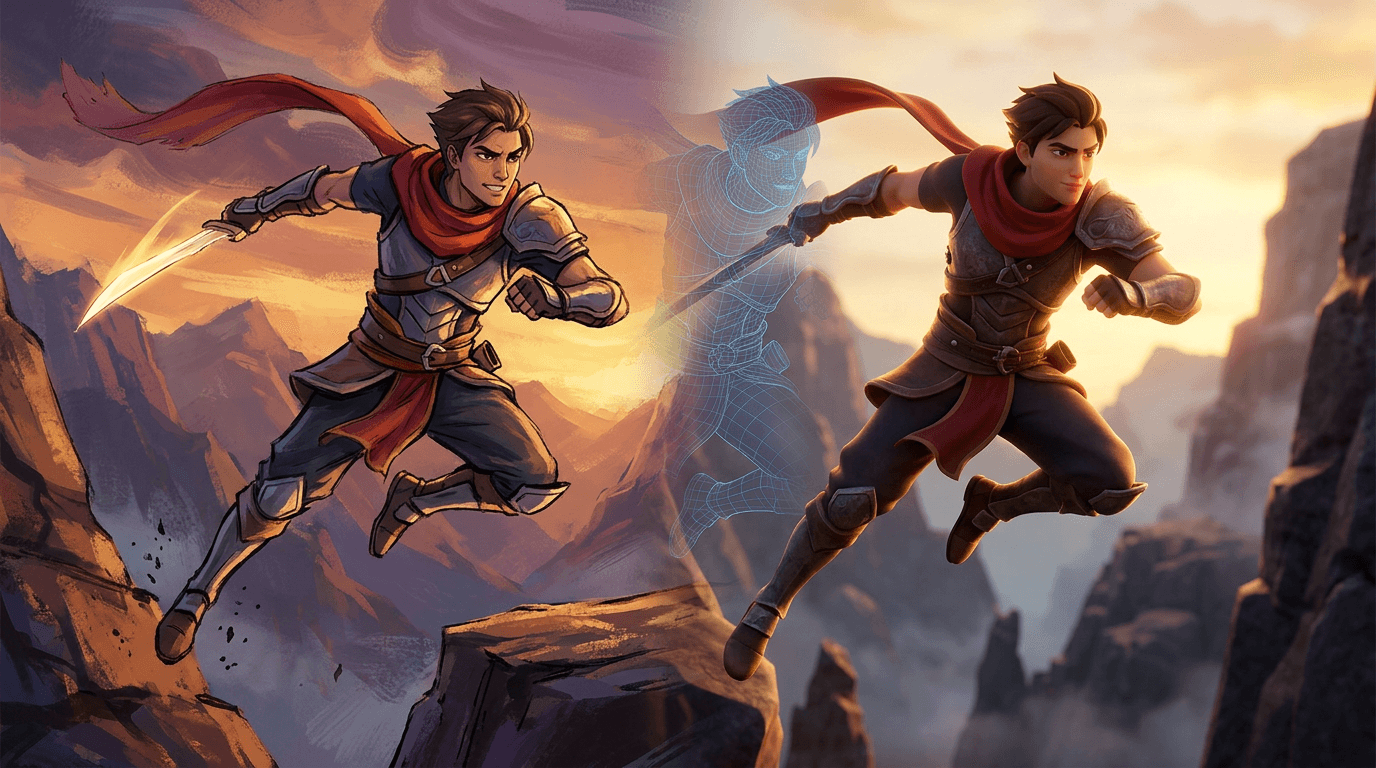
AI animation is the use of generative models to create animated video from text prompts, reference images, and motion direction instead of frame-by-frame drawing or 3D rendering. It compresses months of traditional animation work into weeks, and in 2026 it produces broadcast-usable results when a directed workflow controls style and character consistency.
What that means in practice, as of mid-2026:
- AI video generation models like Seedance, Kling, Veo, and Hailuo generate moving footage from stills and written direction
- Image models (Nano Banana is our current pick for character work) create the character sheets and style frames those video models animate
- A single artist-animator can now produce what needed a 10-person team in 2020
- The failure mode changed: shots rarely look "bad" anymore, they look unrelated to each other
- 87% of marketers already use generative AI in recurring workflows (Salesforce State of Marketing 2026), so animated content made with AI is competing on craft now, not novelty
Here's the part most 2026 guides get backwards. The real AI animation 2026 story isn't that the models got better. They did, but that's not why the good work suddenly looks so good. The story is that workflows grew up around the models. The studios producing watchable AI animation aren't prompting harder. They're running reference systems, style bibles, and edit discipline that no ai animation video generator gives you out of the box. Machine learning gives you frames. It doesn't give you a film.
A quick vocabulary note, because the search results blur it. An AI animation video generator is software: you type, it renders videos from text prompts. An AI animated video is a finished deliverable: story, style, sound, edit. A production workflow is what turns the first into the second. Most of the disappointment people report with AI animation comes from expecting the software to be the whole production.
When we made the Gibbon's Grove AI teaser, a stylized 3D piece in our portfolio, the generation itself was the fast part. The slow part was everything a traditional animation director would recognize: locking the look, rejecting shots that broke it, cutting for rhythm. That ratio hasn't changed since. If anything it's grown.
If you're coming at this from live-action or VFX, our AI film production guide and what is VFX explainer cover the neighboring territory.
AI Animation Styles That Work in 2026: 2D, 3D-Painterly, Anime, Stop-Motion Look
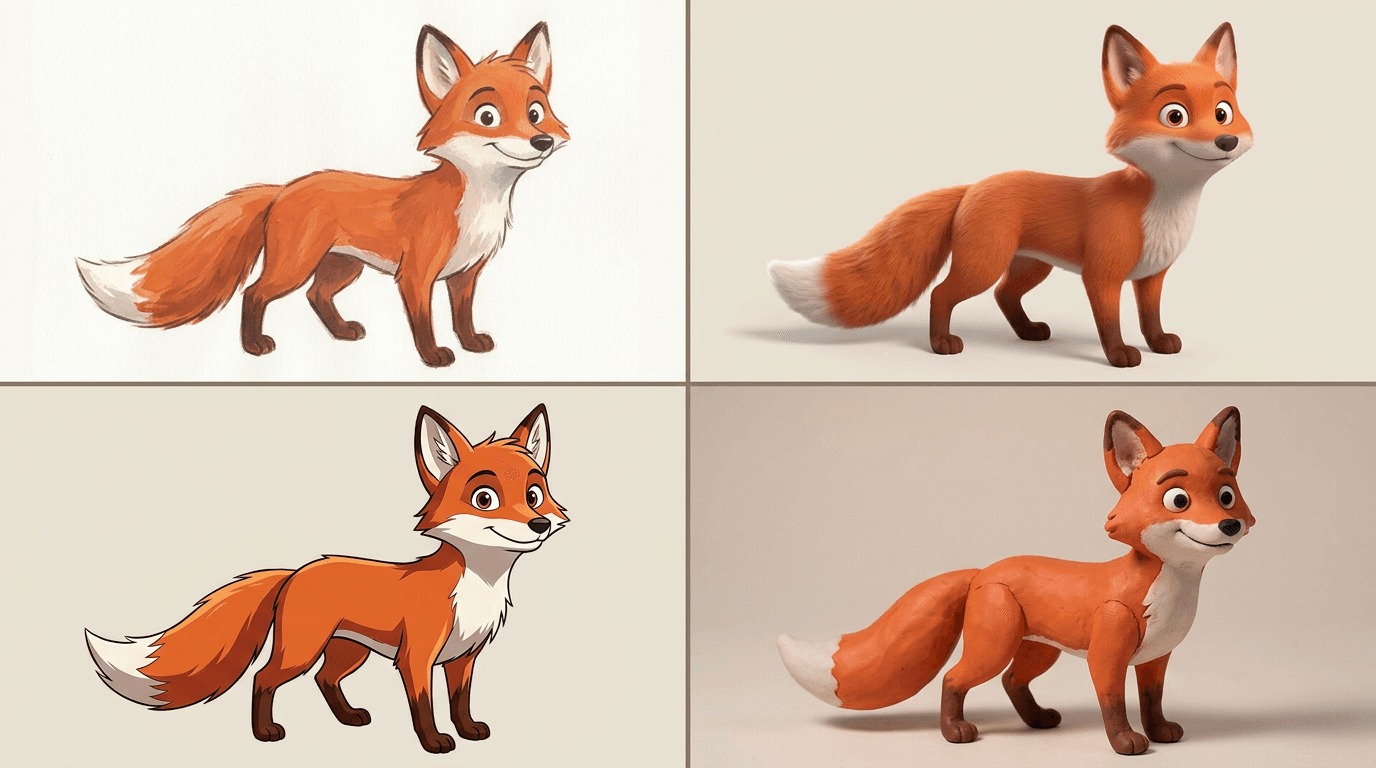
AI animation currently performs best in four style families: painterly 2D animation, stylized 3D animation (the animated-feature look), anime, and a stop-motion aesthetic. Each has different failure modes, so professional studios choose animation styles by how visibly they break under drift, not just by how they look in a frame.
That last sentence is the actual decision rule, so let me expand it.
Painterly 2D animation. Forgiving and gorgeous. Brush texture hides small inconsistencies between frames, which is why so much of the finest AI animation you've seen is painterly. The catch: mouths and hands. Dialogue-heavy 2D needs real cleanup passes.
Stylized 3D animation. The Pixar-adjacent look. This is what we built for Gibbon's Grove. Audiences hold it to a feature-film standard, so lighting continuity and eye behavior matter enormously. When it drifts, everyone notices.
Anime. Strong model support and a huge reference corpus, which makes the anime style easy to hit and easy to hold. The risk is generic sameness: default AI anime looks like everyone else's default AI anime. You need a deliberate style wedge. We break down how studios push past the default look in our AI anime and stylized animation piece.
Stop-motion look. The sleeper. The stop-motion aesthetic expects slight imperfection between frames, jitter reads as charm rather than error. Lovely for brand work that wants craft warmth, and surprisingly strong for an ai cartoon video aimed at younger audiences, where handmade texture beats gloss.
Deliberately not on this list: photoreal humans. That's film work, not animation, and it plays by harsher rules. Full disclosure, it's also where our VFX practice lives, so we're opinionated about keeping the two separate.
Choosing between 2D, 3D, and AI-hybrid approaches for an actual project brief is its own decision, and the honest answer to "2D vs 3D animation" changes once AI enters the comparison. We've written a full 2D vs 3D vs AI animation comparison for that call.
How Insanely Good AI Animation Is Actually Made (Our AI Video Production Workflow)
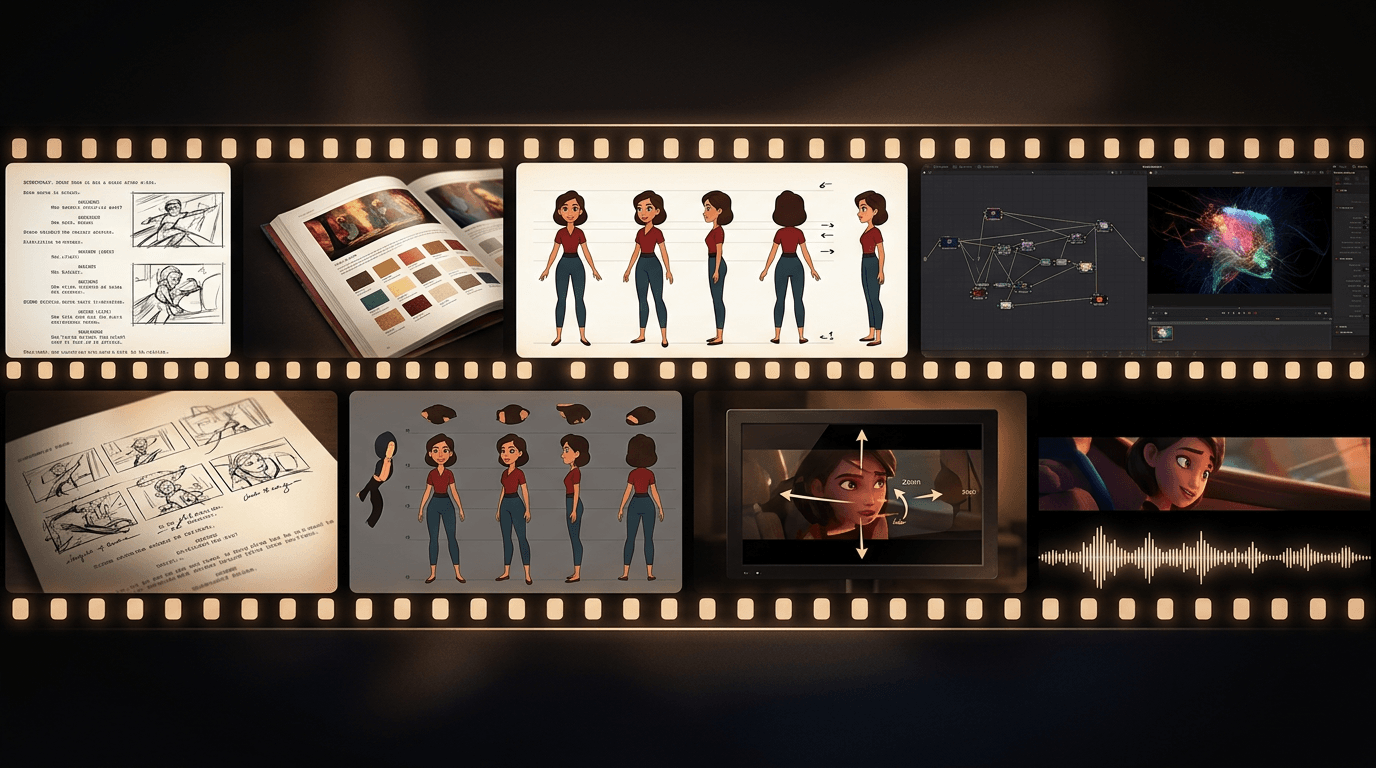
Professional AI animation is made by a directed workflow: script and boards first, then a locked style bible and character references, then multi-model generation (image models for design, video models for motion), then edit, sound, and VFX-grade polish. Generation is one step out of six, not the production process itself.
The version we run, the one behind an awards run of 7 international AI film wins, looks like this:
- Script and boards. Storytelling first, always. "Technology is a servant of narrative structure," as our founder puts it. No board, no generation.
- Style bible. Palette, brushwork or render language, lighting logic, lens behavior. Locked before shot one.
- Character locks. Character creation happens once, on purpose, not fifty times by accident: reference sheets plus our proprietary face, style, and lighting models so a character survives every angle and scene.
- Generation. A custom multi-model stack. Not a single prompt box. As of mid-2026 that means Seedance with omni reference as the workhorse for character- and style-consistent shots, Nano Banana for stills and reference frames, and Kling, Veo, and Hailuo picked per shot for what each is actually good at. (Our 2024-era ComfyUI and Flux rigs are museum pieces already. Stacks here get rebuilt yearly, which is its own lesson.)
- Motion direction. Performance notes, camera grammar, shot timing. Where a performance needs human weight, we use motion capture through Kling's motion capture tools and Runway rather than hoping a prompt lands it. We direct generations the way you'd direct actors, and we throw most takes away.
- Post. Edit rhythm, sound design (ElevenLabs and Suno feed our voice and music passes), lip-sync cleanup, compositing, 4K finishing. We don't ship raw generations.
Style bibles, character locks, motion direction
These three are the pillars, so they deserve their own beat.
A style bible is the contract every shot signs. Without one, each generation quietly negotiates its own look and your film becomes a mood board. A character lock is reference architecture: sheets, trained identity references, and rules for how a face catches light. Motion direction is the unglamorous one. Models will happily give you floaty, weightless movement forever. Traditional animation solved this with the twelve principles and armies of inbetweeners. AI solves nothing here by itself. Someone with taste has to say "again, but heavier," and sometimes the right answer is transferring real human movement in through motion capture instead of generating it.
I'll be honest about what surprised us when we formalized this: the workflow didn't make generation faster. It made rejection faster. Knowing precisely what the film looks like means you can kill a wrong shot in seconds. That's the real speed advantage, and it's why production time compresses even when iteration counts don't.
The step-by-step method, with the practical settings and sequencing, lives in how to make insanely good animation using AI.
AI Animation Generators vs Studio Production: The Quality Ceiling
AI animation generators produce impressive single shots in minutes but cannot hold character, style, and story across a full film. Studio production wraps the same models in reference systems, direction, and post, which is why professional AI animation still costs 5-10x tool subscriptions and still wins the work that matters.
Time for the uncomfortable claim this whole guide has been building toward.
AI didn't really lower the cost of good animation. It lowered the cost of bad animation. The generation layer, the part the AI tools sell you, now runs as little as $20-220 per finished minute (industry cost-guide aggregates). That's the cheapest line item in the entire production. What still costs real money is everything the subscription can't include: taste, direction, iteration, and the discipline to reject 40 nearly-right shots. Good animation got cheaper too, but by maybe an order of magnitude. Bad animation got cheaper by three or four. Which is exactly why you're drowning in it.
The market has already voted on this. Consumer comfort with brands using AI fell from 57% to 46% between 2023 and 2024 (Attest consumer AI research), and 57% of consumers worry about fake AI ads. People aren't rejecting artificial intelligence. They're rejecting slop. That gap between "generated" and "crafted" is the entire premium studio thesis, and honestly, it's why Adwhyta exists.
There's also a quieter reason the tool-only route stalls for brands. AI animation software is genuinely improving at single-shot quality, so the demo you see keeps getting better. But a brand film is a chain of dependent shots. Every extra shot multiplies the odds that one of them breaks character, palette, or physics, and one broken shot is what viewers screenshot. Tools improve frames. Systems protect films.
| AI generator (DIY) | AI animation studio production | |
|---|---|---|
| Single-shot quality | High, often stunning | High, plus art direction |
| 30+ shot consistency | Breaks: character and style drift | Held by style bibles and character locks |
| Story and edit rhythm | Yours to figure out | Directed: screenwriting, camera grammar, cut discipline |
| Sound and music | Stock or bring-your-own | Designed score, voice, mix |
| Cost per finished minute | ~$20-220 (generation only) | ~$100-2,000+ (hybrid, style-dependent) |
| Best for | Social experiments, short video clips | Brand films, series, animated ads, anything with a recurring character |
Are we biased? Obviously. We're a studio. But notice we're not telling you tools are weak. Seedance and Veo are genuinely powerful, and we use them daily. A tool is not a film. Direction is. If you want the studio-side detail of what commissioning looks like, that's our AI animation studio services page.
AI Animation Tools in 2026: How to Read the "Best AI" Lists
Every "top AI animation tools in 2026" list sorts products into three buckets: generative video models (Seedance, Sora, Veo, Runway, Hailuo), avatar platforms for talking-head and training videos, and AI-assisted editing tools inside traditional software. Which bucket you need depends on whether you're making content or making a film.
We don't publish tool rankings, and this pillar isn't about to become one. But the search results around AI animation are wall-to-wall AI video tools roundups, so here's the honest map an affiliate listicle won't give you.
Bucket one: generative video models. This is what most "ai video generators" roundups actually rank. These AI models generate footage from text prompts and reference images, it's where real filmmaking happens, and it's where every consistency problem in this guide lives. Free tier access exists on most of them, which is genuinely useful for one thing: learning what drift looks like before it costs you money. Strong for cinematic shots, character animation, and style range. Weak at memory, because a prompt describes and cannot remember.
Bucket two: avatar and template platforms. These automate avatar videos, explainer videos, and training videos from a script. An AI avatar reading your onboarding deck is fine at what it's for. It is not animation direction, and nobody has won a film award with one.
Bucket three: AI-assisted editing tools. Video editing suites now generate, extend, and clean up video content inline, with motion tools and real-time previews riding along. Useful accelerants for animators, invisible to audiences.
Notice what none of the three buckets contain: taste. AI helps with volume, never with judgment. The right tool for you is whichever one your director already knows how to reject bad takes from, which is why our answer to "which animation software should we buy" is usually a question back: who's directing?
The AI Animation Cost Revolution: Production Costs in 2026
AI animation costs roughly $100-2,000+ per finished minute at professional studio level in 2026, versus about $1,500-25,000 for traditional 2D animation and $5,000-50,000+ for broadcast-quality 3D animation. The compression is real, but iteration volume, not model pricing, is what actually drives an AI animation budget.
The honest animation cost snapshot, using 2026 industry cost-guide aggregates (these are directional ranges, not quotes):
| Approach | Typical cost per finished minute |
|---|---|
| AI generation layer only | ~$20-220 |
| AI + professional studio (hybrid) | ~$100-2,000+ |
| Traditional 2D animation | ~$1,500-25,000 |
| Traditional 3D animation | ~$5,000-50,000+ |
Read the cost per minute table cynically and you'll conclude AI animation is 10-100x cheaper than traditional animation. Read it like a producer and you'll notice the AI ranges are wide. That width is iteration. A style with tight failure tolerance (stylized 3D with a recurring lead character) burns far more takes per keeper than a forgiving painterly one-off. Complexity of characters, dialogue, and hybrid VFX needs move you through that cost per minute range fast.
Budget-defying production is personal history for us, not theory. Our founder made a festival-screened sci-fi short, The Countdown, for under $75 back in 2018, years before any of today's tools existed, and gave a TEDx talk about it. AI animation is that same philosophy with vastly better machinery: the constraint was never really money, it was how much craft you could squeeze out of what you had.
So what does feature-look at explainer budgets actually mean? It means the look that used to be gated behind $25,000-a-minute pipelines is now reachable at budgets that used to buy corporate motion graphics. It does not mean animation became free. The savings are real, big, and conditional on craft.
We keep the full India-specific breakdown, with cost per minute for each style in rupees, in our animation cost in India guide. For your specific brief, commission a custom quote instead of trusting any blog's number, including ours.
Character Consistency: The Problem That Separates Pros from Tools
Character consistency means the same character keeps identical facial structure, proportions, costume, and style across every shot, angle, and scene. It's the single hardest problem in AI animation, and it's solved with reference architecture and trained identity models, not with longer prompts.
If you remember one technical thing from this guide, make it this: character consistency is a systems problem. Prompting harder does not fix it. A prompt describes a character. It can't remember one.
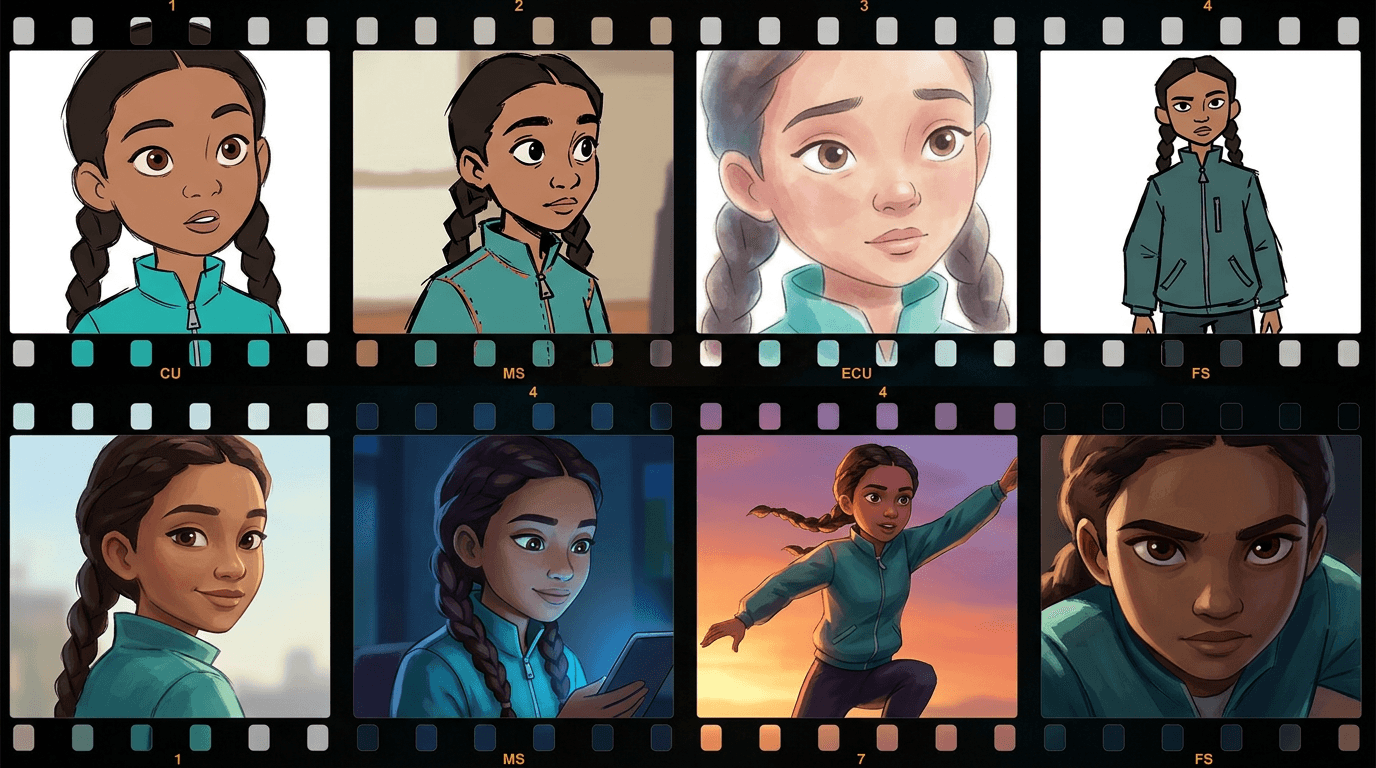
What actually holds a character together across a film? Four things. Canonical reference sheets: turnarounds, expressions, costume details, generated once and treated as law, with every reference image in the lock chosen rather than scraped. Trained identity references: we maintain proprietary face, style, and lighting models per project, so the character's identity is baked into generation instead of re-described each shot (this is exactly the problem omni-reference workflows were built to solve). Lighting logic: faces drift most under lighting changes, and facial animation falls apart fastest when light behaves differently scene to scene, so deciding how light hits a character is part of who that character is. And a reject-fast culture, because every drifted shot that survives review teaches your audience the character isn't real.
This is where tool demos and finished films part ways. A demo needs a character to exist for eight seconds. A kids' series needs her to exist for eight episodes. Our short film Unmasked, which won Best AI Short (Gold) at the Bali International AI Film Festival and was an Official Selection at Cannes World AI Film, lives or dies on one dancer's face staying hers through a seven-minute emotional arc. That's not a prompt achievement. It's a pipeline achievement.
We've written a dedicated technical piece on character consistency in AI video if you want the deeper toolkit.
Use Cases: Animated Ads, Series, Kids' Content, Music Videos, Educational Animation
AI animation is production-ready in 2026 for brand ads, animated series and pilots, kids' content, music videos, and educational animation. The fit depends on failure tolerance: the more shots a recurring character appears in, the more the project needs studio-grade consistency systems.
Rather than the usual benefits list, here's each use case with the thing that breaks first:
- Animated ads and commercials. Best fit in the market right now: short-form, stylized, emotionally led ad films. What breaks first: brand-safety review of anything that reads as slop. Craft is the insurance.
- Series and pilots. The economics are startling; a pilot that priced at feature-adjacent numbers can now be pitched from a finished AI animated video teaser. What breaks first: character consistency, episode two.
- Kids' content. Huge appetite, forgiving styles, recurring characters, and the ai cartoon video format parents actually search for. What breaks first: consistency again, plus the trust bar parents apply. Our kids' and educational animation service is built around exactly that pairing.
- Music videos. The most creatively free lane. Style drift can even read as intentional. What breaks first: sync and edit rhythm, which is an editor's problem, not a model's.
- Educational animation. Per-course video creation finally pencils out at AI economics. What breaks first: sameness. Template-look videos vanish into the feed, and generic social media content vanishes faster still.
One production note that applies to all five: mythological and fantastical worlds, the kind we built for The Ring, our generative mythological epic, are disproportionately good fits. Worlds nobody has filmed have no reality to contradict. Shot entirely on imagination.
The Future of Animation: Where AI Workflows Go Next
The future of animation is hybrid: AI handles generation volume while human animators own design, direction, and final judgment. Professional animation in 2026 is converging on motion-capture-driven performance, real-time iteration, and per-project trained models, with fully automated end-to-end animation nowhere in sight.
A few trajectories we're betting on from inside real production, time-anchored to mid-2026 because this field invalidates predictions fast.
Performance transfer grows up. Motion capture used to mean suits and tracking volumes. Now video-based capture and performance-transfer features let a director act a scene on a phone and map it onto a character, while lip-sync tooling maps dialogue to faces with real temporal tracking. AI generates the frames, but the performance stays human, which is precisely the point.
Real-time direction loops. The gap between typing a prompt and seeing a shot is collapsing toward instant. When iteration is free, the bottleneck becomes knowing what to ask for, which moves the value of the animation industry further toward direction. We think that shift is structural, not temporary.
Animators get promoted, not replaced. The use of AI in animation moves an animator from executing every frame to art-directing the systems that generate them. An ai-assisted workflow with a trained animator behind it beats an ai-generated one without, every single time we've run the comparison. The craft transfers up the stack.
Will some of this age badly? Probably. Our own stack gets rebuilt yearly, and any studio that tells you its process is future-proof is telling you it hasn't shipped much.
India's AI Animation Opportunity
India combines a ₹5,400 crore VFX industry, 4,000+ studios, and 30-50% lower production costs than the US and Europe (FICCI-EY), making it the natural home for AI-hybrid animation. AI-powered animation workflows multiply that existing cost advantage instead of replacing the talent behind it.
The Indian context makes this guide's economics sharper. India's animation, VFX, and post segment contracted about 9% in 2024 as global production volumes fell, which sounds grim until you see what it triggered: studios across the country adopting AI workflows to defend margins and win back outsourced work. The national AVGC-XR ambition targets roughly 5% of the global market with 25-30% annual growth. AI-hybrid animation is one of the few realistic routes to that number.
For brands, the practical takeaway is simple. An India-based AI animation studio now offers a double discount: Indian production economics multiplied by AI economics, with award-validated quality as the filter that separates studios from render farms. We've profiled the scenes city by city: animation studios in Hyderabad, animation studios in Mumbai, and animation companies in Bangalore, plus the wider view on our AI animation studio page.
We work from India for global clients, with our founder based between India and San Francisco. The proof travels: an Indian AI studio winning at Bali, Seoul, and a US contest in the same year says the geography argument is over.
Commission AI Animation
To commission AI animation, brief a studio with your story goal, style direction, references, and budget range, then review a style test before committing to full production. At Adwhyta, that starts with a 30-minute consultation call and ends with a film we'd put our laurels behind.
Here's how we'd suggest starting, whether with us or anyone credible:
- Bring a story problem, not a shot list. "We need parents to feel X" beats "we need 40 seconds of 3D."
- Ask to see consistency, not highlights. Any AI animation studio can show its best frame. Ask for four consecutive shots of one character.
- Style-test before you commit. A short test in your intended style de-risks the whole engagement.
- Check the trophy shelf. 9 laurels and counting, including 7 international AI film awards in 2026, is our answer to that question. Ask every studio for theirs.
Commission a film or browse the Velocity Archive to see the range: Unmasked, Gibbon's Grove, The Ring, and the rest of the 14-work portfolio. Stylised animation is one wing of a full-spectrum studio — the same pipeline carries our narrative films, ad films, and the high-quality microdramas we produce for international clients.
VISION Reborn. We don't just generate shots. We craft cinema.