Key Takeaways
- AI lip sync (the industry now calls it "vubbing", for visual dubbing) re-animates an actor's lip movements to match the new audio, so a dubbed film stops looking dubbed.
- The first theatrical feature released this way, Watch the Skies, hit US cinemas in May 2025. The Swedish cast re-recorded their own lines in English, and AI re-animated their faces to match.
- Under the hood it's face tracking plus generative AI models. Wav2Lip (from IIIT Hyderabad, 2020) started the open-source line. Diffusion models like ByteDance's LatentSync carry it now.
- One model is never enough. In our own films we run 3 to 4 lip-sync models per project and composite the best result, with temporal tracking to keep the face stable across frames.
- Vubbing shines on close-ups, dialogue-heavy scenes, and multilingual releases. It struggles with hard profile angles, occluded mouths, and low light. Plan for that before you commit.
There's a moment in every badly dubbed film where the illusion dies. The dubbed voice says one thing, the lips say another, and your brain quietly files the whole movie under "foreign". I grew up watching dubbed films where that gap was just the price of admission. It isn't anymore.
When we made Unmasked, our short about a Theyyam dancer that went on to win seven international AI film awards, the dialogue you hear was never spoken by the character you see. I dubbed the lines myself, ran them through voice transfer to land the character's voice, then pushed the footage through a lip-sync pass so the mouth agreed with every word. That pass is the subject of this complete guide: what lip sync AI actually is, how vubbing works frame by frame, and when it's the right call for your release.
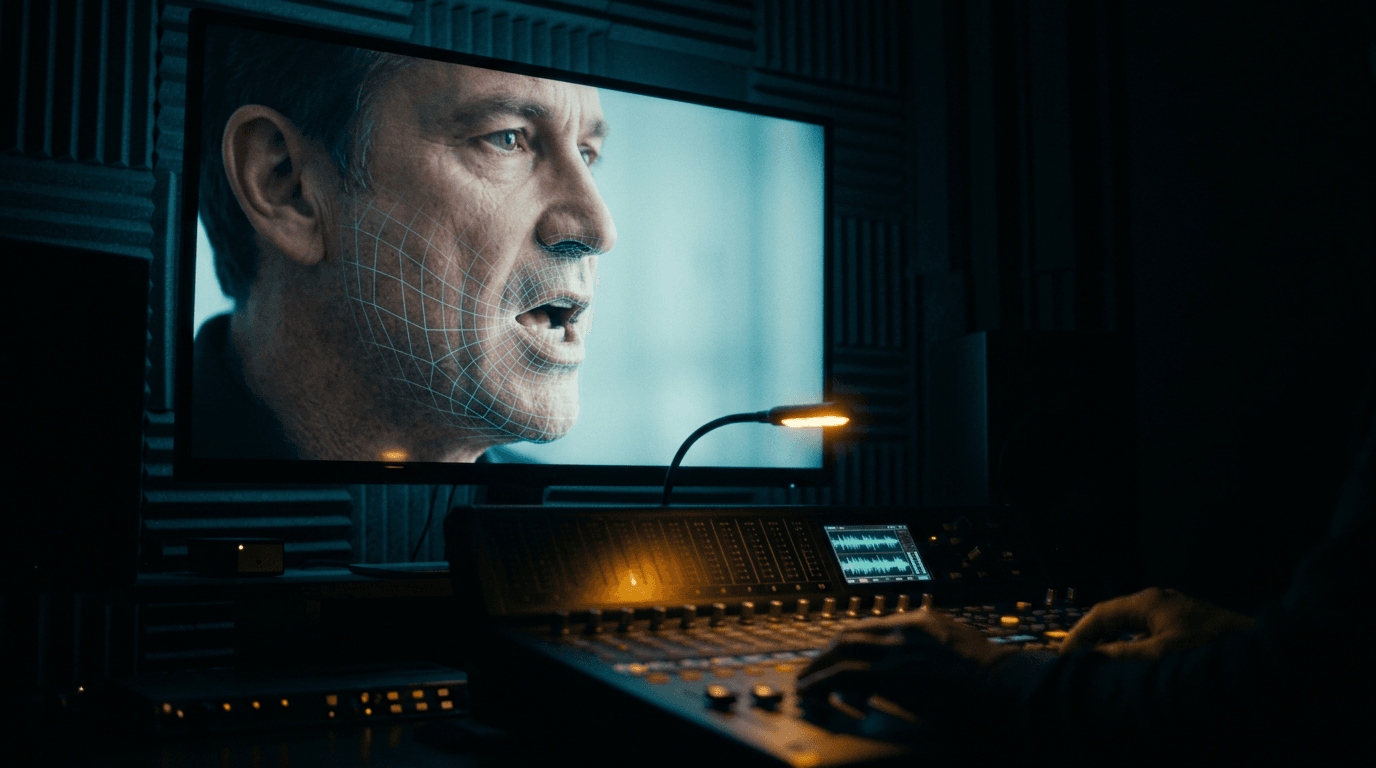
What Is AI Lip Syncing?
AI lip-syncing is a generative artificial intelligence technology that automatically maps and synchronizes a speaker's mouth movements in a video to match any new audio track. By analyzing phonetic speech patterns (phonemes) frame-by-frame, the AI dynamically reconstructs facial landmarks to deliver fluid, native-looking dialogue in any language.
That's the definition. Here's the plain version: you hand the system an original video file and a new voice track, and it redraws the mouth so the face appears to speak those words in the different language. The rest of the performance, the eyes, the head tilt, the breathing, stays untouched.
It sits inside the bigger discipline of AI dubbing. AI dubbing is the process of localizing video content so viewers can watch it in their native language, and AI dubbing uses artificial intelligence at every step: AI translates the original dialogue, generates or converts the new voice, and, at the high end, re-animates the lip movements to match the new audio. For teams that dub content at scale, that last step used to be impossible. Now it's a line item. This article covers that last, hardest step. For the whole chain around it, voice cloning, translation quality, workflow, start with our complete guide to AI dubbing.
Vubbing: When AI Dubbing Becomes Invisible
Traditional dubbing replaces the audio and hopes you won't stare at the mouth. Vubbing replaces the mouth too.
The term comes from Flawless, the London studio whose TrueSync system builds a volumetric 3D model of an actor's face from the footage, then adapts the mouth movements in post-production to match new dialogue. Visual dubbing, shortened to vubbing. The name stuck because this AI technology describes the shift precisely: with AI video dubbing, dubbing stops being an audio process and becomes a picture process.
Why does this matter for anyone releasing video content in more than one language? Because poorly synchronized dubbing is the single biggest tell that a film wasn't made for you. Subtitles preserve the original performance but cost you the audience that won't read. Traditional dubbing wins that audience back but breaks the faces. Vubbing is the first approach that keeps both: lip-synced dubbing preserves the original actor's performance while the dialogue looks native in the target language.
How Does AI Lip Sync Work?
The honest answer: how AI dubbing works at this level is a pipeline, not a button. Every serious lip sync AI system, from open-source research code to studio dubbing platforms, runs some version of these four stages.
- Ingest. The system takes the original video plus the new audio, whether that's a voice actor's recording, an AI voice, or a voice clone of the original performer.
- Face tracking and landmark detection. Frame by frame, the model locates the face and maps its geometry: jaw line, lip contours, the mouth interior. Some systems, like TrueSync, build a full volumetric 3D representation of the face from the entire performance.
- Generation. A neural network maps the phonemes in the new audio onto visual mouth shapes (visemes) and synthesizes new mouth-region frames, adjusting the lip movements to match the new track. This is where the AI models differ, and it's worth knowing the two big families.
- Blending and polish. The generated mouth region is composited back into the original frame, matched for lighting, grain, and skin texture, so no seam shows.
The AI Models Behind the Mouth
The open-source lineage starts with Wav2Lip, published in 2020 by researchers at IIIT Hyderabad with the University of Bath. Its trick was a pretrained "expert" lip-sync discriminator: a judge network already very good at spotting out-of-sync video, which forced the generator to produce genuinely accurate mouth shapes from raw audio. I find it quietly satisfying that the foundational lip-sync paper came out of Hyderabad, given how much of the world's dubbing work already flows through India.
The current generation is diffusion-based. ByteDance's open-source LatentSync skips intermediate motion representations entirely: it conditions a latent diffusion model directly on audio embeddings (extracted with Whisper) through cross-attention, and adds a temporal-alignment mechanism so the mouth doesn't jitter between frames. The quality jump from the GAN era to the diffusion era is roughly the jump from "impressive demo" to "watchable film". Advanced AI of this class is what finally made studios move real budgets to generative AI dubbing work.
Standard Mode vs Precision Masking on AI Dubbing Platforms
Most AI dubbing platforms expose two working modes, and the difference decides your dubbing results.
- Standard mode regenerates the mouth region automatically. Fast, works for talking heads and frontal angles. This is what most creators dubbing videos with AI will ever need.
- Precision masking lets you (or the system) isolate exactly the face region to modify, so the AI changes mouth movement while preserving the actor's head motion, expressions, and the scene's original lighting. This is the mode film work actually uses.
Where AI Lip-Sync Still Breaks
I'd rather you hear the limitations from a studio that uses this daily than discover them in your own footage. As of mid-2026, lip sync AI still struggles with hard profile views (the models are trained mostly on frontal and three-quarter faces), mouths occluded by hands, mics, or props, very low light, and heavy motion blur. Wide shots are usually fine, ironically, because nobody can read lips at that distance anyway. The danger zone is the medium close-up at 60 degrees.
Vubbing vs Traditional Dubbing vs Subtitles
| Vubbing (AI visual dub) | Traditional dubbing | Subtitles | |
|---|---|---|---|
| What changes | Audio + mouth movements | Audio only | Nothing on screen but text |
| Sync quality | Lips match the target language | Lips contradict the dubbed audio | Original performance intact |
| Original performance | Preserved (face re-animated, acting kept) | Replaced by a voice actor's read | Fully preserved |
| Turnaround | Days to weeks, mostly compute + QC | Traditional dubbing takes weeks to months of studio sessions | Fastest |
| Best for | Dubbing films, ads, and dialogue-heavy multilingual content | Markets with a strong dubbing tradition | Festivals, budget-first releases |
Traditional dubbing workflows aren't going away. Traditional dubbing requires hiring voice actors per target language, booking studios, directing sessions, and mixing, and in some markets that craft tradition is the product. Traditional dubbing remains the right call where beloved local dub casts carry their own fanbases. What AI dubbing changes, against traditional dubbing methods, is the economics around all of it: AI dubbing automates the sync layer, AI dubbing removes the cost of re-shooting or re-casting for each market, and one performance travels to many languages with its lip movements intact. That's why AI dubbing matters even to teams that keep human voice casts: sync and voice have become separate decisions.
Types of AI Dubbing: AI Voice, Voice Clone Dubs, and Full Vubbing
Not every project needs the full treatment, so it helps to know the types of AI dubbing you can actually buy, in ascending order of effort.
- Machine voice-over. AI translates the script and a pre-built neural TTS voice reads it over the original video. Cheap, flat, fine for internal or utility content. A generic AI voice is the giveaway.
- AI voice cloning dub. A voice clone of the original speaker performs the translation, so the dubbed voice still sounds like the person on screen. Much better for brand films and any content creator whose voice IS the brand. No lip changes yet: AI dubbing replaces the audio only.
- Full vubbing (visual dubbing). Voice work from tier 2 (or a directed human read) plus lip re-animation. The dubbed version looks and sounds native. This is broadcast and theatrical territory, and it's where high-quality dubbing lives now.
Most projects we scope land in a mix: tier 2 for wide coverage, tier 3 vubbing for the close-ups and the hero cut.
Famous Vubbed Releases (and the Dubbing Workflow Behind Each)
Watch the Skies (2025). The first feature film to reach theatres fully visually dubbed. Shot in Swedish as UFO Sweden, the film was released in US cinemas by XYZ Films in May 2025 with the original cast appearing to speak English. The dubbing workflow is the interesting part: the Swedish actors re-recorded their own lines in English, ADR-style, and Flawless's TrueSync re-animated their mouths to match, per Variety. No replacement voice cast. The actors dubbed themselves across a language barrier.
Fall (2022). Before vubbing went theatrical for localization, the same dubbing technology solved a ratings problem. Lionsgate needed Fall down from an R to a PG-13, and the script had 30-plus F-bombs. Reshoots would have cost millions; instead, Flawless re-animated the actors' mouths to match cleaner replacement lines, in about two weeks of post. Most viewers never noticed. That's the benchmark: invisible.
The pipeline films. Announced follow-ups using visual dubbing include Tom Tykwer's The Light and Michel Gondry's The Book of Solutions, which tells you the technology has moved from stunt to standard video localization option.
The Craft Details: Visemes, Jaw Motion, Performance Preservation
Here's where I put my director hat back on, because the difference between good and uncanny lives in details no spec sheet mentions.
Visemes aren't phonemes. Languages don't share mouth shapes. A Hindi retroflex and an English "th" ask completely different things of a jaw. A good vubbing pass maps the new language's visemes onto the actor's own way of speaking, not onto a generic mouth.
Jaw motion sells it, lips don't. Amateur lip sync obsesses over lip contours. Watch real speech: the jaw, the cheeks, the little throat movements carry half the signal. Models that only repaint lips produce that subtle ventriloquist effect your audience feels but can't name.
Temporal consistency is the whole game. A frame that looks perfect in isolation is worthless if the mouth shimmers across a shot. In our VFX work we run lip sync with temporal tracking and facial consistency checks precisely because single-frame quality is easy now and cross-frame stability isn't. Good dubbing preserves the actor; great dubbing preserves the shot.
No single tool survives contact with a real film. On Unmasked our custom workflow combined five to six video models, two image models trained for character consistency, and 3 to 4 lip-sync models, with 4K upscaling at the end. We generated well over an hour of footage for an eight-minute film and kept maybe 5 to 10 percent. The lip-sync pass sits late in that chain, after performance and camera are locked. A custom multi-model stack. Not a single prompt box.
Voice matters as much as mouth. For Unmasked I dubbed the character's lines myself, then used ElevenLabs with style transfer to move my read into the character's voice. That combination, a human performance underneath AI voice conversion, kept the emotional timing real while solving the accent problem. Pure text-to-speech, by contrast, hands the lip-sync model a flat performance to animate, and it shows. Rather than a generic AI voice, use AI voice cloning over a directed human read whenever the footage carries emotion.
Applications of AI Dubbing: Multilingual Use Cases Beyond Cinema
Film gets the headlines, but most of the volume in the AI dubbing market is quieter, and it's growing on the speed AI offers rather than on novelty. The applications of AI dubbing we see most, and the use case behind each:
- Multilingual ad campaigns. One hero film, vubbed per market. Brands use AI dubbing for regional and seasonal variants without re-shooting, and the same actor's face stays honest in every language. AI dubbing allows studios and agencies to treat languages as versions, not productions.
- OTT and film localization. Streaming catalogues moving between languages, where lip-synced dubbing lifts the viewing experience on dialogue-heavy drama.
- Dubbing a YouTube channel. Multi-language audio tracks turned creators multilingual, and adding lip sync to the top-performing videos is the emerging upgrade. For creators, using AI dubbing well can multiply a video's reachable audience without multiplying the shoot. AI dubbing makes the second language a render, not a re-record.
- Corporate, e-learning, and podcast video. Founder messages, training libraries, video podcasts: talking-head formats are exactly where lip sync AI performs best, and where multilingual content pays back fastest for a global audience.
Every one of these can benefit from AI lip sync, but they don't all need the same tier. Match the spend to how close the camera gets.
When to Use AI Lip Sync (Vubbing) for Your Release
Some clear signals from the projects that cross our desk:
- You're a brand running one campaign across many languages. The multilingual dubbing use case with the most lopsided cost math. One shoot, many markets, no re-casting.
- You're a filmmaker or OTT platform localizing a finished film. The demand we hear from the Indian industry is exactly this: pan-India releases where the lead actor's lips are re-synced per language after the shoot. The performance stays; the language travels.
- Your content is dialogue-heavy and close-up-heavy. The more faces fill your frame, the more vubbing earns its cost. Talking-head founder films, testimonial ads, drama.
- Skip it (or scope it down) when your cut is mostly wides and action, your target market happily reads subtitles, or your footage lives in the failure modes above (profiles, occlusion, murk). Sometimes a plain dub plus a great mix is the right spend. AI dubbing reduces the cost of sync, not the need for judgment.
On cost: in India, AI dubbing with lip sync prices per finished minute and varies with resolution, shot difficulty, and QC depth, so treat any flat rate you see online with suspicion. We've broken the ranges down in our AI dubbing cost guide. And if you're evaluating top AI dubbing options, our AI dubbing software comparison covers the tools and services side, from self-serve dubbing tools to full-service studios. This piece stays deliberately tool-agnostic: AI dubbing tools like the ones in that comparison change every quarter, while the pipeline above doesn't.
Test Vubbing on Your Trailer: Judge the Dubbing Results Yourself
The cheapest way to evaluate this dubbing technology is a 60-second test on your own footage. Not a vendor demo reel. Your lighting, your actors, your language pair.
That's how we usually start with brands and production houses: pick the hardest dialogue scene in the trailer, run it through our multi-tool lip-sync pipeline, and judge the dubbed audio and picture at full resolution against the original. If the mouth survives your harshest close-up, the rest of the film is easy. We're a full-spectrum AI film studio, so dubbing and voice-over work plugs into whatever the project needs around it, from a single ad film to a series to long-form. See the work in our portfolio, read about our AI dubbing services, or book a 30-minute call and bring the trailer.
FAQ
What is vubbing (visual dubbing)?
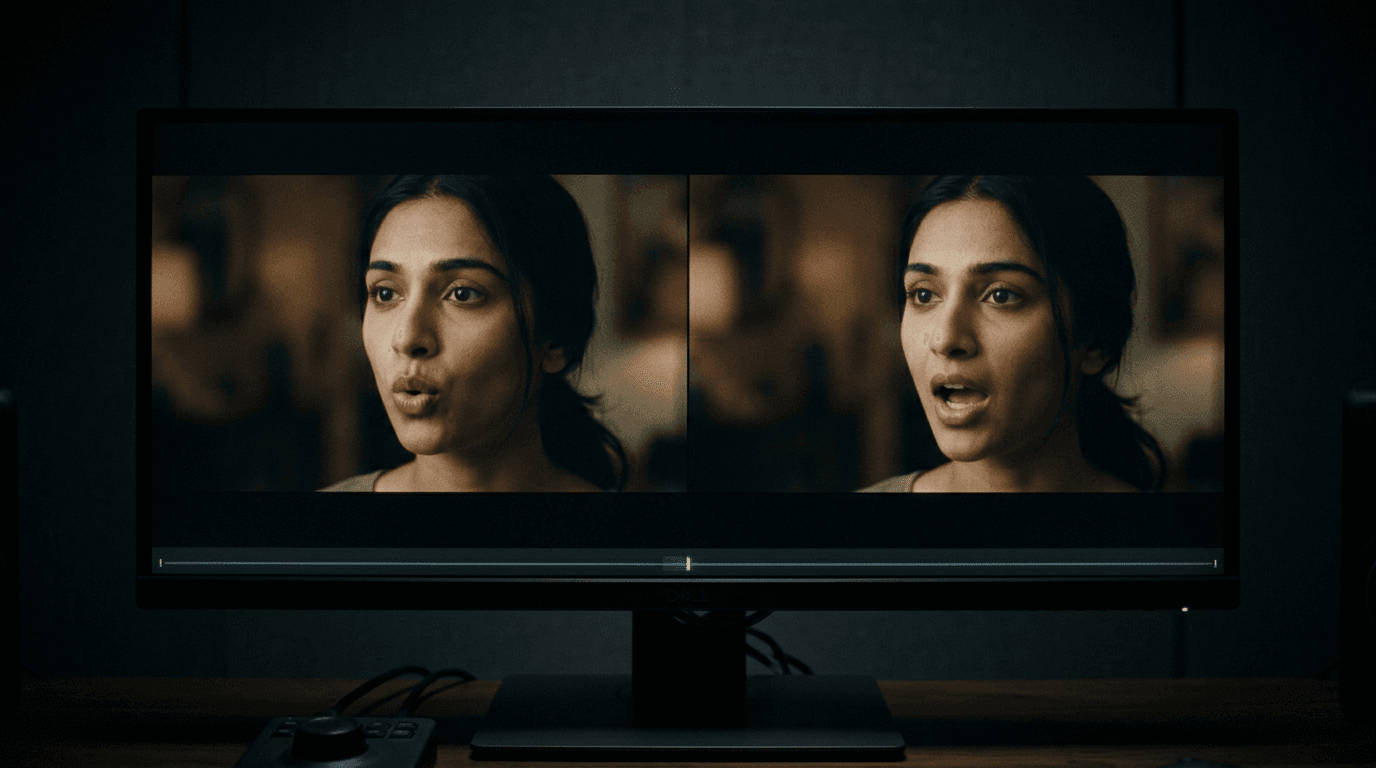
Vubbing combines AI voice or translated dialogue with generative video lip-syncing. Instead of only replacing the audio, vubbing adjusts the actor's mouth movements frame by frame to match the phonemes of the new language, so the dubbed version looks like it was shot in that language.
How does AI lip sync handle complex facial expressions and motion?
Advanced tools use precision modes that mask the face region, letting the AI modify mouth movements while preserving the actor's head tilting, natural expressions, and the scene's original lighting. The generated mouth is then composited back and matched for grain and skin texture.
Does AI lip sync work for animated or non-human characters?
Yes. Many generative engines support cartoon, 3D animated, and stylized character models, applying the same phonetic tracking to non-human facial structures. Results depend on how face-like the character's mouth rig reads to the model, so always test your specific style first.
What AI tool is best for lip syncing?
There's no single best tool, and any page claiming one is selling it. Studio-grade results come from matching the model to the shot: open-source options like Wav2Lip and LatentSync for controlled tests, platform tools for scale, and multi-model pipelines for film work.
Can you lip sync a video for free?
Yes, within limits. Open-source models like Wav2Lip and LatentSync are free to run if you have the GPU and the patience, and several platforms offer watermarked free tiers. Free routes suit tests and low-stakes clips. Broadcast work needs the polish pass on top.
Can I use my own voice for AI lip sync?
Yes, and you usually should. Record the new-language lines yourself (or have your actor do it, as the Watch the Skies cast did), or build a consent-based voice clone of the original performer. A real vocal performance gives the lip-sync model emotional timing a generic AI voice can't.
Written by MSN Karthik, Founder & Director at Adwhyta. IIT Guwahati alumnus, co-founder of Zipy.ai, TEDx speaker, and award-winning AI filmmaker whose short "Unmasked" won 7 international AI film awards including Gold at the Bali International AI Film Festival. He once made a festival-screened sci-fi short for under $75.