Key Takeaways
- AI dubbing replaces a video's spoken audio with a new language track using speech recognition, machine translation, and voice cloning. No studio booking, no actor scheduling, no six-week wait.
- The economics are not close: roughly $2 to $20 per minute for AI dubbing vs $100 to $500 per minute for traditional studio dubbing per language (Vozo, Verbolabs, 2026). Hours instead of weeks.
- Our verdict, from inside a working AI film studio: AI dubbing is production-ready for most brand, creator, and catalog video content IF a human director stays in the loop. Raw auto-dub is fine for reach. It is not fine for your brand film.
- The India angle nobody covers: the story isn't AI replacing dub studios. It's the Indian language markets that were never economically dubbable before, suddenly becoming viable.
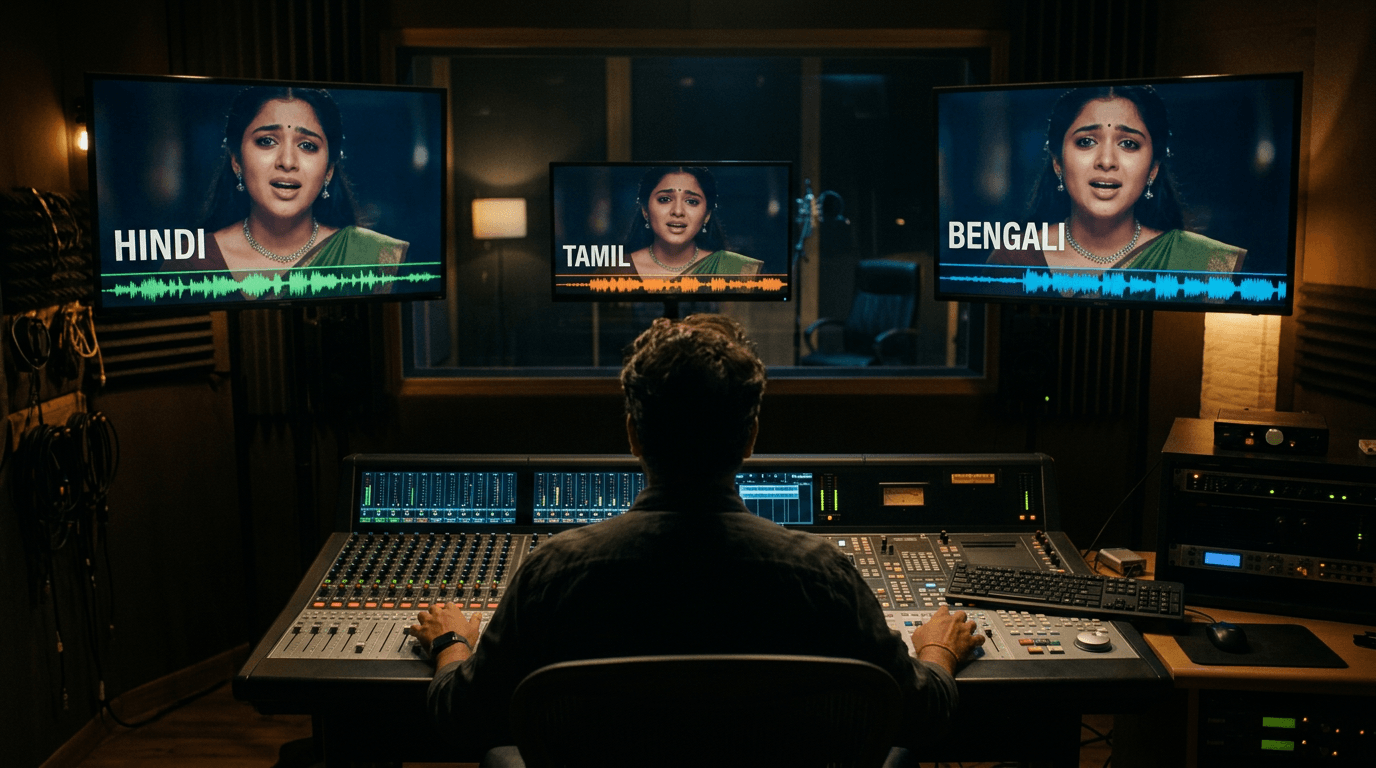
I run a quality-driven AI film studio. We dub our own narrative films, our clients' ad campaigns, and the microdrama series we make for international clients into multiple languages, and I've watched artificial intelligence dubbing go from "funny demo" to "line item in serious production budgets" in about two years. This complete guide covers the whole video localization picture: the AI technology, the real costs, the quality tiers, the law, and the India-specific playbook. It's everything I wish someone had handed me at the start.
AI dubbing is the practice of using artificial intelligence to replace a video's original spoken audio with a new language track. The pipeline transcribes the speech, translates it, then generates the new dialogue with synthetic or cloned voices, without studio sessions or voice actor scheduling. That's the definition. The craft is everything it leaves out.
Quick disclosure: adwhyta is an AI studio, so I'm biased toward this technology. But we're also filmmakers, so I'll be honest about where it still falls flat on its face.
AI Dubbing, Explained in 60 Seconds
AI dubbing (also called AI dub or artificial intelligence dubbing) converts a video's dialogue into another language in three automated steps: speech-to-text transcription, machine translation, and text-to-speech synthesis, often with voice cloning so the output still sounds like the original speaker. Good pipelines add lip-sync correction and human review on top.
The whole field in bullets:
- What it does: one master video becomes 5, 10, or 20 language versions, in hours. One video with AI dubbing behind it is suddenly multilingual video content.
- What it costs: roughly $2 to $20 per minute by quality tier, vs $100 to $500 per minute compared to traditional dubbing (Vozo, Verbolabs, 2026).
- Who's using it: YouTube creators (auto-dubbing features are now rolled out to eligible creators globally), OTT platforms running video localization at catalog scale, brands making regional-language ad variants, and companies quietly using AI voice dubbing on training videos nobody was ever going to re-shoot.
- Where it's weakest: emotional nuance. Laughter, sarcasm, the weight of a dramatic pause. More on that later, because that section is the reason this guide exists.
- The legal line: voice cloning now sits under real law (Tennessee's ELVIS Act, SAG-AFTRA's AI provisions). Consent-first is no longer optional.
If you only came for the definition, you're done. If you're deciding whether to actually localize something, keep reading.
How AI Dubbing Works: Translation, Voice Cloning, Lip Sync
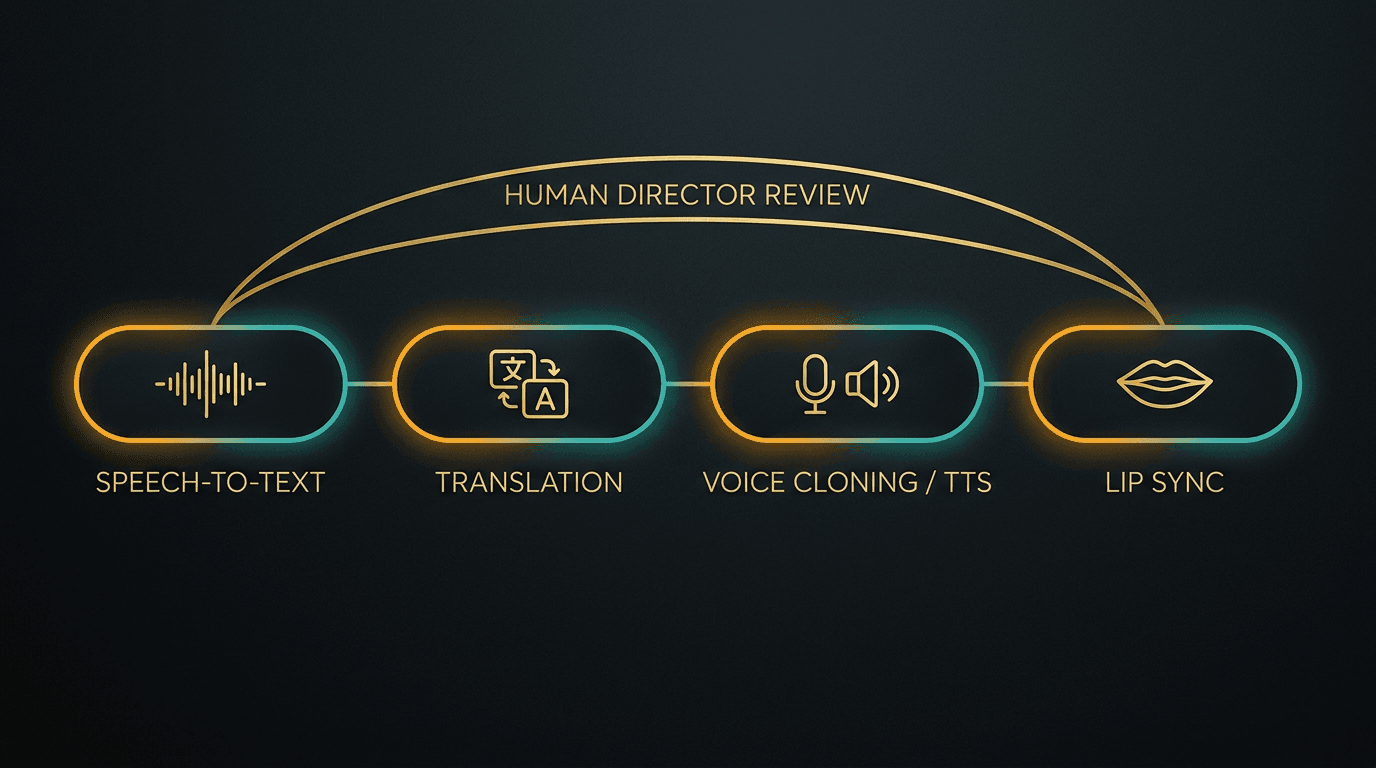
An AI dubbing pipeline runs four stages: transcribe the original dialogue (speech-to-text), translate it with timing constraints, synthesize new speech via TTS or a cloned voice, and align the result to the video, sometimes regenerating lip movement to match. Quality is decided at the translation and voice stages, not the transcription.
When a dub sounds "off," people usually blame the wrong stage. Here's where each one wins or loses.
Stage 1: Speech-to-text
The solved problem, mostly. AI handles transcription of clean dialogue nearly perfectly but stumbles on overlapping speakers, music beds, and code-switching (a Hindi sentence with three English words in it, which is, you know, most actual Indian speech). We hand-check transcripts first. Garbage here compounds downstream.
Stage 2: Machine translation, with a catch
AI translation for dubbing is harder than translation for subtitles. A subtitle can be any length; dubbed dialogue has to fit the same mouth, duration, and emotional beat. "I'm not going" is three syllables in English; its natural Tamil equivalent might be seven. Something gives: the translation compresses, the audio stretches, or the line gets rewritten. Good pipelines run neural machine translation with length awareness for each target language. Great ones let a human dialogue adapter fix lines the way dubbing script writers have for decades. The best translation models still don't know which line is the joke.
Stage 3: Voice cloning and TTS
The stage everyone demos. A text-to-speech model generates the new dialogue as AI speech in any language using a cloned voice, conditioned on the speaker's original recording, so your founder still sounds like your founder in Telugu. At our studio the voice layer runs on ElevenLabs plus a combination of lipsync tools, because no single tool wins on every language and shot type. A custom multi-model stack. Not a single prompt box.
We stress-tested voice synthesis early with two public proof-of-concepts (a Britney Spears style AI brand-music ad, a Steve Jobs AI podcast), and both taught one lesson: cloning the timbre is easy now. Cloning the intent behind a line is the hard part, and that's a direction problem, not a problem of AI models.
Stage 4: Lip sync
The visible layer. Basic pipelines lay the new audio over the old picture and accept the mismatch (fine for voiceover content, distracting for close-up dialogue). Advanced AI lip-sync regenerates the mouth region of the source video to match the new track, frame by frame, so the actor appears to speak the new language. In our VFX work this runs with temporal tracking and facial consistency checks, because a mouth that flickers between frames reads as fake in half a second. I've written a separate breakdown of how AI lip sync and vubbing work if you want the mechanics.
AI Dubbing Quality Tiers: Subtitle-Grade to Broadcast 'Vubbing'
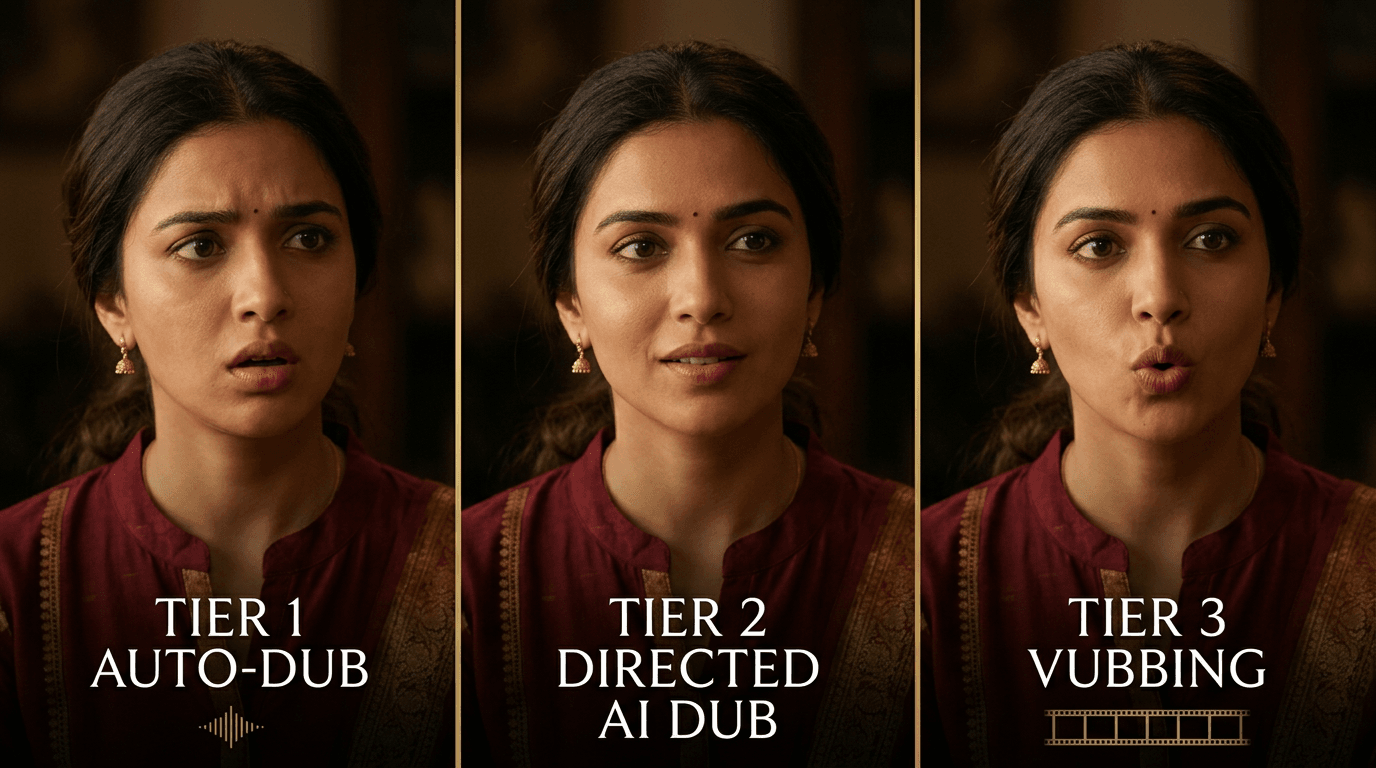
AI dubbing quality comes in three tiers: automated dubbing (platform auto-dub, cheapest, voiceover-grade), directed AI dubbing (cloned voices, adapted scripts, human QC), and visual dubbing or "vubbing," where AI also reframes the actor's lip and facial performance to match the new language, at broadcast and theatrical grade.
Most arguments about "is AI dubbing good enough?" evaporate once you realize people are comparing different tiers:
| Tier | What it is | Cost signal | Right for | Wrong for |
|---|---|---|---|---|
| Tier 1: Auto-dub | Fully automated, generic voices, no human pass. YouTube auto-dubbing is the reference example. | Lowest ($ or free on-platform) | Creator back-catalog, reach experiments, tutorials | Anything where the voice IS the brand |
| Tier 2: Directed AI dub | Cloned voices, length-aware adapted scripts, human dialogue polish, directed retakes, QC | Mid ($ to $$) | Brand ads, OTT catalog, corporate film, podcasts | Theatrical close-up drama |
| Tier 3: Vubbing (visual dubbing) | AI reframes the on-screen lip and facial performance to match the dubbed track, frame by frame | Highest ($$$) | Theatrical and premium OTT drama | Everything that doesn't need it |
Two things about Tier 3 get misreported constantly. Vubbing tools like Flawless AI's TrueSync do not generate or clone audio at all: they modify the visual performance to match dubbed audio produced separately, often still by human voice actors. And it isn't hypothetical: Watch the Skies (2025) became the first fully visually dubbed feature in US theaters, released through AMC. The lead actors re-recorded their own dialogue in English; TrueSync resynced their on-screen performances to it. The picture is dubbed, not just the sound. Hence "vubbing."
My sharpest opinion in this guide, and the one I argue about with clients most: your tier should be set by viewing context, not budget vanity. Paying vubbing rates for a 30-second performance ad people watch muted is waste. Shipping auto-dub on your flagship brand film is self-harm. I've seen both mistakes in the same quarter. The real question: how close is the viewer to the actor's face, and how much do they need to feel?
For specific tools at each tier, we keep a studio-tested comparison of AI dubbing software updated.
AI Dubbing vs Subtitles: Which Localization Path Fits Your Video?
Subtitles are cheaper, preserve the original performance, and help accessibility, but they demand a reading viewer. Dubbing reaches people who watch while cooking, commuting, or half-listening, which is most people. The honest answer for most brands: subtitle every video for accessibility, dub the ones that carry your money.
The classic localization decision used to be binary because dubbing cost 50x what a subtitle file did. AI collapsed that gap, so the question is now about audience behavior, not budget.
Where subtitles win: they're nearly free, they leave the original video untouched, they never mispronounce your brand name, they keep the actor's real voice, and they serve deaf and hard-of-hearing viewers no dub ever will. Where they lose: on-screen text competes with the actual on-screen action, small screens make reading miserable, and a viewer who has to read is a viewer who can't look away. In markets where audiences grew up on dubbed content (most of India, most of Europe's big markets), a subtitle-only release reads as "we didn't bother."
There's also a craft detail people miss: subtitle translation and dubbing translation are different scripts. A subtitle compresses for reading speed; a dub script adapts for mouths and timing in the target language. Running video translation and dubbing off one subtitle file is how you get dubs that feel like someone reading captions aloud. Because they are.
Our default recommendation: both. Subtitles on every video, every language, always (accessibility plus silent autoplay). AI dubbing on the videos where watch time pays: ads, flagship brand films, top-performing catalog. That mixed model is the cheapest way to serve a global audience without dubbing things nobody asked for.
AI Dubbing vs Traditional Dubbing Studios: Cost & Time Math
Traditional studio dubbing runs roughly $100 to $500 per finished minute per language, with two to six week turnarounds. AI dubbing runs roughly $2 to $20 per minute, delivered in hours to days. That 80 to 95% cost reduction changes not just budgets but which languages are worth dubbing at all.
Per-minute numbers spread by market and quality bar, so here's the range sources actually converge on (Vozo, Verbolabs, Perso AI, 2026 pricing guides):
| Traditional studio dubbing | AI dubbing (Tier 1–2) | |
|---|---|---|
| Cost per finished minute, per language | $100–$500 | $2–$20 |
| A 10-minute video in 8 languages | $8,000–$40,000 | $160–$1,600 |
| Turnaround per language | 2–6 weeks | Hours to days |
| Marginal cost of language #9 | Nearly full price again | Marginal |
| Voice consistency across languages | Different actor per language | Same cloned voice everywhere |
| Emotional ceiling | Excellent (skilled actors) | Good, needs direction |
The line that matters is marginal cost. Traditional dubbing scales linearly: every language is another cast, another studio block, another QC cycle. AI audio dubbing is front-loaded in the master; each additional language is marginal. So the sensible strategy has flipped from "dub into the two languages with proven ROI" to "dub wide and let the data tell you which markets respond." That's what 90%+ savings compared to traditional dubbing actually buys: not cheaper versions of the same plan, a different plan.
One caveat: these are market ranges, not a quote. Real pricing moves with runtime, tier, speaker count, and how much human polish the video content deserves. Worked examples in rupees live in our full per-minute cost breakdown.
The India Opportunity: Multilingual Dubbing From One Master
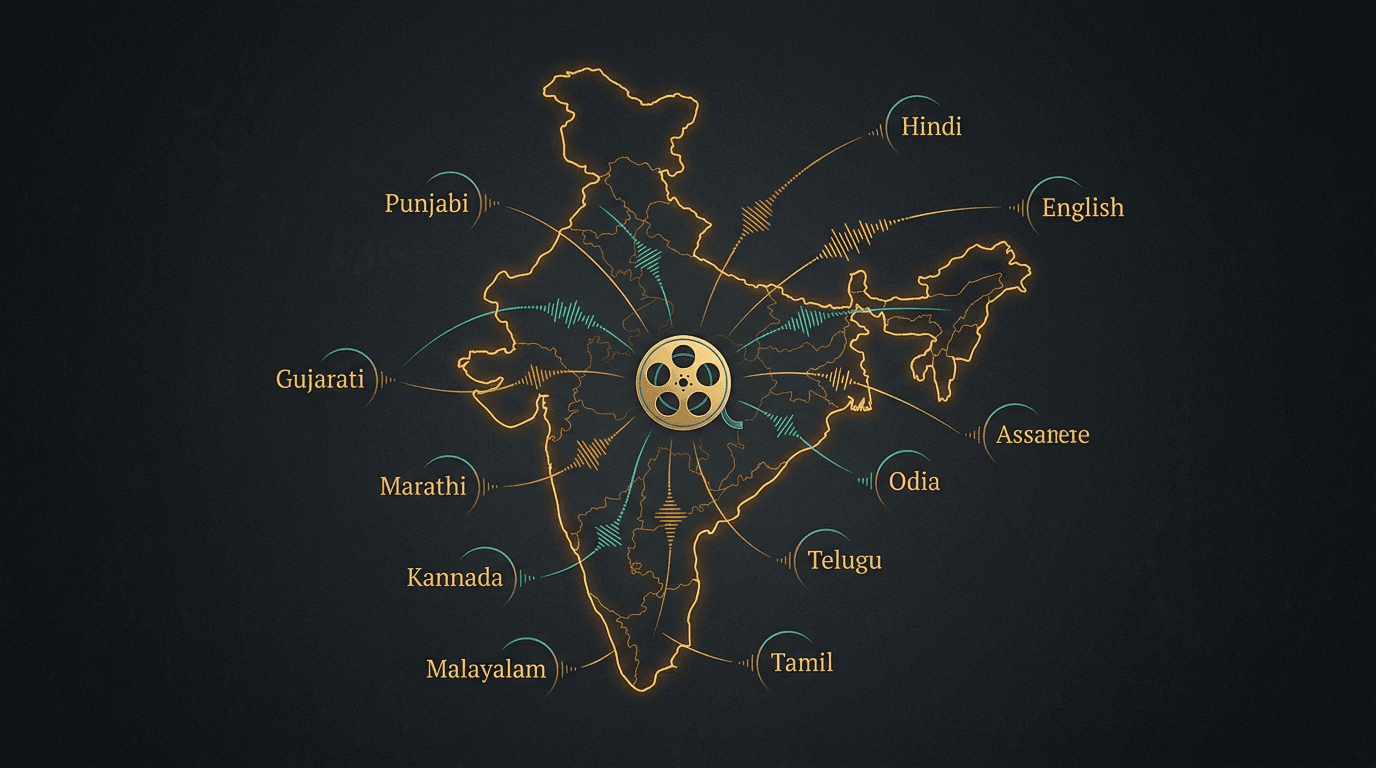
India is the hardest and most rewarding video localization market on earth: 22 scheduled languages, dozens more with real audiences, and most of them outside English and Hindi. AI dubbing collapses the cost barrier that kept most content locked out of most of those languages.
Everyone else's AI dubbing guide is written from a Hollywood angle: one English original, a few European targets, theatrical stakes. But the most interesting dubbing story of this decade is happening here, and it looks completely different.
My contrarian position, stated plainly: "will AI replace voice actors?" is the wrong question for India. The right question is which languages get any voice at all. At $100+ per minute per language, most content was never going to be dubbed into Bhojpuri, Odia, or Assamese. Not pirated, not delayed. Simply never made. There was no dubbing industry for AI to destroy in those markets; the economics forbade one from existing. At $2 to $20 per minute, those versions become rational for the first time. This is less a substitution story than a market-creation story. Evidence:
- Demand is compounding. India's domestic dubbing and localization demand keeps growing, driven by OTT regional expansion, micro-dramas, and creator adoption. Localization-industry trackers put domestic dubbing among the fastest-growing language services in the country, with streamers routinely commissioning dozens of language versions per title.
- New language markets are forming in real time. Bengali has become a serious commercial dubbing market, largely on Hoichoi's regional push. A decade ago that demand curve barely registered.
- Distribution now rewards it. YouTube's auto-dubbing, expanded to all eligible creators in 27 languages by February 2026, surfaces dubbed tracks algorithmically to non-English viewers. The platform is actively looking for regional-language versions to serve. If yours don't exist, a competitor's do.
- The south-to-Hindi corridor already proved the appetite. Dubbed South Indian films have dominated Hindi-belt viewing for years. The pipe works. AI drops the toll.
Operationally: one approved master film. One pronunciation bible (brand names, honorifics per language). Then parallel generation into as many tracks as the title earns. A typical Indian slate covers Hindi, Tamil, Telugu, Malayalam, Kannada, Bengali, Marathi, and Gujarati, with Punjabi, Odia, or an export language added when the audience data justifies them. Every track then gets a native-speaker QC pass before anything ships. That last clause is non-negotiable at our studio. A dub no native speaker has heard is a dub you haven't checked.
This one-master, many-languages workflow is what our AI dubbing services for Indian and global languages are built around. The hard part isn't generation; it's the language QC bench and knowing which lines need a human rewrite.
Voice Rights & Actor Consent: The Rules in 2026
Voice cloning now sits under enforceable law. Tennessee's ELVIS Act (2024) extended right-of-publicity protection to AI voice replicas, California's AB 2602 restricts digital-replica contract terms, SAG-AFTRA contracts require consent and compensation for AI voice use, and the federal NO FAKES Act remains pending. Consent-first isn't ethics theater; it's compliance.
This section didn't exist in most 2023-era dubbing guides, and its absence aged them badly:
- Tennessee's ELVIS Act (signed March 2024, effective July 2024): the first US state law to explicitly cover AI voice simulation under right of publicity. Cloning a voice without permission isn't a gray area there; it's actionable.
- California AB 2602: requires informed consent, with representation, for contract terms covering digital replicas of performers.
- SAG-AFTRA's AI provisions: consent plus compensation for any AI digital voice replica, per use, reinforced again in the agreement members ratified in June 2026. This is now the industry template.
- The NO FAKES Act (federal): reintroduced in the US Senate and House in May 2026 and still pending, but with backers from SAG-AFTRA to Google and OpenAI, its consent framework is already treated as the direction of travel.
- Enforcement is global. In April 2026, 25 French dubbing actors got 47 unauthorized AI voice models pulled from the Fish Audio platform under French personality-rights law, among them the French voices of Julia Roberts and Harrison Ford. Real actors, real takedowns, real precedent.
Our studio policy is simpler than the statute book: no voice gets cloned without documented consent from its owner, and voice talent gets paid when their clone works. Partly because it's right, partly because no campaign is worth the legal exposure, and partly for a colder commercial reason: consumer comfort with AI in ads has fallen from 57% to 46%, and 57% of consumers worry about fake AI ads (per MarketingCharts-reported survey data). A consent scandal converts that anxiety into a boycott of your brand specifically. Planning to clone a founder's or actor's voice? Read our consent-first playbook for AI voice cloning before you sign anything.
Where AI Dubbing Fails (and Our Human-in-Loop Fix)
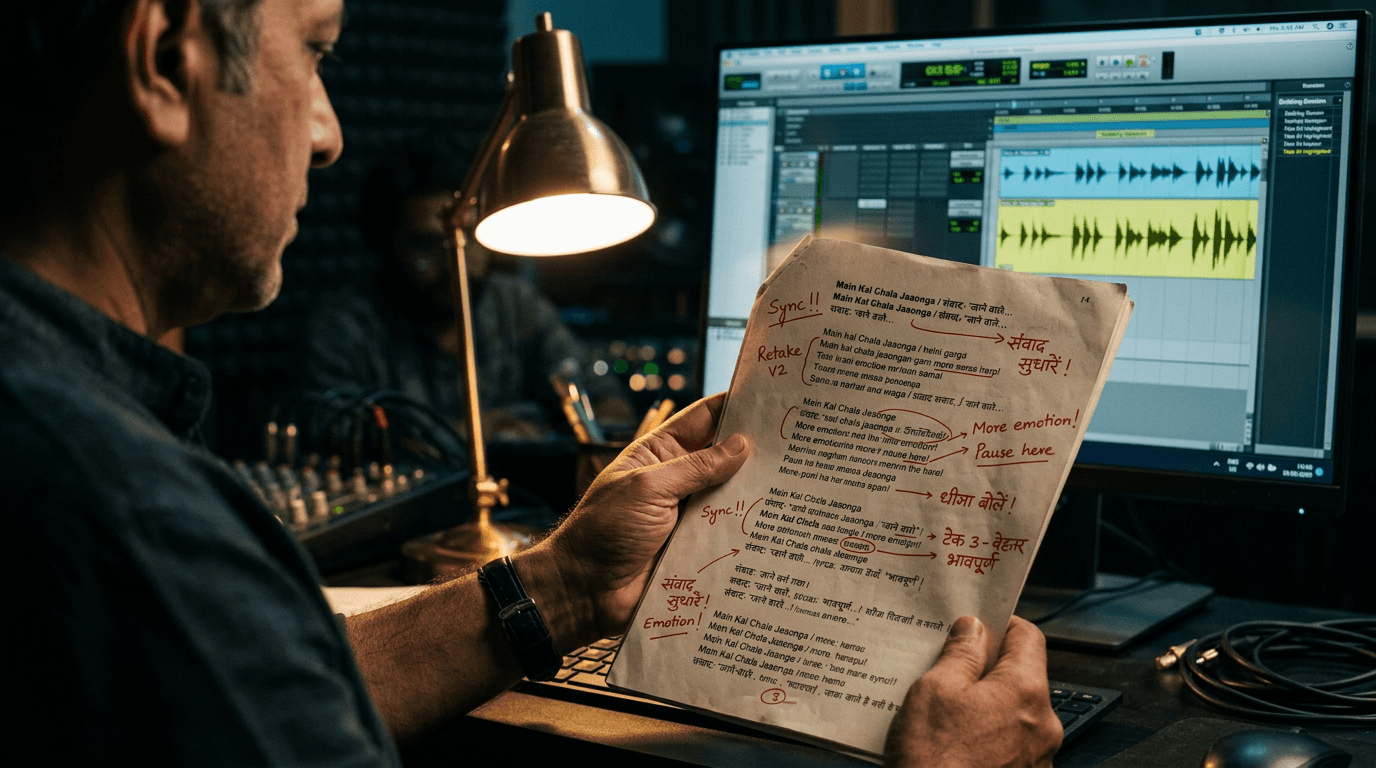
AI dubbing consistently fails at emotional nuance: laughter mid-sentence, sarcasm, grief, comic timing, song lyrics, and culturally loaded lines. The fix isn't a better model. It's a human director auditioning takes, rewriting lines, and rejecting output, which is why pure self-serve dubbing plateaus at "understandable" rather than "moving."
The section vendors write smallest. Having directed dubs across Indian languages, my actual failure list, ranked by how often it bites:
- Emotional weight. A TTS model reads "she's gone" at a funeral and "she's gone" about a missed bus with the same polite competence. Industry analysts keep landing on the same verdict (Slator, RWS): emotional nuance is the persistent gap, whatever the AI accuracy on words.
- Laughter, breath, hesitation. The non-word sounds that make speech human are what synthesis handles worst. A laugh that's 5% wrong is worse than no laugh. Voice quality isn't just clarity; it's breath.
- Sarcasm and subtext. Translation flattens irony; synthesis then delivers the flattened line sincerely. Double damage.
- Code-switching and culture. Hinglish, in-jokes, honorifics, wordplay. A literal translation can be perfectly accurate and completely wrong.
- Songs. Just don't auto-dub songs. I'm begging you.
Our fix is boring and it works: we run dubbing like a session, not a batch job. A director (often me) auditions multiple generated takes per line and picks, the way you'd choose between an actor's takes. Failed lines go to a dialogue adapter, not endless re-rolls. Native speakers run human review on every track. And for the 10% of lines carrying the film's emotional payload, sometimes the honest answer is a human voice actor blended into the AI track. I trained as a Carnatic vocalist long before I touched a camera, and the ear knows when a phrase has no breath behind it, even when the listener can't say why.
We made Unmasked, our short about a Theyyam dancer that won seven international awards, with this philosophy: generate wide, direct hard, polish everything, ship nothing raw. High-quality dubbing deserves the same discipline the picture gets. For when synthetic voices genuinely beat human ones (and when they don't), see our honest AI voice vs human voice comparison.
AI Dubbing Platform Requirements: YouTube, OTT, Broadcast Specs
Each destination has different dubbing requirements: YouTube wants multi-audio tracks on one video, OTT platforms demand per-language QC and loudness compliance, and broadcast requires clean M&E (music and effects) stems so dialogue can be replaced without rebuilding the mix. Plan deliverables before you generate a single line.
The checklist, by destination:
- YouTube. Multi-language audio, now open to all creators, lets one video carry many dubbed tracks, and a platform like YouTube can auto-generate them for eligible channels. In YouTube's pilot, creators who uploaded multi-language tracks saw over 25% of watch time come from non-primary-language views. Platform-side is free; it's also Tier 1. Uploading your own directed tracks keeps the algorithm benefit and adds the quality. Either way: one URL, one comment section, all languages. If your channel is the product, our YouTube dubbing service page covers channel strategy.
- OTT. Platforms run per-track QC: loudness normalization, sync tolerances, content review per language. A rejected track re-enters the queue, so native-speaker QC before submission is schedule insurance, not a nice-to-have. Specs vary by platform and title. Our film workflow lives on the OTT and film AI dubbing page.
- Broadcast. The oldest requirement is still the most binding: an M&E stem, the full mix minus dialogue. If your original was mixed without clean stems, dubbing means unmixing first. AI source separation has gotten decent at that rescue, but starting with stems is always cheaper. Add hard loudness standards, per-language certification paperwork in India, and export requirements down to the video files themselves (codec, loudness, channel layout per broadcaster).
The meta-lesson: decide delivery targets first. A master produced with dubbing in mind (clean stems, sane shot lengths on dialogue close-ups, a locked script) localizes for a fraction of the cost of one that wasn't. We design ad film masters this way by default in video production. It's the cheapest localization decision you'll ever make, because it's free.
AI Dubbing Tools in 2026: Software vs a Studio Pipeline
Use AI dubbing software directly when you have volume, tolerance for Tier 1–2 output, and someone in-house who owns language QC. Hire a studio when the content is brand-critical, the languages exceed your QC bench, or you need lip-sync, mixing, and platform delivery handled. Many teams sensibly do both.
Search for the best AI video dubbing option and you'll drown in "best tools" round-ups of video translation tools in 2026: tools like Rask AI, ElevenLabs, HeyGen and a dozen other dubbing platforms, some pitching AI avatars and full AI video creation suites alongside the ai video translation tools themselves, plus video editing apps with dubbing bolted on. This guide compares approaches instead of checkout pages, because picking the right AI dubbing tool is the easy 20%. These AI tools are genuinely good now; for a creator who wants to dub videos into three languages for reach, self-serve software is the correct call, and best practices are simple: clean source audio, short sentences, one careful native reviewer per language before you export.
The bottleneck is everything around the tool: script adaptation, pronunciation bibles, native QC, clean stems, delivery specs. A localization platform can automate the first pass across entire video libraries; it cannot tell you the Tamil line landed wrong. That gap between "AI localization output" and "a dub you'd put paid media behind" is the actual difference between a scale video localization workflow and a subscription you stopped using in March.
A rough decision rule from our client work: if the video will carry your brand's face or a media budget, treat dubbing as production (studio, directed, QC'd). If it's volume content where "understandable" is enough (internal comms, training videos, back-catalog tutorials), a video translator tool plus one native reviewer gets you far. And if you're genuinely torn, our studio-tested comparison of AI dubbing software ranks the current field by tier, honestly.
Get Started with AI Dubbing: Localize Your First Title
To get started with AI dubbing: pick one title with proven single-language performance, choose 3 to 5 target languages by audience data, run a directed (Tier 2) dub with native-speaker QC, ship, and measure per-language watch time for 60 days before scaling to a full multi-language slate.
AI dubbing is neither magic nor slop. It's a production discipline. The technology is ready; the differentiator is direction.
So don't localize your whole catalog. Every video in every language sounds heroic and wastes money. Take one video that already performs, dub it into languages chosen by data (where do your viewers, customers, or dealers actually live?), insist on human QC, and read the results. The numbers will tell you which languages earn the full rollout. This is also how you audition a dubbing partner: one title tells you everything about their QC honesty.
We do this work end to end (script adaptation, consent-cleared voice cloning, directed generation, lip sync, native QC, platform-spec delivery) for ad films, narrative films, OTT titles, the microdrama series we produce for international clients, YouTube channels, and podcasts and audio content. Making global content is a habit, not a stunt; content for global audiences starts with one title. See the craft standard in our portfolio, the Velocity Archive, then book a 30-minute consultation and bring your title. We'll tell you honestly which tier it needs, and which languages aren't worth your money yet. We don't ship raw generations, and we won't let you either.