Direct answer: 2D animation is flat, drawn frame by frame or built from vector shapes, and it's fast and cost-effective for explainer video and character animation work. 3D animation adds depth: models are built, rigged, lit and rendered in three-dimensional space, which raises production cost and production time but shows physical products from any angle. AI-hybrid animation uses generative models inside a directed workflow to reach either visual style faster, at the price of tighter frame-level control.
Key Takeaways
- The real question in 2026 is not 2D vs 3D. It's 2D vs 3D vs AI-hybrid.
- 2D animation is often more affordable than 3D, wins on speed, and suits stylised storytelling. 3D animation is ideal when shape, materials and physical accuracy carry the message.
- 3D costs more because of 3D modeling, rigging and rendering, not because of the animation itself.
- AI animation is not a discount button. It moves cost out of production and into direction, writing and cleanup.
- Choose the right animation by what your video has to prove, then by budget. Never the reverse.
2D vs 3D vs AI Animation Cost and Timeline at a Glance
Let's break down the differences with real 2026 numbers before the explanation. Costs below are per finished minute of professional studio work, verified against published studio rate guides in August 2026. A real quote lands inside these ranges, never on a single number.
| Feature / Style | 2D Animation | 3D Animation | AI-Hybrid Animation |
|---|---|---|---|
| Look | Flat, hand-drawn or vector, stylised | Depth and realism of 3D space, physical lighting | Either, depending on direction |
| Cost per minute (global) | ~$3,000–$10,000 professional | ~$5,000 to $25,000+ | Wide; production cost drops, creative cost doesn't |
| Cost per minute (India) | ~₹40,000–₹1,10,000+ | ~₹80,000–₹2,50,000+ | Varies by shot complexity |
| Production time (60 seconds) | ~6–8 weeks for 2D character work | ~10–16 weeks | Days to weeks, plus direction time |
| Asset reusability | Low. A new angle means new drawings | High. 3D assets and rigs are reusable | Medium. References and prompts carry forward |
| Revision behaviour | Cheap early, painful late | Cheap before the rig, brutal after | Cheap to iterate, expensive to lock |
| Best use cases | Explainer video, whiteboard animation, training, brand storytelling | 3D product demos, machinery, architecture, realistic 3D | Concept validation, volume variants, stylised films |
That cost comparison is the whole argument in one table. The rest of this guide explains why the numbers sit where they do, and which animation type your brief actually needs.
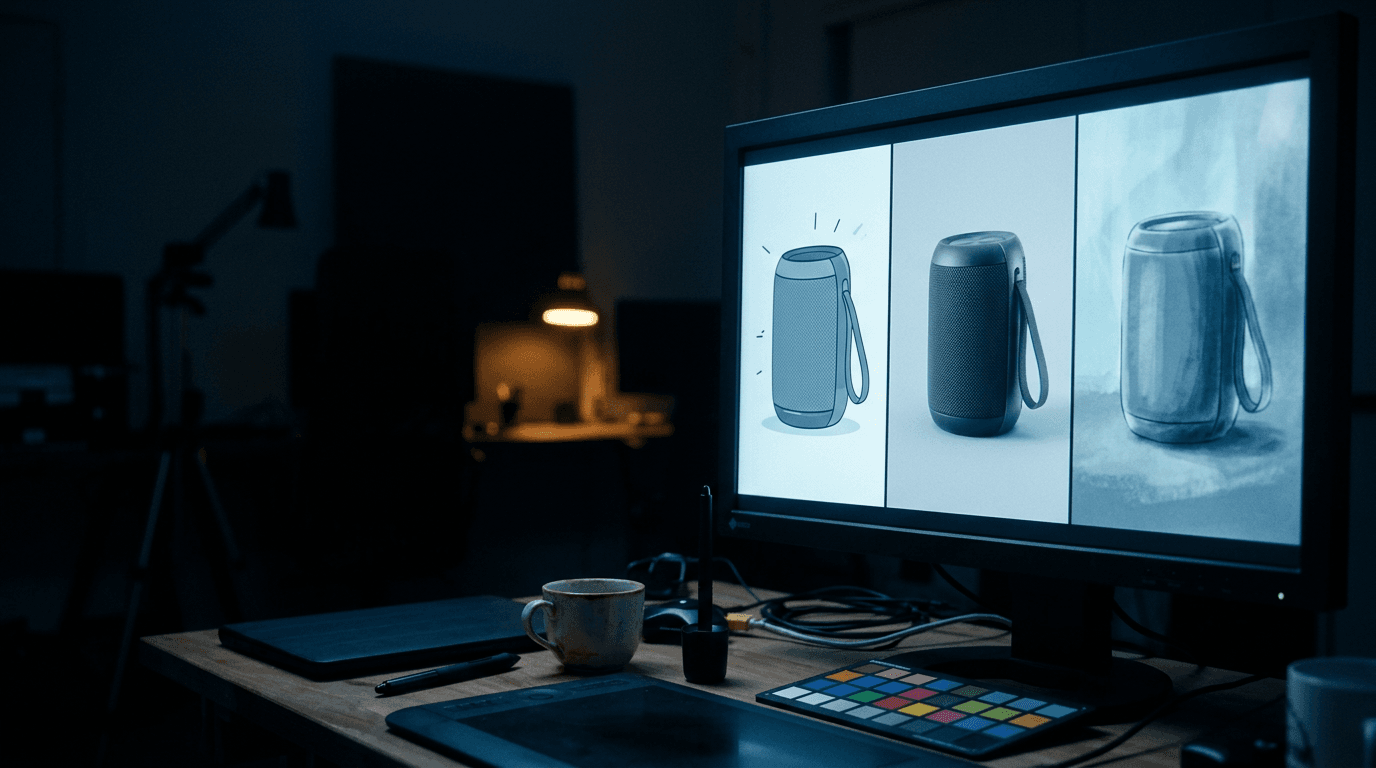
The Key Difference Between 2D and 3D Animation, in One Paragraph
2D animation is flat. It lives on a plane with height and width, and any sense of depth is an illusion the artist draws. 3D animation adds depth by building the scene in three-dimensional space, so a camera can move through it and light behaves the way it does in the physical world. Every other difference between 2D and 3D animation, cost, timeline, revision flexibility, follows from that one thing.
That's it. Everything people argue about downstream comes from that single structural fact.
In 2D, a new camera angle means new art. Nothing is stored in a form a computer can re-photograph. Hand-drawn production redraws the in-between frames by hand; even vector-based 2D motion needs fresh drawing for a turn or a perspective shift. In 3D, you build the model once, rig it once, and after that you can shoot the same 3D scene from anywhere, relight it, and render it again. The labour sits at the front of the project instead of being spread evenly across every shot.
That front-loading is why 3D quotes look alarming. You aren't paying for animation. You're paying for 3D modeling, texturing, rigging and rendering before a single frame of movement exists.
Every Type of Animation: Where 2D, 3D, Motion Graphics and AI Sit
Before choosing between 2D and 3D, it helps to know the full menu. Each type of animation used in business video, and what it's actually for:
- Traditional / frame-by-frame 2D: every frame drawn. Warmest, slowest.
- Vector 2D: shapes and puppets rigged for reuse. The commercial default.
- Motion graphics: a 2D subset built from type, shapes, data and UI.
- Stop motion: physical, photographed. Rare in B2B, gorgeous when used.
- 3D computer animation / CGI: modeled, rigged, lit, rendered.
- AI-hybrid: generative models inside a directed animation pipeline.
Every animation type below the first two shares the same underlying decision: are you drawing a picture of a thing, or building the thing and pointing a camera at it?
What Actually Decides the Right Style
Five factors, in the order that should matter:
- What the video has to prove. Showing how a physical product works needs dimensional accuracy. Explaining an idea does not.
- How long the asset has to live. A campaign with twelve variants over two years rewards reusable 3D assets. A one-off launch film does not.
- Deadline. Some briefs are decided entirely by the calendar.
- Budget shape. Not just the total, but whether you can spend heavily up front or need cost spread thin across the timeline.
- Brand voice. Some brands look wrong in photoreal 3D. Warmth and stylisation are a legitimate reason to pick a 2D visual style.
Budget is fourth on purpose. Teams that lead with budget usually buy the wrong animation style cheaply, then pay a second time to fix it. Choose the best style for what the video has to prove, then work out how much of it you can afford to animate at that quality.
2D Animation: Character Animation, Production Cost, Best Use Cases
2D animation is the workhorse of business video. Explainer video, onboarding, training courses, whiteboard animation, brand storytelling, social cutdowns. It's also where most animated marketing content still gets made. It's forgiving, it's fast to change early, and a strong 2D character can carry personality that a mid-budget 3D character simply can't afford to.
The economics are honest. Professional 2D character animation sits around $3,000 to $10,000 per finished minute globally, and roughly ₹40,000 to over ₹1,10,000 per minute with Indian studios as of mid-2026. Simple 2D motion and whiteboard animation sit below those bands, which is why they dominate the budget end of the market.
Speed is where the myth breaks. 2D animation is cheaper, not instant. Frame-by-frame animators average three to five seconds of finished animation in a working day, and a finished 2D minute typically absorbs 100 to 300 hours of work. A 60-second character piece runs about six to eight weeks of production time.
When to Choose 2D: Explainer Video, Whiteboard Animation, 2D Character Work
Choose 2D if your video explains a concept, a service, a process or a piece of software. Choose 2D if you want stylisation and warmth. Choose 2D if you need the first cut in five weeks rather than fourteen. Choose 2D if there's no physical object whose shape is the point of the story.
Don't choose 2D if you'll need forty variations of the same scene from different angles. That's where the redrawing tax compounds, and where 3D quietly becomes the cost-effective option.
3D Animation for Your Project: Strengths, Production Cost, Best Use Cases
3D animation exists for one reason: physical truth. Depth, perspective, weight, motivated lighting, materials that behave like materials. When the product is the hero and the audience has to believe it, realistic 3D isn't a preference. It's a requirement.
The 3D pipeline explains the price. 3D modeling, then texturing, then rigging, then character animation, then lighting, then rendering, then compositing. Each stage has a specialist and its own animation tools. Rendering alone can eat days of machine time on a complex 3D scene.
Professional 3D animation typically starts near $5,000 per finished minute and runs past $25,000 for cinematic or broadcast work. Indian studios often quote ₹80,000 to ₹2,50,000+ per minute, with premium 3D animation services above that again.
Timelines follow the same shape: around 10 to 16 weeks for a polished 60-second 3D piece. The revision curve runs in the wrong direction too. Changing a 3D character's silhouette after the rig is built is not a tweak, it's a rebuild.
What you get back is reuse. Once the 3D assets exist, the second video costs dramatically less than the first. Studios selling 3D animation for business know this, which is why a good one pushes you toward an asset library rather than a single film.
When to Choose 3D: Product Demos, Realistic 3D, 3D Animation Services
Use 3D for 3D product demos of physical goods, machinery, medical devices and architecture, and for anything where a cutaway or an exploded view does the explaining. 3D animation is ideal if you're producing a series and can amortise the build across episodes. Choose 3D if photoreal realism is the message itself. Even a simple 3D turntable of a product beats an illustrated version when a buyer wants to judge proportions.
Skip it for a single explainer about a software workflow. You'd be paying for a capability the story never uses.
AI and Hybrid Animation: The Third Option
Here's where most comparison guides stop, and where the actual 2026 decision starts.
Full disclosure: we're an AI film studio, so we're biased. We also run this pipeline every week, which means we know precisely where it's still bad.
AI-hybrid animation doesn't replace 2D or 3D. It replaces parts of them. Backgrounds, in-betweening, style variants, previsualisation, dubbed and regional versions. The output can look flat and drawn or dimensional and photoreal, because the visual style is a direction decision now rather than a pipeline constraint.
What the AI Animation Workflow Actually Looks Like
It's less magical than the demos suggest. On Unmasked, our seven-award narrative short, the workflow ran in this order: character sheets first, then environments and scenes, then character placement per camera angle, then prompted performance, then a lip-sync pass, then upscaling. Five to six video models, two image models trained for character consistency, three to four lip-sync models.
The numbers nobody publishes: we generated between one and one and a half hours of footage for an eight-minute film. Only five to ten percent of AI generations were usable. One climax effect that runs 15 to 20 seconds on screen took 150 to 200 generated clips. The whole film took about three months, and the first 20 to 25 days were spent writing the screenplay, before a single frame existed.
As our founder puts it: "AI filmmaking is not just prompt engineering. It's very much like an animation film process. It's very tedious."
The model stack turns over constantly. Workflows we built in 2024 stopped working in 2025, and the 2025 versions aren't what we run today. As of mid-2026, Seedance with omni reference is the workhorse for character and style consistency, with Kling and Veo in rotation. Nano Banana was the inflection point that ended tedious fine-tuning for character consistency in image work.
Where AI Animation Still Loses
Precision. If a client needs a bolt in exactly the right place on a machine, a 3D model wins and it isn't close.
Repeatability at the frame level. A traditional 3D scene can be re-rendered identically a year later. Generative work gives you an approximation you can steer, not a file you can reproduce.
And the honest cost picture: production cost falls, total cost falls less. Our founder's framing is that a ₹500 Cr film becomes feasible at ₹5 to 10 Cr, not ₹5 lakh. Writing, music, editing, sound design and judgement don't get cheaper. Eighty percent of the work is still done at the scripting table.
There's a market reason to care about craft here. Consumer comfort with brands using AI fell from 57% to 46%, and 57% of people say they worry about fake AI ads. Audiences don't reject AI. They reject slop. That's why we treat AI animation as an animation film process with a director attached, and why we don't ship raw generations.
2D vs 3D Animation Cost Comparison: Timelines and Revisions
The per-minute number is the one every animation studio quotes and none of them actually bill on. Use it to sanity-check a quote, not to build a budget. For rate depth, we broke down what animation actually costs per minute in a separate guide.
What moves the number, in every style:
- Character count. Each new character is a new build in 3D and a new set of drawings in 2D. Every character you animate is a separate line item.
- Duration. Per-minute rates fall on longer projects. A five-minute film never costs five times a one-minute film.
- Revision rounds. Two rounds is standard. Open-ended feedback is where budgets die.
- Audio. Voice, score and sound design are separate line items, and they're the ones clients forget.
- Rendering and delivery specs. 4K, long-form and high frame rates all cost machine time at the back end.
On revisions specifically: 2D is cheap to change at storyboard and expensive after animation. 3D is cheap to change before rigging and brutal after. AI-hybrid is cheap to iterate at any stage and expensive to lock, because "almost right" arrives quickly and "exactly right" takes passes.
Compared to 2D animation, 3D front-loads both cost and risk. Compared to both, AI-hybrid front-loads decision-making, because the pipeline will happily generate a thousand near-misses if nobody is directing it.
Choosing Between 2D and 3D: Which Animation Type Is Right for Your Project
| Your project | Best fit | Why |
|---|---|---|
| SaaS or service explainer video | 2D | Concept, not object |
| Physical product launch | 3D | Shape and materials are the message |
| Machinery or medical device | 3D | Cutaways and dimensional accuracy |
| Training course, multi-module | 2D | Volume at sane cost |
| Data, UI or brand system piece | Motion graphics | Type and shapes, no characters |
| Brand film with a stylised world | AI-hybrid | Worlds you can't build or shoot |
| Ad in 8 regional variants | AI-hybrid | Variant cost approaches zero |
| Concept validation before a big spend | AI-hybrid | Test the idea before you fund it |
| Kids' or educational series | 2D or AI-hybrid | Character warmth over realism |
| Product series, 12 videos over 2 years | 3D | Reuse pays the build back |
If you're still choosing between 2D and 3D after that table, the tiebreaker is simple: does a viewer need to understand a shape? Yes means 3D. No means 2D. And if the answer is "yes, but we can't afford 3D," that's the conversation where AI-hybrid previsualisation usually earns its place.
2D or Motion Graphics? Choosing a Visual Style for Data and UI
Motion graphics keeps getting dragged into the 2D vs 3D comparison, and it doesn't quite belong. It's a subset of 2D animation focused on type, shapes, data and interface rather than characters. Nobody rigs a bar chart.
Choose motion graphics over 2D character animation when the story is numbers, product UI, or a brand system in motion. It's usually the most cost-effective professional option on the table, and often the right one for a 30-second social piece. Choose character animation when you need someone on screen for the audience to like.
Frequently Asked Questions
What is the main difference between 2D and 3D animation? 2D animation is flat, built from drawings or vector shapes, so depth is an illusion. 3D animation adds depth by building the scene in three-dimensional space, so a camera can move through it and lighting behaves physically. Every difference in production cost, timeline and revision flexibility follows from that key difference.
Is 2D or 3D animation cheaper to produce? 2D animation is often more affordable than 3D, usually by a factor of two or more per finished minute, because it skips 3D modeling, rigging and rendering. The exception is a long-running series, where reusable 3D assets can win on total cost after the first few videos.
How is AI animation different from traditional animation? AI animation replaces stages rather than the whole craft. Generative models handle backgrounds, in-betweens, style variants and language versions inside a directed workflow. Direction, writing and cleanup stay human, and only a small fraction of raw generations are usable, so the savings land in production, not across the whole project.
Which animation style is best for a product marketing video? 3D, if the product is physical and its shape or mechanism is the selling point. 2D or motion graphics, if you're selling software, a service or an idea. AI-hybrid, if you need many variants fast or a stylised world that would be expensive to build for real.
When should I choose 2D animation? Choose 2D when you need clean, stylised, budget-friendly work at speed: explainer videos, training modules, onboarding, and character-led brand stories. Choose it also when your brand's voice suits illustration more than photorealism.
Why is 3D animation preferred for physical products? 3D simulates depth, perspective, lighting and real-world physics, so a viewer can judge scale, material and mechanism. That makes it the best fit for detailed machinery, medical devices and physical goods that need to be seen from any angle.
Still Unsure? Ask an Animation Studio Which Style Fits
We're a quality-driven AI film studio. Narrative films, premium international microdramas, highly stylised animation, ad films and long-form work, all directed rather than generated. Gibbon's Grove was stylised 3D AI animation. Unmasked was a narrative short that took six international festival honours. Different styles, one rule: no raw AI artifact goes unpolished.
Bring the brief and the deadline to a 30-minute call and we'll tell you which animation type your project actually needs, including the times the honest answer is traditional 3D animation services and not us.
Book a style consultation · See the work · AI animation studio services
Related reading: complete guide to AI animation · how AI animation is actually made · stylised and anime-style work · kids' and educational animation · animation studios in Hyderabad
Written by MSN Karthik, Founder & Director at Adwhyta. IIT Guwahati alumnus, co-founder of Zipy.ai, TEDx speaker, and award-winning AI filmmaker whose short "Unmasked" won 7 international AI film awards including Gold at the Bali International AI Film Festival. He once made a festival-screened sci-fi short for under $75.
Rates verified August 2026 against published studio rate guides. Model stack current as of mid-2026. Re-verify quarterly.