Key Takeaways
- AI models have no memory between generations. Every new clip rebuilds your character from scratch, which is why faces drift.
- Drift is one of the fastest routes into the uncanny valley, and audiences punish it instantly.
- Consistency is won before generation: character sheets, turnarounds, and reference stacks, then per-angle placement into each scene.
- As of mid-2026, reference-based AI models (Seedance with omni reference, Kling 3) have largely replaced LoRA training for film work.
- Drift you can't prevent, you repair: a dedicated fix pass with inpainting, regeneration triage, and upscaling.
- On our award-winning short Unmasked, only 5-10% of generated footage was usable. Character consistency is a process, not a prompt.
How do you get consistent characters using AI? You lock identity before you generate: build a character sheet and turnaround set, place that same reference into every scene per camera angle, generate with reference-conditioned AI models, then repair residual drift in a post fix pass. Consistency comes from pipeline discipline, not from a clever prompt.
Here's the problem that ends most DIY AI film projects. You generate a beautiful clip of your lead character. Then you generate the next one, and she has a different jawline. Third clip, her costume changed color. By shot ten you're not making a film anymore. You're running a casting call for strangers who vaguely resemble each other.
I've been fighting this exact problem since the Stable Diffusion days of 2022, and at Adwhyta we've built our whole production pipeline around beating it. This article is the full technical picture: why drift happens, how we prevent it in our AI filmmaking work, and what it took to hold one character's face steady across an entire award-winning short film.
Why Do AI Characters Drift Between Shots?
The technical reason is almost disappointingly simple. A generative AI model doesn't remember anything. Each generation is an isolated sampling event from latent space. When you ask for "a woman in a red Theyyam costume, close-up," the model reconstructs that woman from scratch, every single time. It has no idea she existed five minutes ago in your last render.
Within a single clip, you usually get stability for free. The model processes one temporal sequence in one context, so frame 40 inherits identity from frame 1. That's within-clip stability, and modern AI models handle it well, including facial expressions holding through a performance.
Cross-clip identity is the real fight. The moment you start a new generation, the identity contract is void. Same prompt, new face. And text is a terrible identity anchor. "Sharp jawline, almond eyes, silver nose ring" describes roughly four hundred million people. The model will happily pick a different one of them per render. Certain characters are simply difficult to generate reliably from text at all: heavy costume, unusual features, anything far from the center of the training dataset.
Three things make it worse:
- Angle changes. A character described from the front gives the model almost nothing to hold onto in profile. New geometry gets invented.
- Scene changes. New lighting and new environment shift the whole distribution the model samples from, and the face shifts with it.
- Model changes. Real productions mix AI models (one for dialogue, one for physics, one for action). Each has its own idea of your character baked into its training data.
So the question isn't how to write a better character description. It's how to stop relying on descriptions at all.
Drift Is How You Fall Into the Uncanny Valley
Before the techniques, it's worth naming why this matters so much. The uncanny valley, described by roboticist Masahiro Mori back in 1970, is the sharp dip in comfort we feel when something looks almost human but not quite (his original essay is worth reading). A cartoonish character sits safely outside the valley. A photorealistic character who's 97% right falls straight into it. That's the uncanny valley effect in one sentence: the closer you get to a real human without arriving, the worse it feels.
Character drift is one of the fastest routes in. Viewers might not consciously notice that your lead's eyes sit two millimeters wider in scene three. Their nervous system notices. The emotional response is instant and unkind: something is off, this looks robotic, disengage. That uncanny valley feeling doesn't register as a technical critique. It registers as distrust, and all the empathy you built in scene two evaporates. Emotional storytelling depends on the audience believing the character is one continuous person, and realism without consistency actively works against that authenticity.
For brands, this is a commercial problem as much as an aesthetic one. Consumer comfort with AI in advertising fell from 57% to 46% in a single year, and 57% of consumers say they worry about fake AI ads (survey data as reported by MarketingCharts). When people see AI content, they aren't rejecting AI video as a category. They reject the almost-right kind. A consistent character who emotes believably reads as quality and craft. A drifting one reads as slop, and it takes your brand's credibility down with it.
The good news: you can avoid the uncanny valley with process. That process is the rest of this article.
The Character Lock System (Sheets, Turnarounds, Reference Stacks)
At Adwhyta we treat a character the way an animation studio treats one: as an asset that gets designed, approved, and locked before a single shot is generated. Our pipeline on every film runs in this order: character sheets first, then environments and scenes, then placement of the character into each scene from each specific camera angle, then performance, lip-sync, and upscaling passes.
The character sheet is the foundation. For each principal character we build:
- A neutral identity set: front, profile, three-quarter, and back views under flat, even lighting. This is the turnaround, and it's the closest thing the character has to a birth certificate.
- Expression and emotion variants, because a face that only exists smiling will drift the first time it needs to grieve. Locking facial expressions early also protects performance later.
- Costume and prop references shot clean, since outfits drift even more readily than faces.
- Lighting variants: the same face under warm firelight, hard noon sun, and blue night ambience, so no scene forces the model to improvise.
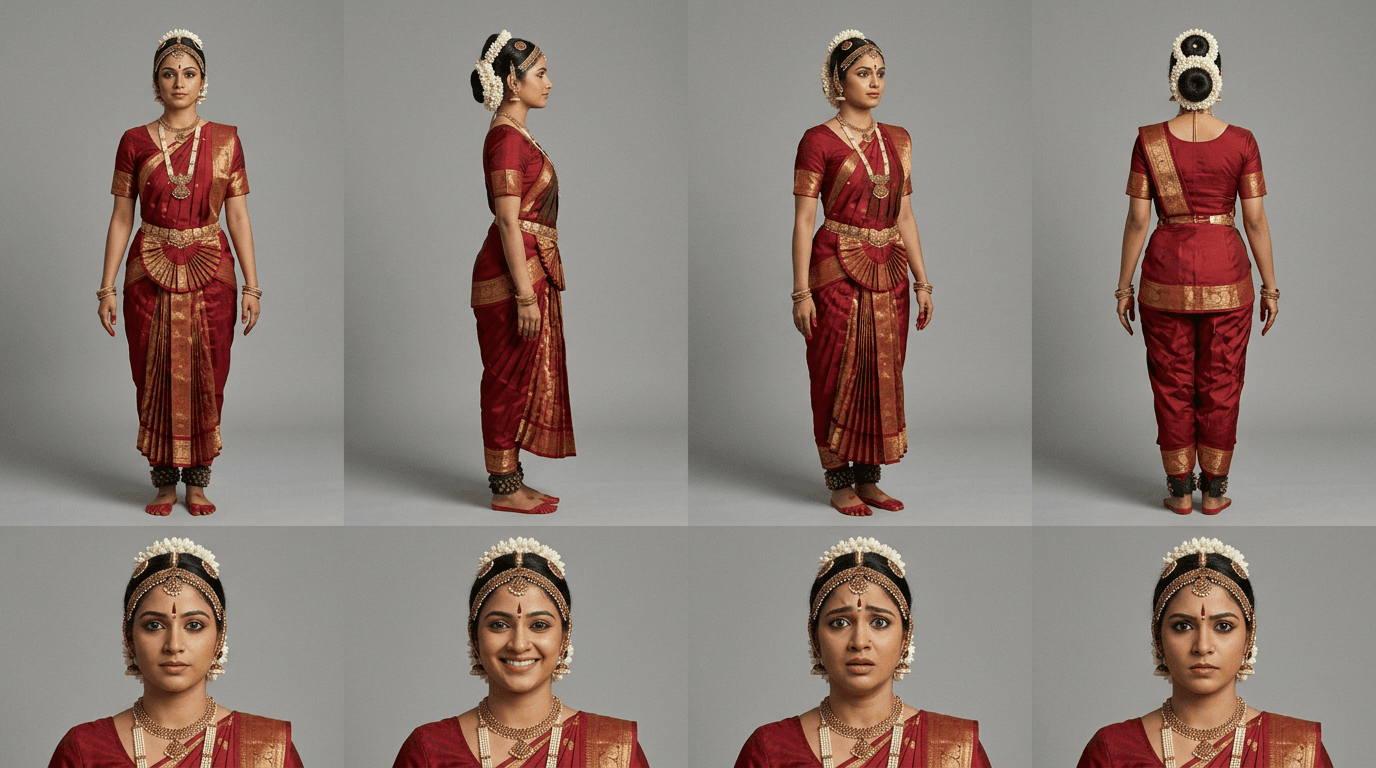
From those sheets we assemble a reference stack: the curated set of reference images that rides along with every generation request involving that character. When we generate a scene, we don't describe the character to the model. We show her to it, from the angle the shot needs, in lighting that matches the scene. That per-angle placement step is the part most DIY workflows skip, and it's the single biggest consistency lever we've found. A front-facing reference does very little for an overhead shot. The reference must answer the exact question the shot is asking.
Two practical rules make the system hold at production scale. First, version the stack. When a character's look evolves during development, retire the old references completely, because a stack with mixed generations of the character will reintroduce drift on its own. Second, lock before volume. We never start batch-generating coverage until the character sheet is approved, for the same reason animation studios don't start animating before the model sheet is signed off.
Seed and Reference Strategies by AI Model (as of Mid-2026)
The tooling here turns over brutally fast. Workflows we built in 2024 didn't survive 2025, and our 2025 workflows aren't what we run today. So treat everything in this section as a mid-2026 snapshot, and treat any article without a time anchor with suspicion.
The big shift of the past couple of years: fine-tuning gave way to reference conditioning. We used to run LoRA training on Flux, teaching custom LoRAs a character from a dataset of 20-40 images so identity lived in the model weights. It worked, and it was tedious. Then Nano Banana arrived and changed the approach overnight. Suddenly a strong image model could hold identity from reference images alone, with no training run, and character sheets became something you generate and iterate in an afternoon. (Midjourney's character reference feature brought a lighter version of the same idea to its own ecosystem.)
Here's how the main approaches compare for filmmaking right now:
| Approach | How it locks identity | Where it fits best |
|---|---|---|
| Omni reference generation (Seedance) | Multiple reference images conditioned directly into video generation | Our current workhorse for character and style-consistent shots |
| Multi-reference anchoring (Kling 3) | Character references anchored across multi-shot generations, with native lip-sync | Dialogue scenes and multi-shot sequences |
| Character sheets + image-to-video | A locked still used as the starting image for animation | Precise framing control, hero shots, per-angle placement |
| LoRA training (Flux-era, legacy) | Fine-tuned adapter bakes the character into model weights from a training dataset | Very high shot counts in one visual style, ComfyUI-based teams |
| CGI hybrid (MetaHuman, UE5) | An actual 3D asset that cannot drift, rendered then AI-enhanced | Projects needing frame-perfect identity or real-time work |
A few notes from the trenches. Seed values are a stability aid, not an identity system. Reusing a seed keeps composition and mood in the neighborhood, which helps two shots feel related, but a seed will not hold a face across scene changes. References do that.
The image-to-video path deserves more respect than it gets. Pure text-to-video asks one model to invent identity and motion simultaneously. Generating a locked starting image first, then animating it, splits one hard problem into two easier ones: get identity perfect in a single frame you can inspect, then ask the video model only to move it. When a shot absolutely must match, that's the route we take.
And LoRA training isn't dead, it's just niche now. If you're producing hundreds of video clips of one character in one style, trained LoRAs still pay for their setup cost. For most film work, reference stacks got faster, better, and infinitely more flexible.
On Unmasked, our custom workflow combined five to six video models and two image models trained for character consistency, plus three to four lip-sync models and 4K upscaling on top. Not because we enjoy complexity. Because each model has different modalities and different failure points, and the reference stack is what keeps one identity coherent across all of them. Tools like Runway sit in that rotation too, alongside the others, depending on what a shot needs. Prompt engineering still matters for performance and camera, but it's the reference discipline underneath that decides whether your character survives the edit.
How to Get Consistent Characters Using AI (The Short Version)
If you want the condensed, do-this-today workflow for using AI to keep a character stable, here it is:
- Design the character once, properly. Generate a turnaround sheet (front, profile, three-quarter, back) plus expressions in one session, in one style.
- Approve and freeze it. This sheet is now canon. Nothing generates without it.
- Build the reference stack. Pull the sheet views plus costume and lighting variants into the set of reference images every generation uses.
- Match reference to shot. For each new shot, feed the views and lighting closest to that camera angle. Front references for front shots, profiles for profiles.
- Prefer image-to-video for hero moments. Lock a perfect still first, then animate it, instead of asking text-to-video to reinvent identity in motion.
- Reuse seeds within a scene for compositional continuity, never as your identity system.
- Inspect in edit context, not in isolation. Cut shots together early. Drift shows up between two shots, not inside one.
- Fix or reroll, then unify with a single upscaling and grading pass.
That's the whole game for a solo creator or a small team making short films. A studio runs the same loop with more formality, more models, and far more discarded footage.
Avatars, MetaHumans and Non-Human Characters
A quick detour, because the consistency conversation is bigger than photorealistic human leads.
If your project needs an ongoing digital presenter or brand avatar, the calculus shifts toward CGI-hybrid pipelines. MetaHumans in UE5 are proper 3D models, so identity literally cannot drift: the geometry is the character. The trade-off is that pure CGI needs heavy craft to simulate genuinely lifelike, human-like performance, which is why we sometimes render a MetaHuman base and use AI applications on top for skin, light, and micro-movement realism. That hybrid gets you CGI's stability with generative AI's texture, and it's the closest thing to a drift-proof avatar that still feels alive rather than hyper-realistic mannequin.
Non-human characters are, counterintuitively, easier. A stylized creature or cartoony mascot sits far from the uncanny valley, so audiences forgive small inconsistencies they'd never forgive on a human face. The same sheet-and-stack discipline applies, but stylization gives you margin. This is one honest argument for animation-styled AI film work when a project's budget can't support photoreal consistency standards, and traditional film references still guide how we block and light those characters.
One boundary we hold: consistency techniques and deepfake techniques are cousins, and we only ever apply them to characters we created or to a real human likeness with explicit written consent. Likeness rights in AI-generated work are a live legal topic, and a studio that's careless there is a liability to its clients.
Style Drift Is the Same Disease in a Different Body
Everyone worries about faces. Fewer people notice their film's entire look sliding until it's too late. Style drift is when scene one feels like moody 35mm celluloid and scene four has quietly become a glossy video game cutscene. Same characters, same story, and it still reads as three different projects stitched together.
The cause is identical to face drift: every generation resamples the aesthetic, and text descriptions of a look are as leaky as text descriptions of a face. The cure is also identical. We build a style bible alongside the character sheets: reference frames that lock palette, grain, contrast behavior, lens feel, and the exact degree of stylization, from grounded realism through deliberate animation looks. Those style references ride in the stack with the character references on every generation.
The stylization level is the setting to guard most jealously. Realistic and cartoonish are both stable places to stand. The gradient between them is a slide. If your film sits at "painterly but grounded," a scene that drifts 10% toward photorealistic will feel wrong in a way that's very hard to diagnose after the fact. Name the level, reference it, and check every batch against it.
Across episodes and campaigns the risk compounds, because months pass and AI models update between productions. The style bible is what makes episode six match episode one even when the underlying tools changed twice in between.
Repairing Drift in Post (The Fix Pass)
Prevention gets you most of the way. It never gets you all the way, so our workflow ends every film with a dedicated fix pass. Ours looks like this:
- Triage. Review the AI-generated footage specifically for identity breaks. Grade each shot: usable, fixable, or regenerate. On a real production most drift is caught here, in edit context, where a face that looked fine in isolation suddenly doesn't match its neighbors.
- Regenerate the hopeless. When identity is badly broken, rerolling with a corrected, angle-matched reference is almost always cheaper than surgery. This is where the wastage lives, and you should budget for it honestly.
- Repair the fixable. Targeted inpainting to rebuild a face region against the reference sheet, face-consistency passes for shots that are right everywhere except the face, and cleanup compositing for costume and prop breaks.
- Unify in the finish. A consistent upscale pass (Topaz-class tools plus our own custom 4K upscaling step) and a proper color grade pull the surviving shots into one texture. Grade hides a multitude of small sins. It will not hide a different jawline.
Our studio rule is blunt: no raw AI artifact goes unpolished. We don't ship raw generations, and honestly, the fix pass is where a lot of the "wait, this is AI?" reaction to good AI film work comes from. More on how this fits the wider edit in our post-production piece: AI film editing and post.
What Unmasked Taught Me About Consistency in AI Filmmaking
Theory is nice. Here's what it costs in practice.
Unmasked is our 8-minute narrative short about a Theyyam dancer and a Gen-Z vlogger. It went on to win seven international AI film awards, including Best AI Short (Gold) at the Bali International AI Film Festival and Best Cinematography at Indywood AI Cinefest. One lead character, heavy ritual costume and makeup, emotional close-ups, dance sequences, VFX. In other words: a consistency stress test from every direction at once.
The honest numbers. The film took a little over three months end to end, and the first 20-25 days were purely screenwriting, because as I keep telling people, 80% of the work is done at the scripting table. To cut 8 finished minutes, I generated between one and one and a half hours of footage. Only 5-10% of AI generations were usable. The climax VFX effect, which is on screen for maybe 15-20 seconds, took 150-200 generated clips to get right.
Every one of those unusable clips died for a reason: a wrong camera move, a broken hand, a random new character wandering in, or our lead wearing a subtly different face. The character sheet pipeline is what kept the usable 5-10% coherent, so that shots generated in December (on that month's models) could sit in the same film as VFX shots generated three months later on much better ones. The references held identity steady while the entire toolchain shifted under our feet.
AI filmmaking is not just prompt engineering. It's very much like an animation film process, and it's tedious in exactly the way animation is tedious. What the audience experiences as one continuous person is actually hundreds of decisions and a mountain of discarded footage. When people see AI films that feel like cinema, this invisible discipline is what they're actually responding to.
Can You Hold Consistency at Series Scale?
Yes, and this is exactly where process separates studios from AI tools. One film is a sprint. A brand campaign with regional variants, an episodic microdrama, or a long-form project is where small drift rates compound into chaos.
Scale changes three things. Asset locks become formal: signed-off character sheets, style bibles, and versioned reference stacks that any generation, by anyone, on any model, must draw from. Continuity becomes a tracked discipline, the AI-era equivalent of the script supervisor's binder. And model churn becomes certain rather than possible, so your identity system has to live outside any single model. That's the deeper reason we build reference-first rather than fine-tune-first: reference images are portable across the next model generation. Trained weights usually aren't.
This applies across everything we make, whether it's narrative film, international microdramas, stylised animation, ad films, or long-form work. The consistency system is the same spine every time. It's also why our craft articles fit together the way they do: consistency is an asset-lock stage of the nine-stage AI film pipeline, downstream of the style bible and upstream of shot generation and prompting and cinematography decisions.
Questions Filmmakers Ask About Character Consistency
Why does my AI character's face change in every new clip?
Because the model has no memory between generations. Each clip is rebuilt from scratch out of latent space, and a text description is too loose an anchor to pin one specific face. Without reference images conditioning the generation, you're asking for a face type and getting a new member of that type each time.
What's the difference between within-clip stability and cross-clip identity?
Within-clip stability means the character stays consistent across the frames of one generated clip, which models handle well because it's a single temporal sequence. Cross-clip identity means the same face, hair, and costume across separate generations, and that only comes from reference conditioning, locked starting images, or a trained character model.
Can you use LoRAs for video character consistency?
You can, and in ComfyUI-era workflows a trained LoRA was the standard answer: fine-tune an adapter on a dataset of your character's images so identity lives in the weights. As of mid-2026 it's the legacy path. Reference-based generation delivers comparable identity with no training run, so we reserve LoRA training for very high shot-count projects in a single locked style.
How do you avoid the uncanny valley in an AI film?
Pick a stylization level deliberately and hold it. Fully stylized characters sit safely outside the valley. If you go photoreal, consistency becomes non-negotiable: locked identity, real emotional performance direction, and a fix pass that removes the robotic tells (dead eyes, waxy skin, micro-drift between shots). Most uncanny AI content fails on consistency and performance, not on resolution.
What's the best AI tool for character consistency?
The honest answer: no single tool. As of mid-2026 we lean on Seedance's omni reference for consistent character generation, Kling 3 for anchored multi-shot dialogue, and locked stills for hero shots, with everything fed by the same character sheets. The tool matters less than the reference discipline behind it. Tools change every few months. The system is what survives.
Struggling With Drift? It's the First Problem We Solve
If you've fought this yourself, you now know the shape of the real answer: character consistency is a pipeline you run, not a feature you buy. Sheets, turnarounds, reference stacks, per-angle placement, model-specific strategies, and a ruthless fix pass, all before anyone talks about a finished film.
That pipeline is the spine of everything Adwhyta makes as a full-spectrum, quality-driven AI film studio, from ad films and brand campaigns to narrative shorts, international microdramas, stylised animation, and long-form projects. It's the reason our characters hold their faces, and a fair chunk of the reason our work keeps winning festival laurels.
If your brand or production needs characters that stay themselves across an entire campaign or series, commission a film or book a 30-minute consultation. Bring your hardest drift problem. We collect them.
Written by MSN Karthik, Founder & Director at Adwhyta. IIT Guwahati alumnus, co-founder of Zipy.ai, TEDx speaker, and award-winning AI filmmaker whose short "Unmasked" won 7 international AI film awards including Gold at the Bali International AI Film Festival.