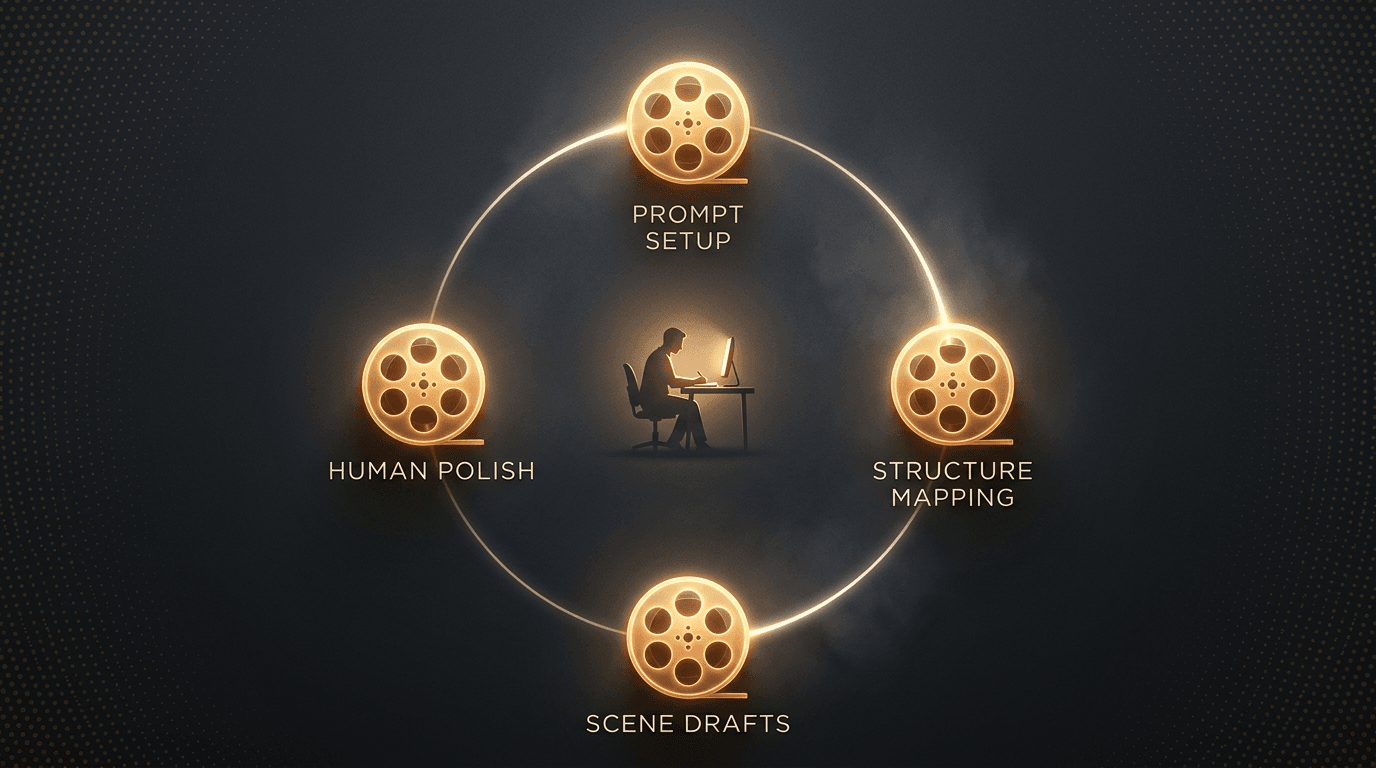
AI script writing is a collaborative process where writers use AI to research, structure, and draft scripts for video and film while keeping every creative decision human. Done right, it follows four steps:
- Prompt Setup: Define genre, central conflict, and scene goals.
- Structure Mapping: Build the beat sheet before any prose exists.
- Scene Draft Generation: Generate rough scene drafts against locked beats.
- Human Polish: Rewrite every line — especially dialogue — in your own voice.
I'm going to argue for a version of this that sounds slower than the sales pitch, because it is. It's also the version that survives contact with an audience.
Quick credential, so you know where this comes from: I run Adwhyta, an AI film studio. Our short Unmasked won awards at six international festivals in 2026. The production took about three months — and the first 20 to 25 days were spent doing nothing but writing the screenplay. No generation. No treatment. Actual writing.
Key Takeaways
- AI is a script assistant, never an author. It compresses research and structure work dramatically; it cannot decide what your movie script is about.
- Structure first. Lock the beat sheet before you let AI write prose. Pages before beats is how you get fluent nonsense.
- The dialogue problem is real. AI dialogue is where your writing voice goes to die. Every line gets a human rewrite pass.
- Speed claim, from production: a research-heavy screenplay that once took me ~3 months now takes ~10–20 days with AI research assistants. The writing time didn't disappear — the busywork did.
- Credits: under the WGA's 2023 agreement, AI can't receive writing credit. Copyright on an AI-assisted script is narrower than most tools imply.
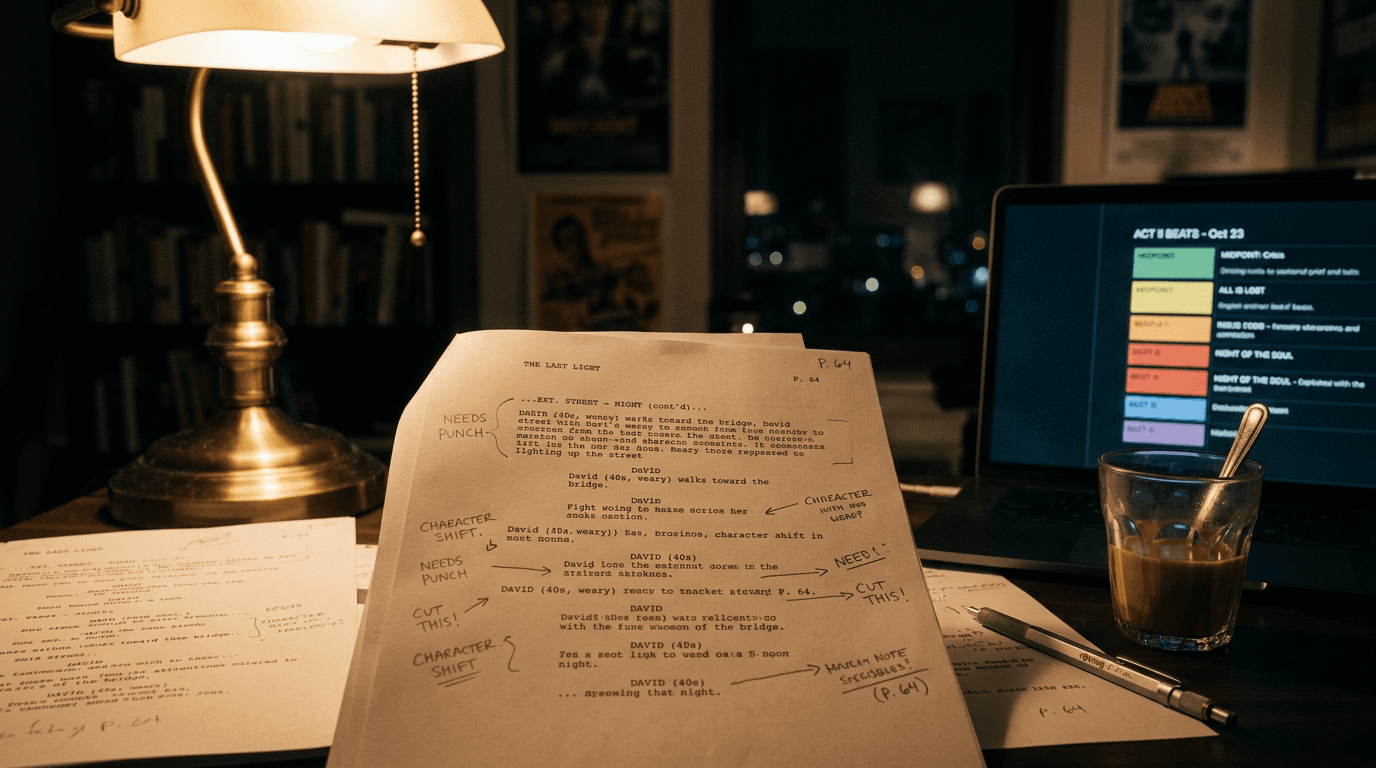
AI as Co-Writer: How an AI Script Writer Actually Helps
An AI script writer works best as a development department, not a screenwriter: it researches your world, proposes structures, generates coverage of your drafts, and produces rough scene passes. The writer makes every choice about story, meaning, and voice. AI provides options; the human provides the film.
Here's my honest position, and it hasn't changed since I started to use AI at the writing table: 80% of a film's work is done at the scripting table. Not on set, not in the edit — at the table. Which is exactly why the scripting table is the last place you fully hand over to an AI generator.
Before AI, I once spent a year and a half writing 25 drafts of a feature film script, with focus groups in between. Today I run script assistants — research bots and LLM agents — that handle the reading, the fact-finding, the "what are eight ways this second act could turn" grunt work. A research-heavy screenplay that would have taken me three months of writing now takes ten to twenty days with AI assistance. That's not hype; that's my working reality on Unmasked — and I still spent 20–25 days writing that film myself.
Notice what changed and what didn't. The busywork compressed. The authorship didn't move an inch. AI is transforming how fast a screenwriter gets to the real decisions; it hasn't touched who makes them. There is no such thing as an AI screenwriter — there's an AI assistant, and AI can help with everything around the writing: research, options, coverage. Use AI to create options, never decisions.
There's a production reason for this, beyond craft pride. In an AI pipeline, only 5–10% of what the models generate is usable — for Unmasked I generated over an hour of footage to cut an 8-minute film. A vague script multiplies that waste, because every fuzzy scene becomes fifty fuzzy generations. A good script is the cheapest form of precision in the entire AI film pipeline.
Structure First: Beat Sheets Before You Prompt
The single biggest mistake in script writing with ChatGPT, Claude, or any AI chat tool: asking for pages before the structure exists. Ask AI for pages and it will happily generate a script — fluent, formatted, confident pages assembled from the statistical average of every screenplay it's seen. AI tends toward average. Average is the enemy.
The method that works inverts it:
- Write your premise and stakes yourself. One paragraph. If you can't, no writing assistant can help yet.
- Prompt the AI for structure options, not scenes. Ten ways the midpoint could turn. Five endings that betray the protagonist's want. You're using the model as a beat-sheet sparring partner, and AI can suggest turns you'd never have shortlisted — that's the useful part.
- Lock the beat sheet by hand. You choose. You reorder. You cut. This document is yours, and it's the contract for everything downstream.
- Only then let AI generate scene drafts — one scene at a time, with the beat's goal, the characters' wants, and the scene's exit condition in the prompt.
Why so rigid? Because structure is where a film is actually authored. Advanced AI systems can propose beats; they cannot know which beat is true to what you're trying to say. Once the beat sheet is locked, every AI draft is contained — a bad scene can't derail the story, because the story lives in a document the model doesn't control. Structure also sets pace: scene lengths and turn positions are pacing decisions, and they're yours.
That locked script is also what feeds the next stage of production — breakdown and AI storyboarding — so precision here pays twice.
What AI Can Generate Well (and the Dialogue Problem)
AI drafts research, structure options, coverage, action lines, and format scaffolding well. It writes dialogue badly: technically fluent, dramatically dead. Dialogue carries subtext, rhythm, and character voice — the things AI can only average. That's why every co-writing method ends with a human dialogue pass.
The honest capability split, from months of production AI usage:
| Task | AI alone | With the co-writing method |
|---|---|---|
| Research & world facts | Fast, needs verification | Excellent — verified by writer |
| Beat sheet options | Generic but useful | Strong sparring partner |
| Coverage / script analysis | Surprisingly sharp | Great second opinion — a script doctor on retainer |
| Action lines | Serviceable first pass | Good after trims |
| Dialogue | Fluent, dead, interchangeable | Human rewrites every line |
| Endings | Predictable | Human territory, full stop |
| Theme & meaning | Absent | Never delegated |
The script-doctor row deserves a note: paste in your script and ask AI what's sagging, and the coverage you get back is often sharper than the generation it produces. Ask AI to diagnose; don't ask it to author.
The dialogue problem deserves its own paragraph, because it's the reason "AI cannot write your script" stays true even as ai models improve. Good dialogue is people not saying what they mean. Models are trained to say exactly what things mean, as smoothly as possible. So an AI draft arrives with the subtext pre-dissolved: characters announce feelings, answer questions directly, and all speak in the same register. A generated script reads fine. It plays dead.
The fix is the dialogue pass: let AI help with the scene's skeleton — who enters, what's exchanged, where it turns — then rewrite every spoken line yourself. Give characters back their evasions, interruptions, and verbal tics. Read it aloud. If two characters could swap lines without anyone noticing, keep rewriting.
The Rewrite Method: Keeping Your Writing Voice at AI Speed
Your writing voice doesn't survive by accident. It survives because you rewrite.
The working rule at our studio: no AI output ships untouched. Not because every AI sentence is bad — because voice is cumulative. One generic line is invisible; three hundred of them are a style. The rewrite method:
- Rewrite forward, not backward. Don't polish AI prose; retype the beat in your own words with the AI draft as reference. Retyping forces your rhythm back in.
- Protect character cadence sheets. A half page per character: how they dodge questions, their sentence length, what they'd never say. Check every scene against it.
- Read aloud, always. Your ear catches what your eye forgives.
- Keep your weird. The odd image, the too-long pause, the joke that shouldn't work — models sand these off. They're your fingerprint. Put them back.
On Unmasked, this is where those 20–25 writing days went. The research assistants had done their job in days. The remaining weeks were the actual writing: me, rewriting until a Theyyam dancer and a Gen-Z vlogger sounded like two specific people instead of two positions in an essay. The models changed twice during that production; the screenplay never had to.
How Do You Choose an AI Script Writing Tool?
The best AI script writing tools are the ones that fit your stage of work, not the ones with the longest feature list. For research and structure, a frontier AI chat model (Claude, ChatGPT/OpenAI) beats a template tool. For drafting in screenplay format, use a script writing tool that formats natively. For video scripts, purpose-built generators are fine — for cinema, they're training wheels.
I won't rank tools — this is a craft guide, not a listicle, and every "best AI tool" roundup is outdated in a quarter. But the categories matter when you're choosing the right AI for the job:
- Frontier LLMs (Claude, ChatGPT) — the best AI script writing tools for the parts that matter: research, beat-sheet sparring, coverage. An AI chat interface with a long context window will read your whole draft and argue with you about it. The top AI writing tools all sit in this category now; a tool that helps you argue with your draft is worth ten that autocomplete it, and that's the only AI writing distinction worth paying for.
- Screenplay-native writing tools — Final Draft with AI features bolted on, or AI-era tools like Squibler's AI script generator and Saga, which output proper screenplay format directly. Useful as drafting environments; the formatting is real, the prose still needs you.
- Marketing-video generators — Jasper's YouTube script writer and similar tools can help a marketing team turn a brief into a serviceable video script fast. Know what they're for: an AI script generator is designed for volume — bulk script generation from templates — not for cinema.
Whatever you pick, the method doesn't change. How you use AI tools matters more than which ones you buy: AI tools can help you move faster through structure and drafts, and none of them removes the rewrite.
AI Video Scripts for Brands and Video Teams
A quick word for the video teams reading this, because brand work is half of what our studio ships. AI is transforming video production economics — 87% of marketers now use generative AI in at least one recurring workflow (Salesforce State of Marketing, 2026) — and the script stage is where most of that video creation quality is actually decided.
The co-writing method scales down cleanly to a 30-second commercial or a YouTube script. Lock the single idea (one conflict, one turn, one feeling) before you use AI to generate variants. Let AI produce ten hook options and structure the voiceover; keep a human rewriting the lines the audience will actually hear. Audiences are already drowning in generic AI content, and even the best AI video models can't save a weak script. High-quality video content isn't the result of a better generator — it's the result of a better script feeding the generator. The same 5–10% usability math applies to brand video content: precise scripts waste fewer generations, which is why our ad-film process starts at the writing table too.
Formatting for Production: Screenplay Format to Shot List
A screenplay is a production document. In an AI pipeline it's even more literal: the script gets broken down into a shot list, and each scene's text becomes the basis for image and video generation prompts. Sloppy script formatting upstream becomes ambiguity downstream, and ambiguity is what generative models fill with clichés.
Two practical notes. First, respect screenplay format — scene headings, action, character cues, parentheticals. Modern script writing tools handle screenplay format automatically, so there's no excuse for a wall of prose. Second, learn how AI changes what you write: generative video still struggles with long unbroken dialogue scenes and complex physical interaction, so favor strong visual storytelling and scenes designed to be performable. We go deeper in writing characters AI can perform and the AI video prompting guide.
Credits, Ethics & Guild Positions on AI Screenwriting
Under the WGA's Minimum Basic Agreement, AI cannot be credited as a writer: AI-generated material is neither "literary material" nor "source material," so it can't reduce a human screenwriter's credit or compensation. Companies must disclose when they hand writers AI-generated material, and a writer can't be required to use AI. As of August 2026 those rules are current, not historical: the 2026 MBA, ratified in April 2026 and running from May 2026 to May 2030, preserved every AI protection won in 2023 and added one — studios must give the Guild written notice before licensing writers' scripts to train a commercial generative AI system.
That's the clearest guild position in the world right now. India has no equivalent binding rule yet: the Screenwriters Association has voiced concerns about AI use, but as of mid-2026 there's no negotiated credit framework comparable to the WGA's — norms are being set contract by contract. If you're commissioning scripts in India, make the use of AI explicit in the agreement, because default rules don't exist yet.
Copyright is where most AI-tool marketing oversells. The US Copyright Office's 2025 report (Copyright and AI, Part 2) is blunt: purely AI-generated material isn't copyrightable, and prompts alone generally don't make you the author. What IS protectable is your own human contribution — the structure you authored, the dialogue you rewrote, the selection and arrangement of the whole. So the co-writing method above isn't just better craft; it's what makes the script meaningfully yours. If a script was written end-to-end by a model, you may own nothing enforceable. India's Copyright Act attributes computer-generated works to "the person who causes the work to be created," but how that applies to generative AI is genuinely unsettled. This isn't legal advice — for anything commercial, talk to an entertainment lawyer, and see our practical guide to AI copyright in India.
One more transparency note. Some producers now run drafts through AI detection tools before signing off. The detectors are unreliable — but the underlying question ("did a human author this?") is fair, and the rewrite method is the honest answer to it. Full disclosure: we're an AI studio, so we're biased toward this technology. The bias makes us more careful about authorship, not less — our scripts are the one asset that must be unambiguously human.
Script Development Services
Before Adwhyta was an AI studio, it was a writers' room — six writers on sci-fi and crime drama scripts for production houses. That's still how we start every film: at the table. If you're developing a brand film, a commercial, or a narrative project and want a good script built for AI production from day one, book a 30-minute consultation or see the work on our portfolio.