Meta description: When AI avatar ads build trust and when they wreck it: the go/no-go playbook, disclosure rules, and custom avatar rights, from an AI film studio.

A synthetic spokesperson video is an ad or explainer fronted by an AI-generated presenter instead of a filmed real person. In 2026 performance marketing, these avatar videos convert well in functional, high-volume slots but lose audience trust in emotional ones, which makes casting, not rendering, the real decision.
Key Takeaways
- An AI avatar video puts a synthetic presenter on camera: stock or custom, script in, talking head out. Thanks to current ai avatar technology, it's now a default format for tutorials, video ads, and localization.
- The trust data cuts both ways: 50% of US consumers say they'd prefer brands that don't use generative AI in consumer-facing content (Gartner, Oct 2025), yet platforms don't down-rank labeled ai-generated video.
- Use AI avatars in functional slots: creative variant testing, multilingual versions, personalized video clips after purchase. They backfire in luxury, high-empathy, and crisis messages.
- From the director's chair: the uncanny valley is usually a casting error, not an avatar quality error. Put a synthetic face in a slot that demands real feeling and the audience will find the seams.
Why Brands Use AI Avatars and AI Spokesperson Videos in 2026
AI avatar platforms like HeyGen and Synthesia turn a script on video into a presenter-led clip in minutes, no camera or actor required. Brands use AI to create product explainers, training videos, and social media ads at a volume no shoot could match, which is exactly why the format spread so fast.
Search "ai avatar video" and you'll find two kinds of pages: avatar platforms selling the button, and marketing analysts arguing about whether the button is a trap. Both are half right.
I run an AI film studio, so full disclosure: we're biased toward AI video production. But we're the craft-obsessed end of it, and I'll be honest about where the talking-head format works and where it quietly costs you. Our studio doesn't sell subscriptions to video tools. We make narrative films, international microdramas, stylised animation, and ad films, and across all of it we build performed AI characters with realistic human emotion. That's a different lane, and it means I've spent years staring at exactly the facial details that make audiences trust or reject a face generated by AI.
The economics explain the boom. A presenter video that needed a studio day, a human presenter, and a video editor now needs a script and a render queue. Update the offer? Re-render. Need new videos in Hindi, Tamil, and Bahasa? Swap the AI voice track and lip sync. Recurring video formats like weekly product updates get especially cheap, because the marginal cost of unique videos approaches zero. Once ai video generation crossed into usable territory, this became the fastest way to ship video without a camera, a crew, or a call sheet. That's real, and for some jobs the best AI presenter is the correct call over traditional video production.
What the Trust Data Says About AI Avatars vs Human Presenters
Consumer sentiment on AI-generated avatars is split and slot-dependent. Gartner's October 2025 survey of 1,539 US consumers found 50% would prefer brands that don't use generative AI in consumer-facing content, and comfort with the use of AI in ads has slid from 57% to 46%. Trust holds for functional video content and drops for emotional appeals.
Three numbers I keep in front of clients:
- 50% of consumers would rather give business to brands not using ai-generated content in ads (Gartner, Oct 2025).
- Consumer comfort with AI advertising fell from 57% to 46%, and 57% worry about fake ai-generated ads (Counterpoint).
- Disclosure research shows audiences punish discovered AI far harder than declared AI. Labels sting a little. Deception stings a lot.
Read those carefully and the pattern isn't "audiences hate AI avatars." It's "audiences hate feeling tricked, and they resent synthetic sincerity." An AI talking avatar walking you through a software update? Fine. The same avatar delivering a heartfelt founder apology? That's where trust falls off a cliff, no matter how natural the avatar looks.
When AI Avatar Videos Work (The Go List)
Use AI avatars where the message is functional and the volume is high: performance video variants, multilingual localization, personalized video outreach after purchase, and internal training. In these slots the presenter's consistency and near-zero marginal cost are the advantage, and audiences don't expect a soul.
AI Avatar Playbook: Go vs. No-Go
| When They Work (Go) | When They Backfire (No-Go) |
|---|---|
| High-volume creative testing of video variants (20 hooks, one afternoon) | Premium and luxury branding |
| Multilingual localization of tutorials and explainers | High-empathy appeals (charity, health, grief) |
| Personalized post-purchase and WhatsApp clips | Brand crisis and PR announcements |
| Training and internal comms at scale | Founder-story and trust-building films |
The Go column shares one trait: nobody is being asked to feel anything. They're being asked to understand, remember, or act. Synthetic presenters are excellent teachers and terrible mourners. Short ads built for the feed, with a hook in the first second, sit comfortably in the Go column too.
This use case also overlaps AI UGC: creator-style videos featuring synthetic presenters, made through AI UGC video services, tested in volume as social media ads, killed or scaled by the numbers.
Where Synthetic Presenters Backfire in the Uncanny Valley of Brand Trust
Avatars backfire when subtle facial signals contradict the emotional weight of the message. Micro-delays in eye contact, blinks that don't match speech rhythm, and mouths that lead or lag the audio all read as "something is off," and in a high-stakes message that feeling transfers straight onto the brand.
The uncanny valley isn't mystical. Your brain runs a constant lie-detector on faces: gaze timing, blink rate, the tiny pre-movements before a real person speaks. Most ai avatar platforms get the phonemes right and the anticipation wrong. The video and audio sync, but the face doesn't live. In a 15-second feature explainer, nobody's looking that hard. In an apology, a charity appeal, or a luxury film, everybody is.
We learned this the long way. When we made Unmasked, our short about a Theyyam dancer, the entire job was making AI faces carry real feeling. It took custom face, style, and lighting models plus VFX-grade cleanup on every shot, and it won seven international awards because the emotion landed. That level of performance is a directed craft process, not a feature of ai tools, and no amount of newer ai technology hands it to you by default. So my honest best practices, in one line: if the slot demands emotion, either budget for performed AI characters built for emotional realism or cast a human. A default avatar speaking your most important message is the most expensive cheap decision you can make.
Custom Avatar vs Stock: Owning Your Brand's Face
Stock avatars are licensed faces shared across every customer of the platform. A custom avatar is trained on footage of your own presenter, so you own the likeness and the consistency. Custom costs more upfront but removes the risk of your "spokesperson" appearing in a competitor's ad.
Yes, you can create an avatar of yourself, a digital twin for brand video creation. The workflow: record a few minutes of clean training footage (steady framing, varied expressions, good audio), the platform trains a model of your face and voice, and from then on it performs any script. You can then create videos in six languages on a Tuesday afternoon without ever sitting down in front of a lens again. As of mid-2026, model stacks like Seedance with omni reference have made character-consistent, hyper-realistic AI generation dramatically better. It's the same consistency problem we solve for digital doubles and character replacement in VFX work.
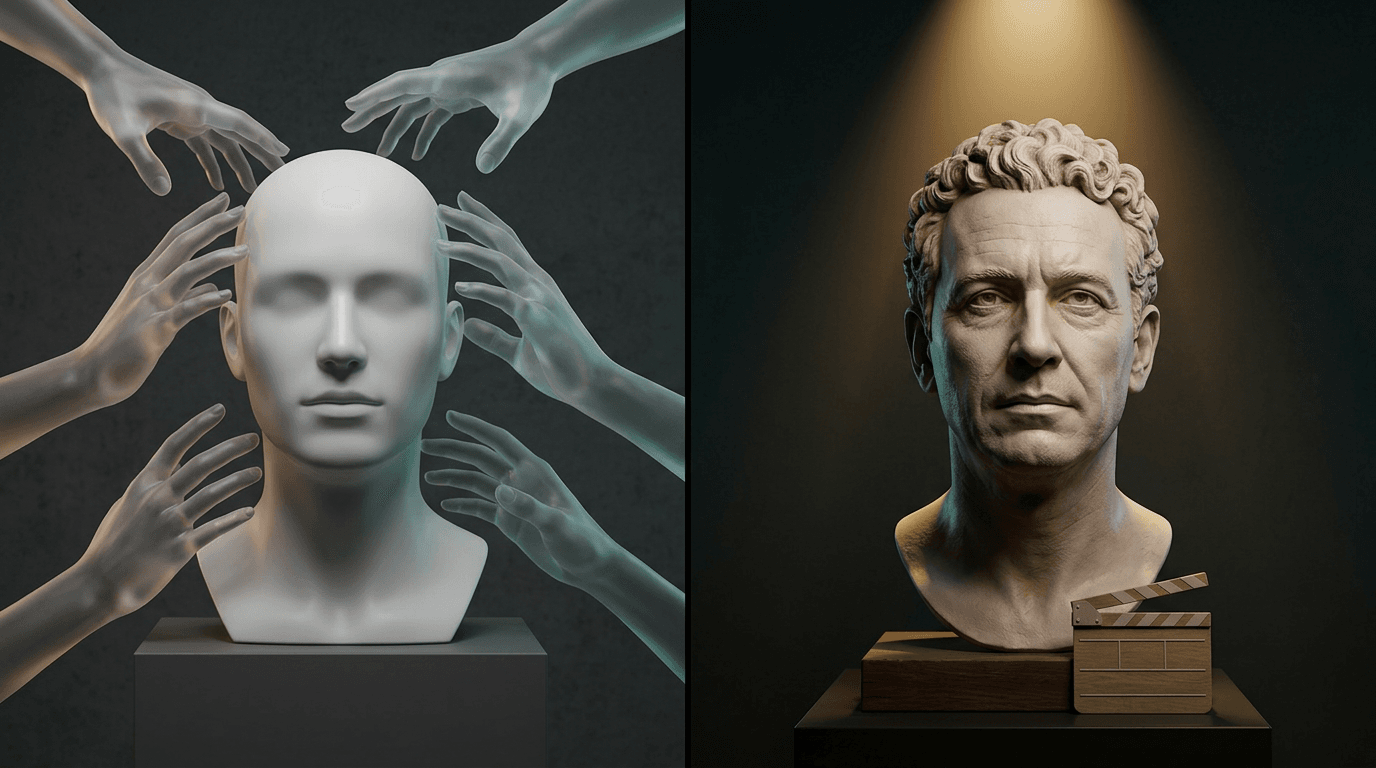
One warning from the rights side: a custom avatar is a likeness contract, not just a file. Pin down in writing who can use ai-generated versions of the founder's face, for how long, and what happens if they leave. The same consent-first logic applies to voice. We hold the same line in AI voice cloning for video.
Likeness Rights & Disclosure Rules for AI-Generated Video Ads
No major platform down-ranks disclosed AI content. YouTube requires labels on realistic synthetic people and says disclosure doesn't affect ranking. Meta mandates disclosure only for political and social-issue ads but auto-labels photorealistic AI. From 2 August 2026, the EU AI Act's Article 50 requires machine-readable marking of synthetic media.
The practical rulebook, in one breath. Label realistic synthetic humans on YouTube. Expect auto-labels on Meta. If you run an AI ad into the EU, the AI Act's Article 50 marking obligations are now live, though tools already on the market before that date have until 2 December 2026 to ship machine-readable marking. Google's July 2026 "How this ad was made" panel discloses AI use in its own ad products, and in India, ASCI's draft AI-disclosure guidelines point the same direction. Lip-synced dubbing sits in a gentler zone than fully synthetic humans, which we cover in AI lip sync technology.
So the "will video platforms punish AI" fear is mostly misdirected. Disclosed avatar content is not demoted anywhere that matters. The punishment comes from audiences, and only when they feel deceived. Disclose, and disclosure becomes a trust asset.
Will AI Avatars Replace Human Presenters?
Not across the board. AI avatars replace human presenters in functional, high-volume video content without emotional stakes: training videos, product walkthroughs, localized variants. Humans (and directed AI performances) keep the slots where trust is the message: brand films, testimony, crisis comms, and anything a viewer needs to believe.
Here's how ai avatars work in a sane 2026 content stack. The top AI use is volume: avatars for video content that would otherwise never get made, because no team films forty onboarding clips a quarter. The middle is hybrid: a real spokesperson on camera for hero films, their consented digital twin handling updates and translations. The top of the trust ladder stays human or becomes directed performance. Even AI assistants answering support queries now hand off to a person when the conversation turns emotional. Your video strategy should copy that instinct. I'll correct myself slightly. "Replace" is the wrong frame entirely. The winning brands aren't replacing anyone. They're producing video content without burning presenter time on jobs a render queue can do.
How to Test AI Spokesperson Videos in Your Funnel Safely
Start synthetic presenters in low-risk, high-volume slots: post-purchase onboarding, FAQ explainers, and paid-social variant tests. Measure completion and conversion against your human-fronted baseline, disclose the AI, and only promote the format upward in the funnel if trust metrics hold.
The ramp we recommend: bottom-of-funnel functional videos first, then localization, then top-of-funnel performance variants. Emotional brand films last, if ever, and by then you're in directed-performance territory, not subscription territory. That's the lane we work in. The wider strategy lives in our AI advertising playbook.
If you're weighing a rollout of AI spokesperson videos, or you've discovered your message needs a performance no talking head can give, book a 30-minute call or see how we make synthetic faces feel alive in our work.
FAQ
Do consumers trust AI avatar ads? Conditionally. Half of US consumers say they'd prefer brands that don't use generative AI in consumer-facing content (Gartner, Oct 2025), yet acceptance is high for functional videos like tutorials and product explainers. Trust collapses mainly when AI use is discovered rather than disclosed, or when avatars front emotional messages.
What triggers the "uncanny valley" in synthetic presenters? Micro-mismatches your brain catches subconsciously: eye contact that locks or drifts unnaturally, blink timing decoupled from speech rhythm, lips that fractionally lead or lag the audio, and missing pre-speech facial movement. Each alone is subtle; together they signal "not alive," and that unease transfers to the brand.
Can I create a custom AI avatar of myself for brand videos? Yes. You record several minutes of clean training footage with varied expressions and good audio, the platform trains a face-and-voice model, and it then performs any script in your likeness. Put the likeness rights in writing: who can generate with your face, where, and for how long.
Do platforms like Meta or YouTube down-rank AI avatar ads? No. YouTube requires disclosure for realistic synthetic people and states labels don't affect ranking or monetization. Meta requires disclosure only for political and social-issue ads, though it auto-labels photorealistic AI content. The EU AI Act's Article 50 adds marking obligations from 2 August 2026. Deception, not disclosure, is what gets punished.
Written by MSN Karthik, Founder & Director at Adwhyta. IIT Guwahati alumnus, co-founder of Zipy.ai, TEDx speaker, and award-winning AI filmmaker whose short "Unmasked" won 7 international AI film awards including Gold at the Bali International AI Film Festival. He once made a festival-screened sci-fi short for under $75.